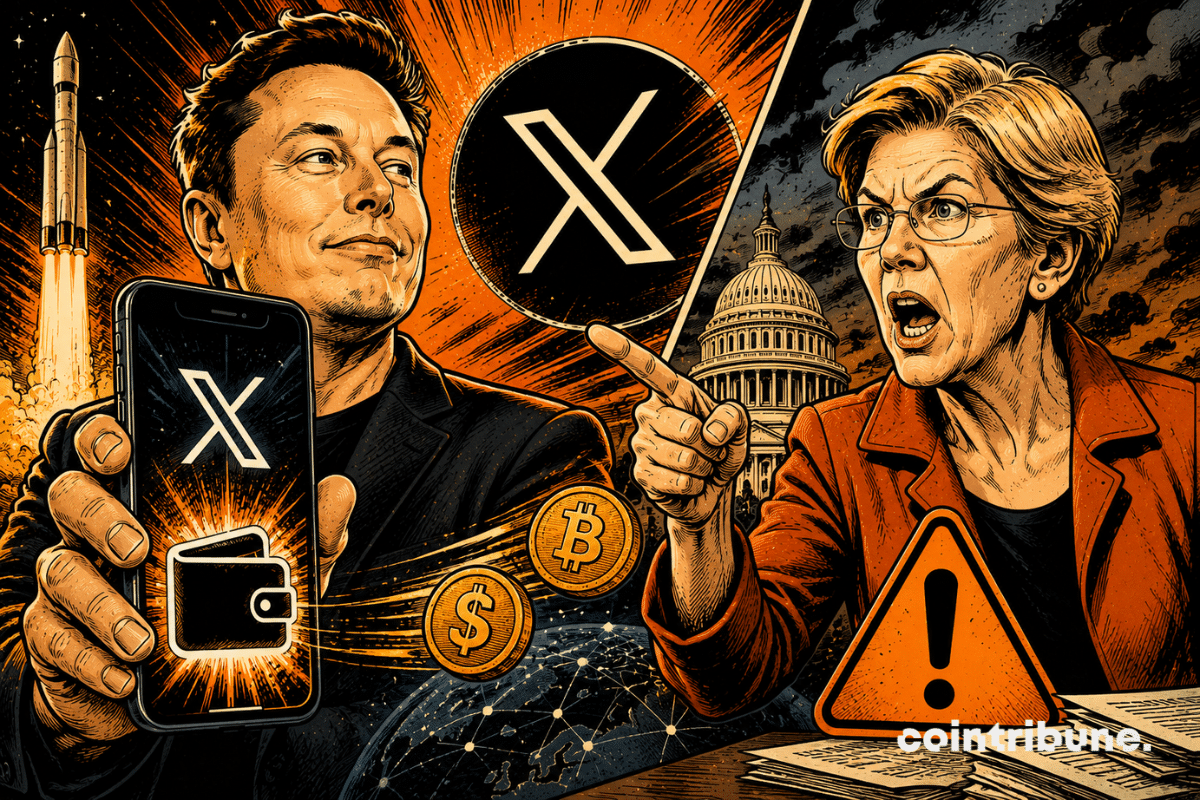
Elon Musk is accelerating his offensive in finance. Since July 27, X Money is no longer a simple test reserved for a few users. The payment service is now available to Premium and Premium+ subscribers in the United States. With an annual yield of 6%, a Visa card, instant transfers and FDIC coverage of up to $10 million, X has ambitions that extend well beyond the payments sector. This rise in power is already placing the social network under fire from American regulators.
In brief
- X Money exits its beta reserved for Premium+ users and opens to all Premium subscribers in the United States.
- The service offers 6% annual yield (APY), 3% cashback, instant and free P2P transfers, and a Visa debit card (virtual or metal).
- Through a partnership with Cross River Bank, deposits are covered by FDIC insurance up to $10 million per account.
- Already active in 41 states, X Money faces opposition from Senator Elizabeth Warren, who warns of the risks for the financial system and denounces a “suspicious exemption” in the law on stablecoins.
X Money infrastructure revealed
X’s banking and payment service takes a major step forward by now opening up to all American paying subscribers, abandoning the strictly private framework that prevailed since its initial launch in restricted beta at the end of June. The overall offer is based on a set of financial advantages and integrated monetary tools:
- A P2P deposit and transfer account: this is a payment system between users without fees and without limits within the application;
- An annual yield (APY) of 6%: it is immediately accessible for Premium+ subscribers, and conditional on direct transfer of salary for standard Premium subscribers;
- A dedicated Visa debit card: available immediately in virtual format in Apple Wallet, or as a personalized physical metal card emblazoned with the username;
- Commercial advantages: 3% cashback on all card purchases, total absence of fees on foreign transactions and a $15 registration bonus.
To guarantee the liquidity and compliance of these operations, X relies on a partnership architecture initiated in January 2025 with the banking giant Visa. Transfers execute in real time through the Visa Direct network, delivering on the strategic roadmap that the platform’s former leader, Linda Yaccarino, set out qualified SO “a new decisive step for universal application”. Thus, the conservation and management of funds deposited by users are entrusted to Cross River Bank, a regulated establishment.
Through a cash sweep mechanism that distributes capital across a network of partner institutions, FDIC insurance coverage is extended up to a maximum of $10 million per account, well above the standard legal limit of $250,000. The firm has already formalized the launch of this offer on its own channels by publishing the message: “your money, on the most powerful network in the world”.
Regulatory pressures and political opposition on Capitol Hill
Although X Money now has money transmitter licenses in 41 US states as well as the District of Columbia, the service still faces denial of approval from major financial jurisdictions such as New York and Massachusetts. This incomplete territorial progression is accompanied by a direct political offensive led by Democratic Senator Elizabeth Warren, who sent explicit warnings concerning the banking ambitions of Elon Musk’s firm.
Expressing her concerns about the risks to consumer protection, national security and market stability, the senator directly challenged management in an official letter. So, she has asserted : “If the way you handled X gives even the slightest clue about how you will handle.
Beyond criticism of the operational management of the platform, the regulatory objections raised in Congress also point to deeper structural and legal flaws. Senator Elizabeth Warren notably denounced a “suspicious deviation” within the GENIUS Act, believing that this text would offer technology companies of the size of
What are the prospects for the monetary ecosystem?
For the moment, X Money remains an infrastructure exclusively limited to fiat currencies, with no official integration of tokens or stablecoins. However, the financial ecosystem is already anticipating a gradual shift in the model towards Web3. Zach Pandl, head of research at Grayscale, emphasizes that the current banking structure only provides a temporary foundation. He declared: “Although X Money starts with a traditional infrastructure based on banks and fiat currencies, a move towards deeper crypto integrations seems inevitable to us. Crypto will play a central role in this evolution”.
This confrontation between the acceleration of a Tech giant and the stranglehold of American regulators outlines the contours of a crucial trade-off for the global financial ecosystem. On the one hand, the deployment of a 6% return backed by a massive social network shows the capacity of technological players to challenge traditional commercial banks in the area of savings collection. On the other hand, the resistance of regulatory authorities and the persistent blockages in key states like New York illustrate the difficulty of imposing a centralized financial model without impeccable compliance guarantees.
If the integration of alternative assets represents the final stage of this transformation, the trajectory of
Maximize your Tremplin.io experience with our ‘Read to Earn’ program! For every article you read, earn points and access exclusive rewards. Sign up now and start earning benefits.