
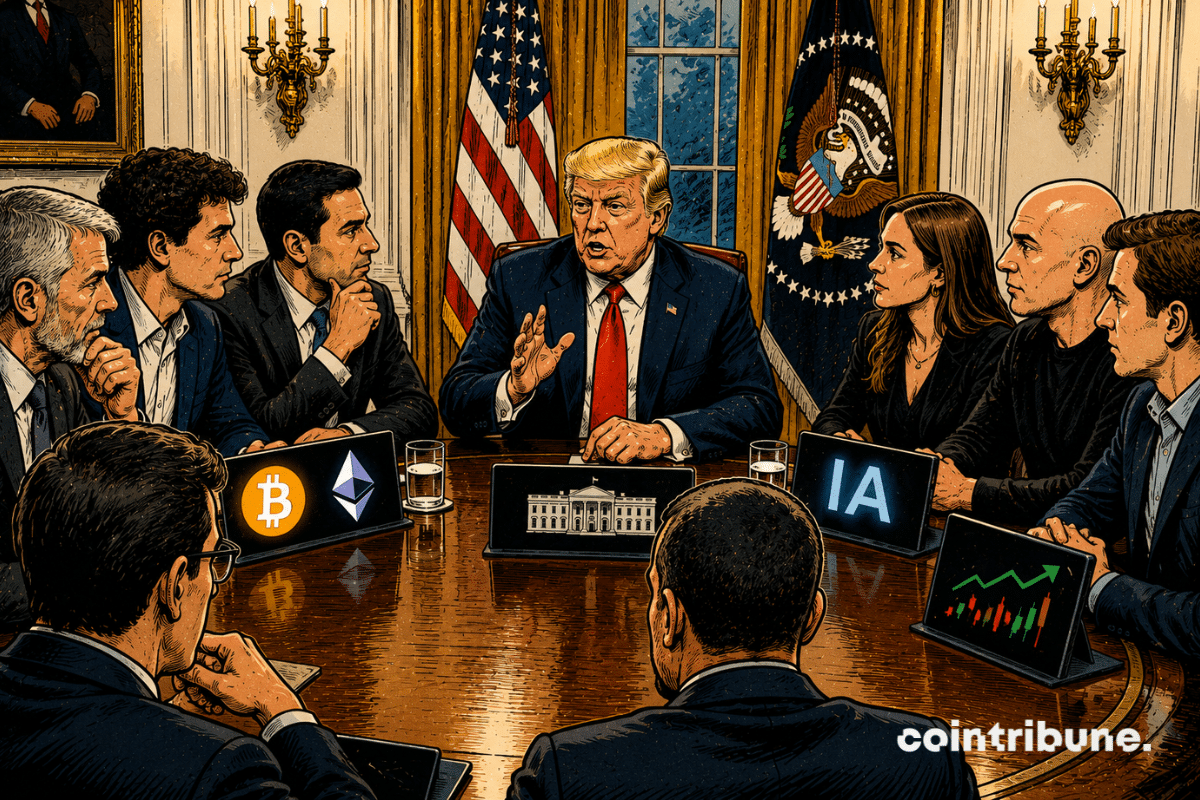
Donald Trump puts pressure on the US Senate. This Wednesday, the president brought together several major figures from the crypto industry at the White House to try to unblock the CLARITY Act. The text, bogged down in Congress, now crystallizes a confrontation that goes beyond the regulation of cryptos. Washington is also playing on its ability to maintain its technological lead against China, against a backdrop of political tensions and disagreements over the supervision of the sector.
In brief
- Donald Trump brings crypto giants together at the White House to demand the Senate adopt the CLARITY Act.
- Industry leaders support a law capable of securing American regulation over several decades.
- The parliamentarians oppose the demands of the Executive and denounce the risks of conflicts of interest of the Trump family.
- The SEC and CFTC are preempting congressional delays by issuing their own rules and exemptions for the sector.
Donald Trump’s offensive at the White House to impose a regulatory framework in the face of Chinese competition
During a high-profile press conference from the White House, President Donald Trump took the stand alongside major figures in the Web3 industry, including Coinbase CEO Brian Armstrong and Gemini co-founders Cameron and Tyler Winklevoss. Speaking in front of an audience of leaders, the head of state exhorted senators to adopt “a fair version” of the CLARITY Act upon their return to Washington. The stated objective is unambiguous: imposing a clear market structure to imperatively keep the United States ahead of China.
This key text of law, formally validated by the House of Representatives in July 2025, has been trampled in the Senate for months due to bitter blockages relating to tokenized shares, the distribution of returns via stablecoins, as well as strong disputes around potential financial conflicts of interest of the Trump family with the crypto ecosystem.
Taking over from presidential addresses and heads of regulatory agencies, Brian Armstrong firmly defended the historic significance of this structural reform. According to the boss of Coinbase, the ratification of the text would make American policy on cryptos “sustainable for the future, so that it can survive for decades and decades to come”. Confident in the outcome of the negotiations, the leader estimated that the bill could cross the symbolic bar of “more than 60 votes” during the examination of the closing motion scheduled for September 15 in the Senate.
A projection immediately supported by Donald Trump, who reaffirmed the transpartisan dimension of the discussions by declaring: “It’s very transpartisan, I would say. Many Democrats support him”. This political forcing is a continuation of the pressure exerted in July by the presidency following the death of Senator Lindsey Graham, a great defender of the CLARITY Act, whom Donald Trump had erected as a symbol to push parliamentarians to vote for the text in tribute to him.
To better understand the dynamics of this presidential mobilization, here are the structuring elements and key players at the heart of the declarations held at the White House:
- An unprecedented alignment of the industry: the presence alongside the president of figures like Brian Armstrong (Coinbase) or the brothers Cameron and Tyler Winklevoss (Gemini) illustrates a sacred union of American crypto giants behind a unique text;
- An explicit geopolitical imperative: Donald Trump openly formulates the regulation of crypto markets as a weapon of direct competition aimed at preserving the technological lead of the United States over China;
- A parliamentary deadline set for September 15: leaders are banking on crossing the critical threshold of 60 votes in the Senate during the closing motion to definitively unblock the law.
The reservations of part of Congress regarding the risks of presidential conflicts of interest
The response from parliamentarians to executive demands was not long in coming, highlighting a deep institutional divide. Speaking from the Wyoming Blockchain Symposium, Democratic Senator Ruben Gallego sharply reframed the presidential claims. Directly targeting the White House’s refusal to accept the inclusion of restrictive ethics clauses targeting the Trump clan’s investments, the parliamentarian retorted: “I think that, unfortunately, what the president means by that is fair to him”.
Formally questioning the authority of the Executive over legislative work, Senator Gallego firmly recalled the constitutional foundations: “the president accepts certain limitations. It’s not up to him to accept. This is the role of Congress, the Senate, then the White House […] the president does not simply decide how much regulation he gets”.
Aware of the parliamentary stalling and the one-month vacancy in the Senate, the financial supervisory authorities took the decision to get ahead of the legislative power. The Commodity Futures Trading Commission (CFTC), under the leadership of its president Michael Selig, is organizing this Thursday a meeting of its Innovation Advisory Committee dedicated to the development of direct sectoral rules in the absence of a passed law.
Meanwhile, the Securities and Exchange Commission (SEC) this same week unveiled emergency regulatory proposals available to Web3 companies. These provide for the establishment of a protection zone explicitly protecting certain tokens from the strict qualification of “investment contracts”accompanied by targeted exemptions for issuances of digital securities.
Towards a lasting recomposition of institutional and regulatory balances in Washington
This joint acceleration by the SEC and the CFTC marks a major tactical break in the history of crypto regulation in the United States. By deciding to unilaterally set temporary rules of the game, federal agencies seek to overcome congressional political paralysis while providing immediate visibility to investors.
However, this pragmatic circumvention of the parliamentary process exposes the sector to an underlying legal vulnerability. The absence of a basic federal law passed by the representatives leaves the perpetual risk of an administrative change depending on future changes of majority or legal actions brought by dissatisfied actors.
The outcome of the standoff therefore no longer lies solely in the adaptability of regulators, but in the verdict of the senatorial vote of September 15. If the closure motion were to fail under the weight of ethical disagreements, the crypto market in the United States would have to deal with fragmented and precarious regulation for the long term. Conversely, the adoption of the CLARITY Act would seal the definitive institutionalization of this asset class on American soil, setting in stone a unified legal framework capable of serving as a global model in the face of Asian ambitions.
Maximize your Tremplin.io experience with our ‘Read to Earn’ program! For every article you read, earn points and access exclusive rewards. Sign up now and start earning benefits.


