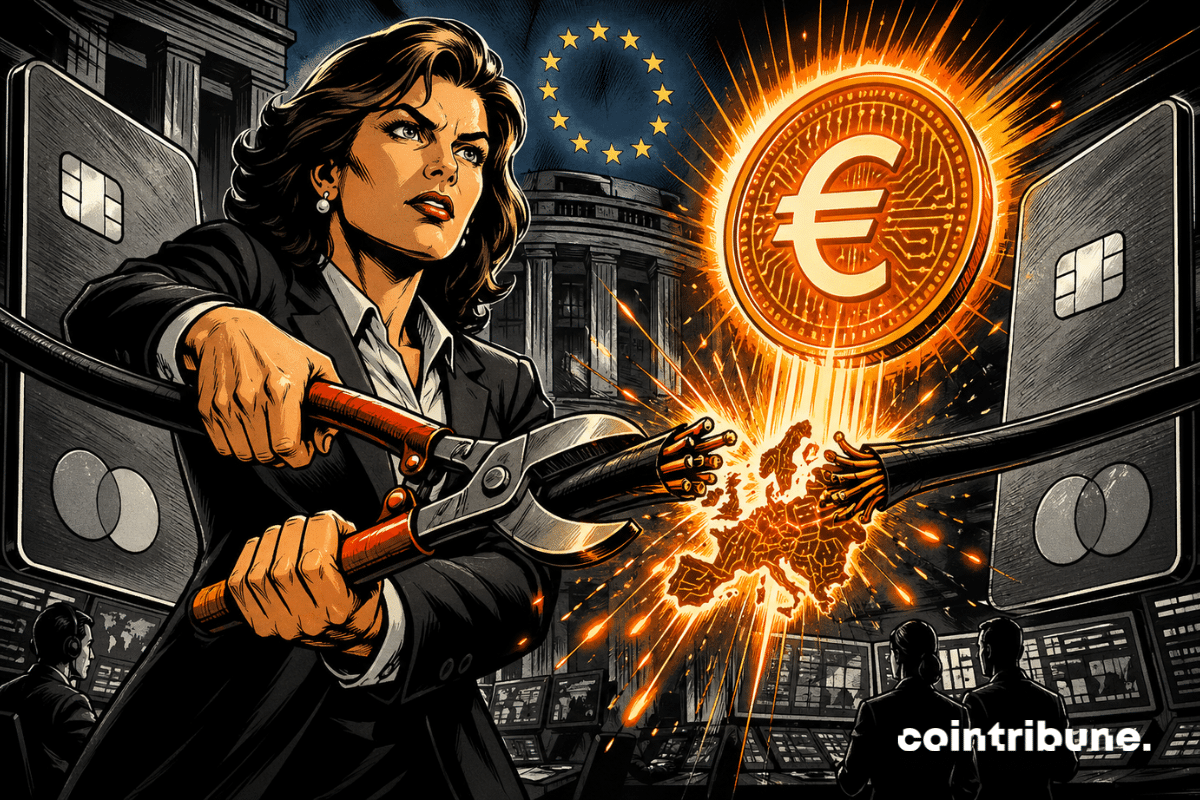
The digital euro is taking a more political than technical turn. The ECB wants to build an open European payment infrastructure, capable of reducing the continent's dependence on Visa, Mastercard and large foreign digital wallets.

In brief
- The digital euro becomes a tool of European sovereignty.
- The ECB wants to reduce dependence on Visa and Mastercard.
- The project remains suspended pending the adoption of the European regulation.
The ECB no longer just wants to create a digital currency
As the adoption of cryptocurrencies stalls in developed economies, the European Central Bank has reached agreements with three standardization bodies to prepare digital euro payments based on open standards. These are the European Card Payment Cooperation, nexo standards and the Berlin Group.
These partnerships aim to enable European banks, merchants and service providers to rely on a common technical infrastructure, free from the proprietary rails of large international networks.
This choice changes the reading of the project. Until now, the digital euro was often presented as a digital version of cash. Useful, but a little abstract for the general public. With this announcement, the ECB shows something else. She also wants to regain control of the payment pipeline.
The message is discreet, but heavy. In Europe, paying with a card or wallet often means using non-European infrastructure. The consumer doesn't see it. The merchant feels it through the costs. The banks know this too. The ECB therefore wants to avoid the digital euro being born prisoner of the same circuits.
Three standards to build a European alternative
The first pillar is CPACE, supported by the European Card Payment Cooperation. It must be used for contactless payments, in particular the famous “tap-to-pay” used with physical terminals. The objective is not to reinvent the payment process. It is to change what is happening behind the gesture.
The second pillar comes from nexo standards. Its role concerns the connection between merchant terminals, acquirers and payment providers. It's a less visible, almost thankless part. However, this is where the real acceptance of a means of payment in stores and distributors comes into play.
The third pillar is the Berlin Group. Its standards are already very present in European open banking. They can facilitate account-linked payments, with simple identifiers like a phone number. Clearly, the ECB is not starting from a blank page. It assembles bricks already known to the market.
The real subject is the sovereignty of payments
The ECB is not just looking for a cheaper solution. She is looking for room to maneuver. In a world where payments are becoming strategic, depending on external players is no longer a simple commercial question. It's a vulnerability.
Reuters already recalled that the institution sees the digital euro as a tool to maintain public currency in the digital economy, unify a very fragmented European market and limit the weight of non-European suppliers. The expected cost remains high: between 4 and 6 billion euros for European banks over four years, according to an estimate communicated by Piero Cipollone.
But this cost can also be read differently. The ECB is betting that common infrastructure will reduce fees in the long term, especially for traders. Banks would distribute the applications to users, while the ECB would not charge financial institutions for its network service. This detail matters. It gives the project an economic logic, and not just an institutional one. At the same time, China is further hardening its line against crypto and gradually reducing its financial ties with the United States, which reinforces the idea of an increasingly fragmented monetary world.
Maximize your Tremplin.io experience with our 'Read to Earn' program! For every article you read, earn points and access exclusive rewards. Sign up now and start earning benefits.