
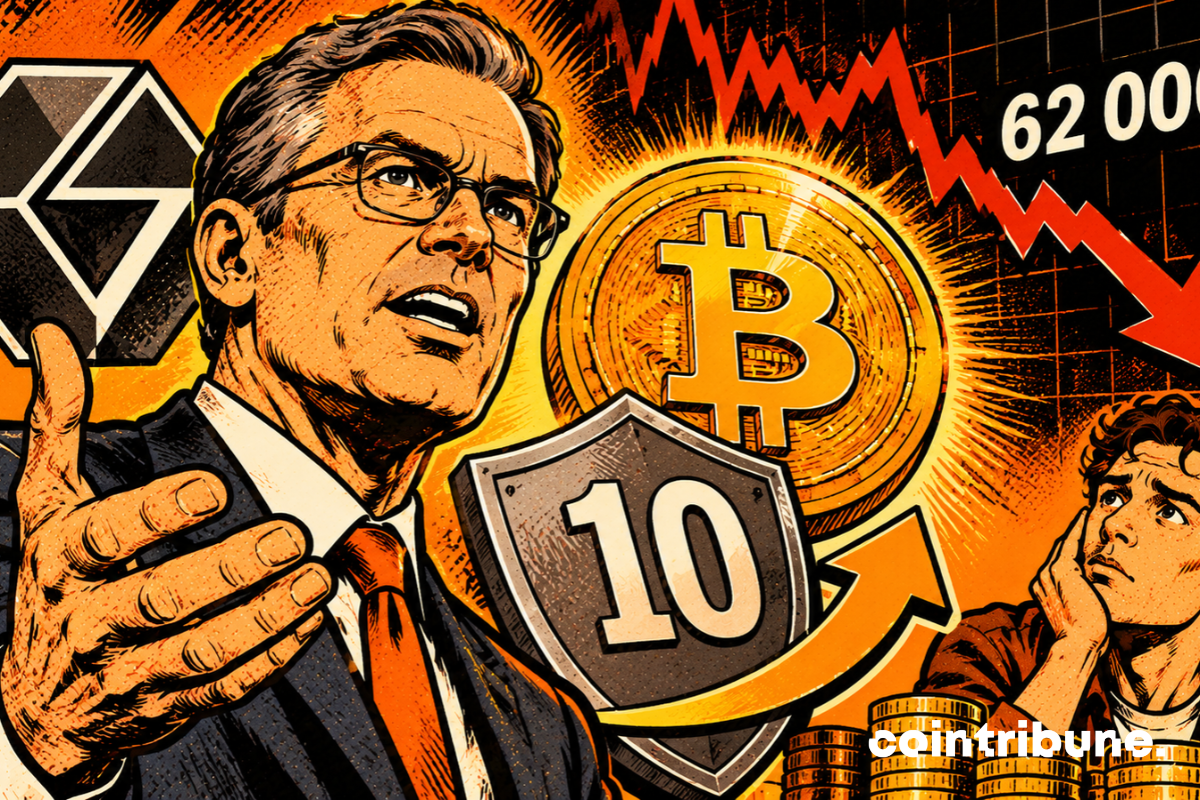
Bitcoin no longer has the same risk profile as it did ten years ago. Its volatility has decreased with the arrival of institutional investors and the development of regulated financial products. However, this development does not mean that BTC has become a safe investment. According to Grayscale, risks are now more concentrated on a few particularly decisive market days. This transformation could change the way investors integrate bitcoin into their portfolios.

In brief
- The volatility of Bitcoin has decreased significantly with the arrival of institutional investors and the development of ETFs.
- Its performances remain concentrated on a few particularly decisive market days.
- Despite the risks of strong corrections, BTC is gaining interest as a portfolio diversification tool.
Bitcoin is gradually moving away from its status as a speculative asset
For a long time, bitcoin’s fluctuations were one of the main arguments put forward by its detractors. This characteristic, however, tends to diminish.
Grayscale observed a structural transformation of the market, driven by several developments:
- The gradual arrival of institutional investors;
- The development of ETFs and regulated financial products;
- Improving market liquidity;
- Better structuring of the crypto ecosystem.
Bitcoin’s realized annualized volatility, which could approach 200% in its early years, is now around 43 to 45%, according to data presented in the analysis. Grayscale also points out that BTC today exhibits lower volatility than approximately 19% of companies making up the S&P 500.
This comparison does not mean that bitcoin has become a defensive asset. It nevertheless shows that its behavior is gradually approaching that of certain traditional financial assets.
Ten market days can disrupt several years of performance
For Grayscale, one of the major particularities of bitcoin lies in the concentration of its performances over a limited number of sessions.
Over the three years studied, bitcoin recorded an annualized return of 60%. However, by removing the ten best days from this period, this performance drops to only 7%. Conversely, without the ten worst sessions, the annualized return would have reached 197%.
These figures illustrate an important reality. A few days are enough to determine a large part of the performance of bitcoin over several years.
This configuration complicates investment strategies. A holder who systematically sells their bitcoins during periods of turbulence also risks missing the biggest rebounds. The best sessions can in fact occur in particularly unstable market phases.
Volatility therefore does not only represent a threat. It also constitutes a component of the potential returns of bitcoin. For investors, the challenge is less about avoiding each correction than about controlling their exposure to extreme movements.
Diversification could become bitcoin’s main argument with institutional investors
Beyond the reduction in its volatility, another development could strengthen the interest of bitcoin: its ability to diversify a traditional portfolio.
Grayscale believes that the economic factors that usually explain the performance of stocks and bonds less well account for variations in BTC. This feature could improve the diversification of a portfolio made up of several asset categories.
The historical simulations presented in his analysis show that adding a modest bitcoin allocation to a diversified institutional portfolio improved its return and Sharpe ratio, without a proportional increase in its volatility or maximum losses.
This perspective nevertheless remains to be qualified. Bitcoin has experienced seven declines greater than 50% since 2011. Its reduced volatility therefore guarantees neither the stability of its price nor the protection of the invested capital.
For institutional investors, the question is evolving. It is no longer just a question of determining whether bitcoin is too volatile to integrate into a portfolio, but of measuring the place it can occupy without unbalancing all investments.
Maximize your Tremplin.io experience with our ‘Read to Earn’ program! For every article you read, earn points and access exclusive rewards. Sign up now and start earning benefits.


