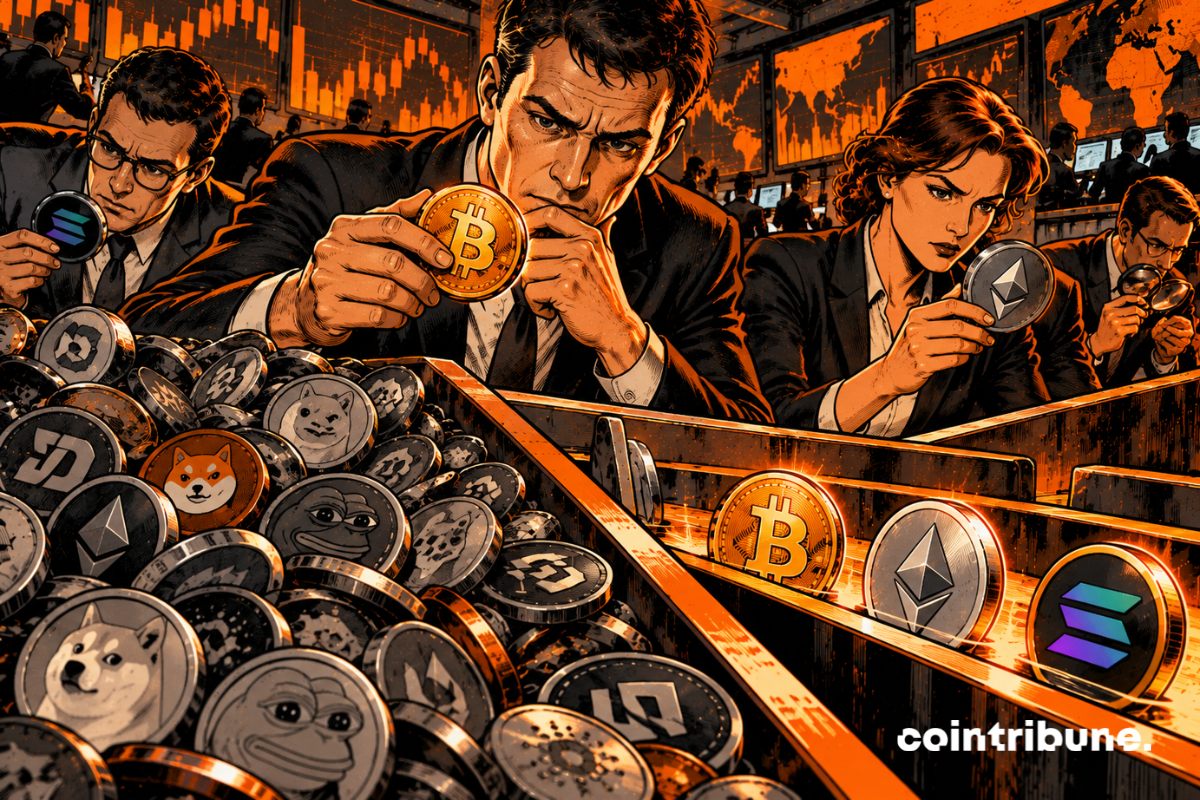
The crypto market has not yet entered a confirmed altseason, however many altcoins are strongly outperforming bitcoin. Unlike previous cycles, the various capitals are concentrated on a limited number of projects, mainly those which generate income or which meet specific uses.
In brief
- The altseason is getting closer, but it is not yet confirmed.
- The Altcoin Season index is progressing, without reaching the threshold of 75.
- Capital is concentrated in a limited number of altcoins.
- Protocols that generate revenue attract more investors.
- Memecoins remain active, despite stronger market selection.
The altseason is getting closer without being confirmed yet
Bitcoin dominance currently stands at around 58.6%. A lasting correction in this indicator could signal a significant rotation of capital towards the rest of the market. For the moment, the increases remain powerful, nevertheless very uneven depending on the sectors and projects.
The Altcoin Season Index around 64 out of 100compared to 48 the previous week. This development reveals that a growing number of altcoins are outperforming bitcoin over a 90-day period, however it remains below the threshold of 75 used for confirmation of an altseason.
Four indicators justify this gradual shift:
- Altcoin Season Index stands at 64 out of 100;
- Bitcoin dominance remains below 60%;
- The ten main altcoins account for almost 80% of the market;
- Revenue-generating protocols are among the winners.
The crypto market therefore finds itself in an intermediate phase. Many altcoins are recording significant performances characteristic of an altseason, without the majority of major cryptos having overtaken bitcoin.
Profitable protocols attract more capital
The best performances do not exclusively concern a single category. Over thirty days, the PONS token exploded by more than 350%, while Uniswap grew by more than 110%. Arbitrum soared more than 150% and NEAR nearly 180%, according to available data.
However, David Hoffman, co-founder of Bankless, noted a commonality between many winners like UNI, ARB, JUP and ONDO. He therefore asserted :
They make money, they all generate income.
Such a characteristic indicates that investors are placing more and more importance on economic models than in previous speculative phases.
This selection particularly benefits exchange protocols, on-chain derivatives platforms and certain DeFi projects. HYPE, LIT, UNI and MORPHO are among these different projects.
However, such progress remains partial. The revenues of a protocol are still not redistributed to the holders of its token. Significant activity therefore guarantees neither lasting demand for the asset nor an immediate increase in its price.
Memecoins remain present despite this selection
Speculation remains present despite the return of fundamentals. Thus, the memecoin launch platforms PUMP and PONS continue to record considerable activity. Data studied by linch co-founder Sergej Kunz even reveals that memecoins attracted the largest 30-day buyer growth.
However, their weights among the best performers seem to be falling. Two memecoins remain the best performing over a week among around twenty cryptos. Pudgy Penguins was then the only representative of this category in the weekly ranking.
Other themes captured some of the flows. Privacy-related cryptos including Zcash and Moreno are growing alongside AI-related tokens like TAO and VVV. Also, tokenized real-world assets and on-chain stocks have attracted new buyers.
This diversity does not provide proof of the existence of a global rotation. Rather, it indicates that multiple narratives coexist, with rapid movements between DeFi, AI, privacy, RWAs and memecoins.
A narrower altseason than in previous crypto cycles
From now on, the top ten altcoins represent, according to Talos, nearly 80% of the total capitalization of this category, compared to around 70% at the end of 2024. Samar Sen, head of international markets at the company, describes “a market where capital is concentrated around a smaller number of assets”.
The participation of brokers would also have declined. Thus, their share in altcoin trading would have fallen from nearly 65% at the end of 2024 to 32% in September 2026. Liquidity providers and market makers could play a less crucial role in the current progression.
“Investors are focusing on specific narratives and ecosystems rather than treating altcoins as a single overarching strategy”underlines Samar Sen.
A true altseason could now require a broadening of the rise beyond a few leaders. As long as the index remains below 75 and the ten largest altcoins concentrate the bulk of capital, the market looks more like a selective rotation than a generalized advance.
Maximize your Tremplin.io experience with our ‘Read to Earn’ program! For every article you read, earn points and access exclusive rewards. Sign up now and start earning benefits.