
The Clarity Act has never been closer to a vote. The US Senate must vote on September 15. However, it is going through an unprecedented zone of turbulence. Indeed, the prediction markets now give little chance of adoption to this bill on the regulation of crypto-assets. On Polymarket, the probability of success fell from 82% in February to only 13% on August 3, 2026. Enough to cause concern!

In brief
- Polymarket only gives the Clarity Act a 13% chance of being adopted in 2026.
- Kalshi, for his part, predicts 91% of a Senate vote before October 1.
- The American Senate tests the text on September 15, with a threshold of 60 votes.
- Three disagreements still block a crypto compromise.
- The SEC and CFTC are already moving forward on crypto regulation on their own, without waiting for Congress.
Prediction markets radically revise their expectations
On Kalshi, traders estimate 91% probability of a vote in the Senate before October 1. This market has already generated over $1.25 million in volume. The largest contract for the full adoption of crypto regulation even exceeds $6.8 million exchanged.
Polymarket tells a completely different story. On this prediction platform, the bet directly addresses the following question: will HR 3633 (more commonly known as the Clarity Act) become law in 2026? Certainly, more than $11.5 million was bet on this contract. Nevertheless, the implied probability collapsed to 13%. A spectacular drop compared to the 82% chance that traders were still anticipating last February!
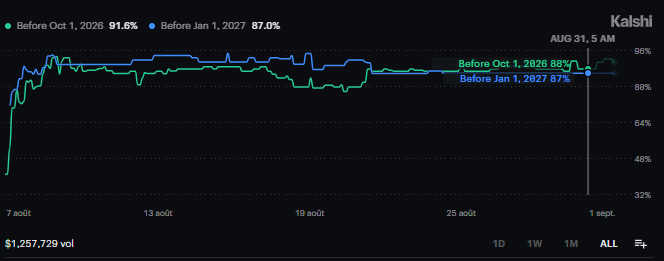
For crypto investors, this divergence between Kalshi and Polymarket translates:
- confidence in the ability of senators to vote;
- a deep doubt about their ability to transform this vote into effective law.
A crypto vote in the US Senate under high tension
The Clarity Act (HR 3633) aims to create a clear federal framework for American crypto market. It was adopted by the House of Representatives in July 2025 by 294 votes to 134. The vote in the Senate also constitutes the last major obstacle with deadlines postponed several times.
Concretely, this text of law would give the Commodity Futures Trading Commission (CFTC) exclusive authority over digital commodity spot markets. For its part, the Securities and Exchange Commission (SEC) would retain supervision of certain securities offerings as well as the activity of crypto exchanges.
Important clarification: September 15, 2026 will above all be a closing vote on the “motion to proceed”. This is therefore a procedure to authorize the start of debate on the bill. Supporters of the CLARITY Act need 60 votes in favor. The Republicans already control 53 seats. Thus, at least 7 Democrats will have to join them in order to cross the fence.
In this context, opinions differ within the crypto community. Coinbase CEO Brian Armstrong states in particular that he is “rather optimistic” to exceed 60 votes. During a interview with CNBChe stated:
Both sides got about 90% of what they wanted.
According to information relayed by American Bankeranalyst Ian Katz of Capital Alpha Partners revised his estimate downward. The latter went from around 40% to 25%. Same thing for Galaxy Digital which is more pessimistic with an estimate of only 10% in August.
Three blockages now threaten American crypto regulation
The first concerns ethics. Several Democrats, including Kirsten Gillibrand, are demanding a binding ban on civil servants holding crypto-assets. Without this clause, they refuse to support the text.
The second sticking point involves stablecoins and traditional banks. The latter refuse any compromise on rewards. This conflict directly opposes crypto innovation to the interests of the traditional banking sector.
The third issue affects DeFi and non-custodial software developers. The protections to be granted to these actors indeed divide legislators. Some fear creating regulatory loopholes.
Good to know: while the US Senate gets bogged down in its partisan quarrels, the SEC and the CFTC are pushing their own crypto reforms. Unlike this, these regulators prefer to build a legal framework through regulations rather than legislation.
Now led by Paul Atkins, the SEC appears to be taking a more conciliatory approach towards blockchain and digital assets. The proof: it abandoned certain application procedures and outlined a taxonomy of crypto assets
The CFTC, for its part, works on leveraged exchanges and DeFi. This strategy, however, presents a major risk: the rules can be dismantled by a future administration.
Either way, the countdown is on. The future of the Clarity Act will be decided in a few decisive weeks with direct consequences for the entire American and global crypto ecosystem. File to follow closely!
Maximize your Tremplin.io experience with our ‘Read to Earn’ program! For every article you read, earn points and access exclusive rewards. Sign up now and start earning benefits.