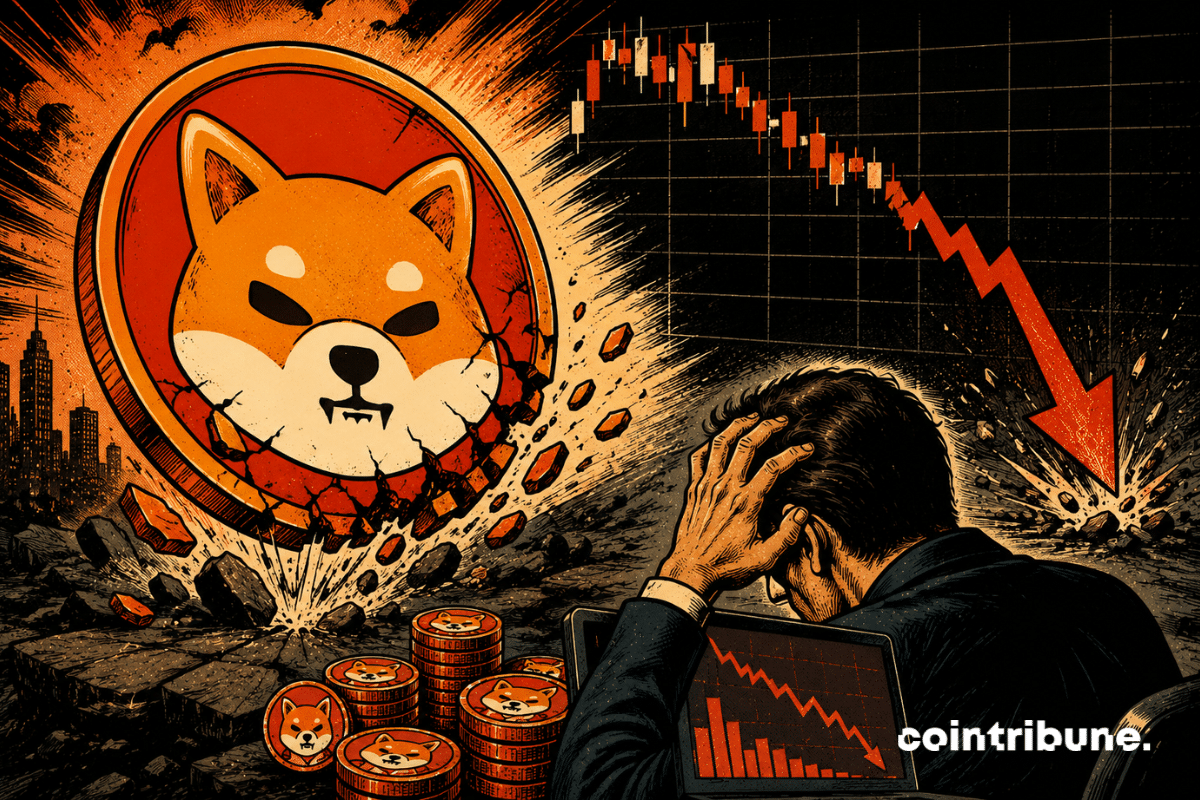
Shiba Inu (SHIB), the second largest memecoin in terms of market capitalization, is currently experiencing very strong turbulence which is calling into question its technical structure and shaking traders during this first half of the year. While the asset has just recorded its most severe monthly underperformance since January, this situation is attracting the attention of the industry, because it embodies an intense standoff between an apparent graphic capitulation and discrete accumulation signals.
In brief
- The Shiba Inu is going through its worst month of 2026, with a strong deterioration of its technical structure and the breakdown of several support levels.
- Market indicators confirm persistent selling pressure, while futures data reflect a clear slowdown in speculation.
- The whales are adopting a strategy opposed to the market, withdrawing more than 443 billion SHIB from exchange platforms despite the drop in price.
- The evolution of the SHIB in the second half of the year will depend on the strength of this accumulation phase and the capacity of its ecosystem to support a possible recovery.
The collapse of the major supports of the Shiba Inu
This month of June is particularly critical for the Shiba Inu price, with indicators confirming its heaviest correction of the year. Several factual elements of this deterioration are revealed by market data:
- The token fell to a 5-year low of $0.00000404, matching levels seen before the May 2021 rally;
- The structure is part of a major trend since the SHIB has collapsed by more than 38% this year alone, after recording a massive loss of 67% last year;
- The cumulative decline over the month of June exceeded 15%, threatening to validate the largest monthly decline since December 2025.
On the macroeconomic level, this fall was accentuated by the systematic rejection of the price in the face of technical barriers, testifying to the domination of sellers over the order book. Data shows that memecoin suffered a resounding failure when it attempted to “retest a key supply zone at $0.00000520”. This failure caused a massive retreat during which, in a ten-day period from June 16 to 25, the token “experienced nine intraday losses” consecutive.
Momentum indicators corroborate this technical distress, with the Relative Strength Index (RSI) showing a marked bearish divergence. Thus, prices were trying to stabilize while the RSI was plunging to lower lows. Experts are keeping an eye on the $0.00000457 level as a first near-term buffer before a possible slide to lower extensions.
The institutional resilience of whales
Beyond the visible deterioration of the price, capital flows in derivatives markets and on-chain movements reveal a very different dynamic, without widespread panic. While small holders are affected by the decline, the Futures market is particularly cautious, with massive position closures and not a cascade of forced liquidations.
On a weekly basis, “Futures inflows of $28.6 million versus outflows of $31.9 million”which reflects this defensive behavior. This slowdown in speculative activity paradoxically coincides with a drying up of sales volumes during market troughs, indicating that selling pressure is exhausting as the token approaches its historical support zones.
Such a lack of capitulation is confirmed by the attitude of large wallets who take advantage of this annual decline to purchase tokens discreetly. CryptoQuant’s on-chain metrics indicate that “large investors withdrew more than 443 billion SHIB from exchange platforms” even as the asset reached local lows.
This massive withdrawal mechanically reduces the immediately liquid supply available for sale on the exchanges, acting as a potential stabilizer in the face of the fall in price. If the basic activity of the Shibarium secondary network shows short slowdowns, the maintenance of the overall reserves of the exchange platforms around 80,000 billion tokens shows that the large holding structures refuse to liquidate at a loss.
Seasonal outlook and fundamental balance for the second half
Given the contrasting nature of this data, the medium-term future of the Shiba Inu will rest on its ability to make this whale accumulation zone a solid macroeconomic floor in the event of a significant correction.
Analysts believe that its speculative streak (in which it is currently wavering) could be attenuated thanks to successive integrations into regulated finance vehicles and by the perpetuation of its decentralized ecosystem.
The ongoing cleanup of the derivatives market is ridding the order book of excess leverage, allowing for a healthier rebuilding of pricing structures as we approach the close of the second quarter. This stability is still essential to reassure the community of developers who continue to build the token valuation infrastructure.
Maximize your Tremplin.io experience with our 'Read to Earn' program! For every article you read, earn points and access exclusive rewards. Sign up now and start earning benefits.