The latest report on cryptocurrency adoption in Europe, published by blockchain analysis firm Chainalysis, reveals that Russia has overtaken the United Kingdom, becoming the leading European country in adoption. Despite consistent growth across the continent, Russia is now the leader, while the United Kingdom and Germany are slipping down the rankings.

In brief
- Russia leads crypto adoption in Europe, ahead of the UK and Germany.
- Between July 2024 and June 2025, it recorded $376.3 billion in inflows into cryptocurrencies, compared to $273.2 billion for the United Kingdom.
- Growth is driven by institutional activity and decentralized finance (DeFi).
Russia dominates Europe in crypto activity
Over the period from July 2024 to June 2025, Russia received $376.3 billion in cryptocurrencies, well ahead of the United Kingdom ($273.2 billion). This shift marks a change in regional leadership, with the United Kingdom having long held first place. According to Chainalysis, this progression is explained by a strong rise in power of institutional players and the rapid growth of DeFi.
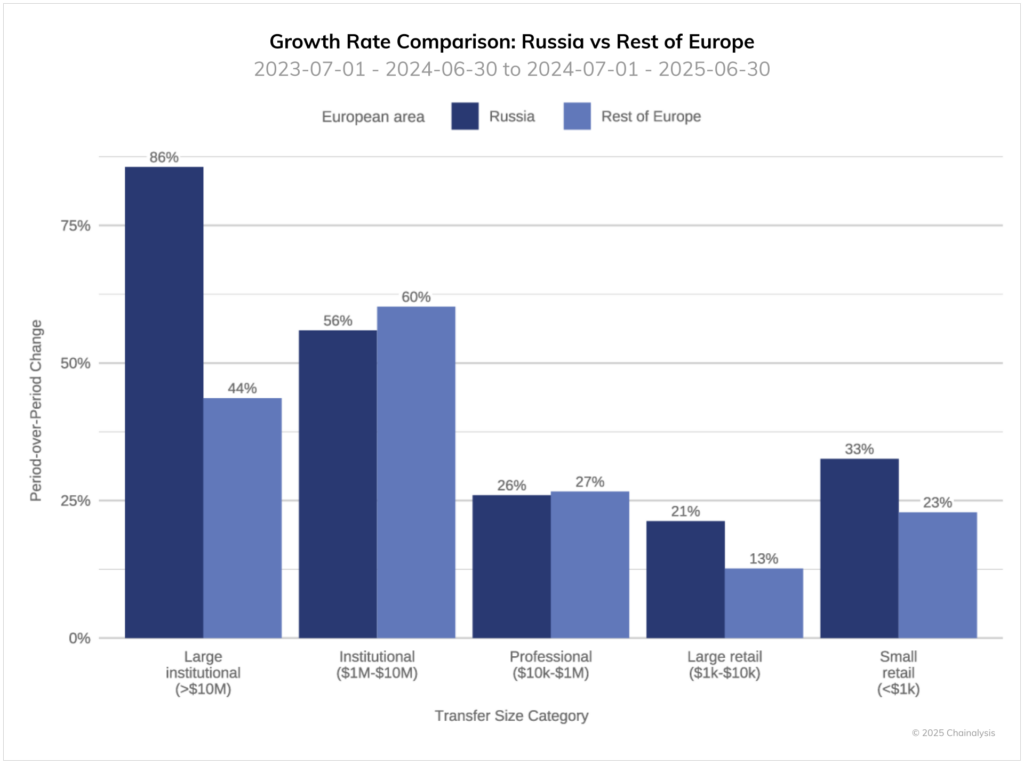
Chainalysis data shows that large cryptocurrency transfers in Russia, those exceeding $10 million, jumped 86% compared to the previous period. This is almost double the average growth rate observed elsewhere in Europe (44%). This dynamic reflects an increased involvement of institutional players, particularly companies and professional investors, who now represent a growing share of the total volume of transactions in the country.
The rest of the Russian market is also growing steadily: individual users, large and small, are recording an annual increase around 10% higher than that observed in other European countries.
Growth reinforced by DeFi and stablecoins
At the same time, DeFi activity in Russia has exploded. Chainalysis specifies that “ In early 2025, DeFi activity grew eightfold from previous levels, before stabilizing at around 3.5 times the mid-2023 base “.
The report cites the ruble-backed stablecoin A7A5 as an example of Russia's growing role in digital finance. Launched in early 2025, A7A5 has quickly become a major tool for cross-border payments between businesses and institutions.
Despite the sanctions, this stablecoin has established itself as the most important outside of the US dollar, with a capitalization reaching $500 million at the end of September, surpassing other stablecoins not backed by the dollar, including Circle's EURC.
European markets still dynamic
If Russia now dominates the region, several European markets are also showing solid growth:
- Germany records growth of 54%, confirming its attractiveness for companies specializing in crypto;
- Ukraine and Poland follow closely, with +52% and +51% respectively, driven by increased daily use and the rise of remittances.
Regulation and institutions: a changing Europe
According to Chainalysis, the European cryptocurrency market has entered a phase of major transformation between 2024 and 2025. This development is explained by several factors: the implementation of the Markets in Crypto-Assets (MiCA) regulation, reinforced institutional commitment and the continued progression of DeFi adoption.
The MiCA framework has brought clearer and harmonized rules for cryptocurrency activities across the European Union, helping to structure the industry and strengthen the confidence of institutional investors.
Maximize your Tremplin.io experience with our 'Read to Earn' program! For every article you read, earn points and access exclusive rewards. Sign up now and start earning benefits.