
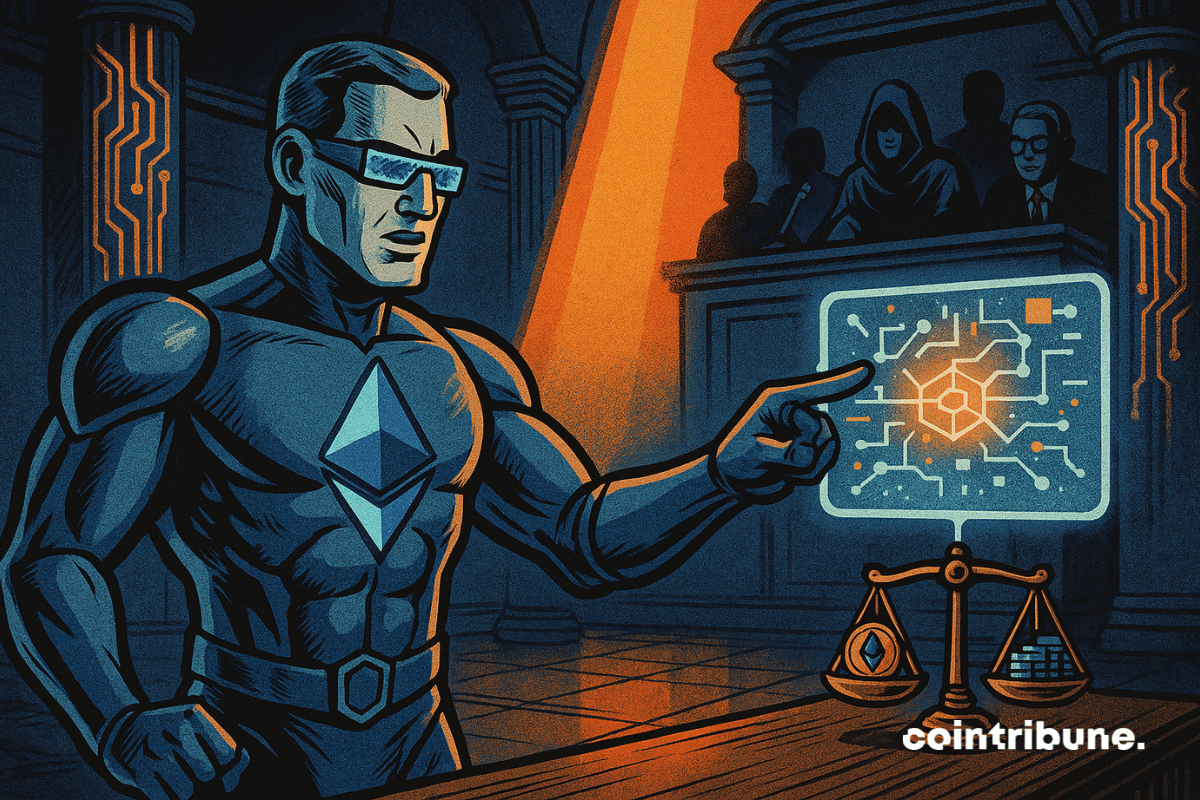
At Toronto's 2025 consensus, Ethereum has broken the silence. Faced with criticisms of his governance, his technical roadmap and the flight of talents, Paul Brody (EY) and Josh Stark (Ethereum Foundation) defended an assumed vision: that of a complex network, but fundamentally robust. While the course of the ETH stagnates and the competition intensifies, the leaders of Ethereum are betting over the long time and recall that the markets will end up catching the technology, not the opposite.

In short
- Toronto's 2025 consensus served as a forum for Ethereum, which publicly responded to criticism of its governance.
- New governance was implemented in March 2025 with the appointment of two executive co-directors.
- The leaders highlight solid figures: more than 120 L2 active, up to 450 million daily transactions.
- Despite the doubts of the market, Ethereum claims to remain faithful to his vision, focusing on innovation and modularity.
Contested leadership, assumed defense
While the news around Ethereum is dominated by a prolonged drop in the course of the ETH and a visible decline in developer engagement, criticisms focus on a nerveless point: the governance of the Ethereum Foundation.
Josh Stark, speaker during a panel at the 2025 consensus from May 14 to 16, A recognized Without detouring the expectations of the community:
The ecosystem needs stronger leadership […] on the roadmap, its execution, and the coordination of efforts in the face of major challenges.
However, this partial self -criticism did not prevent the speakers from defending the work already accomplished.
Paul Brody, president of the Ethereum Alliance Enterprise and a reference figure in EY, wanted to salute the action of Aya Miyaguchi, former executive director of the foundation: “If I watch the results of his mandate objectively, I give him the note A+“He said.
Here are the main elements mentioned with regard to the governance of the Ethereum network:
- Structural criticism: lack of coordination, strategic vagueness, loss of speed perceived vis-à-vis more agile competitors;
- Internal responses: recognition of a reinforced leadership need and better communication around the fundamentals of the project;
- The management record: Defense of Aya Miyaguchi's mandate, in post since 2018, to whom a deep transformation of the foundation has been attributed;
- A recent reorganization: appointment in March 2025 of two executive co-directors-Hsiao-wei Wang and Tomasz Stańczak, in order to structure the next phase of strategic development.
This institutional clarification aims to stabilize a project that has become sprawling and often perceived as lacking readability since its transition to the proof-of-stake.
If the effects of this reorganization on the price of the ETH or the community dynamics remain to be demonstrated, it nevertheless marks a desire displayed to regain narrative and strategic control within a sometimes torn ecosystem.
An assumed technical complexity, but divisive
Beyond the organizational aspects, the representatives of Ethereum defended the technological management of the network, in particular the assumed choice of an “Rollup-Centric” model.
Paul Brody recalled that Ethereum is now a blockchain for stake (Proof-of-Stake) Supporting more than 120 Layer 2 type solutions, with a daily capacity located between “300 and 450 million transactions».
He pointed out that on these L2, transaction costs have been less than one penny for three months. Faced with criticisms which denounce too much fragmentation or a loss of network coherence, Brody has not fallen: “I am delighted“He said about the current roadmap.
Josh Stark has defended this modularity as a visionary choice, saying that “No ecosystem can avoid this type of long -term structure».
This technical positioning is not without consequences. If it allows a drastic reduction in usage costs and an unprecedented rise in load, it also introduces new vulnerabilities.
Rollups ask complex security questions, inter-chaînes and user experience, sometimes with counter-productive silo effects.
However for Stark, these obstacles are normal in a process of deep innovation: “We are the ones who have advanced the most on this path, and we face turns and challenges“He said.
The implications of this debate go far beyond the case of Ethereum. They touch on an essential question: is technical complexity a brake or an asset in the construction of a long-term infrastructure network? While Bitcoin takes advantage of a simplified narrative around the value reserve, Ethereum claims a more sophisticated vision, less readable for short -term markets, but potentially more fruitful. Josh Stark is convinced: “The markets always end up reflecting the value. And Ethereum is the most important project in the history of crypto».
Maximize your Cointribne experience with our 'Read to Earn' program! For each article you read, earn points and access exclusive rewards. Sign up now and start accumulating advantages.


