
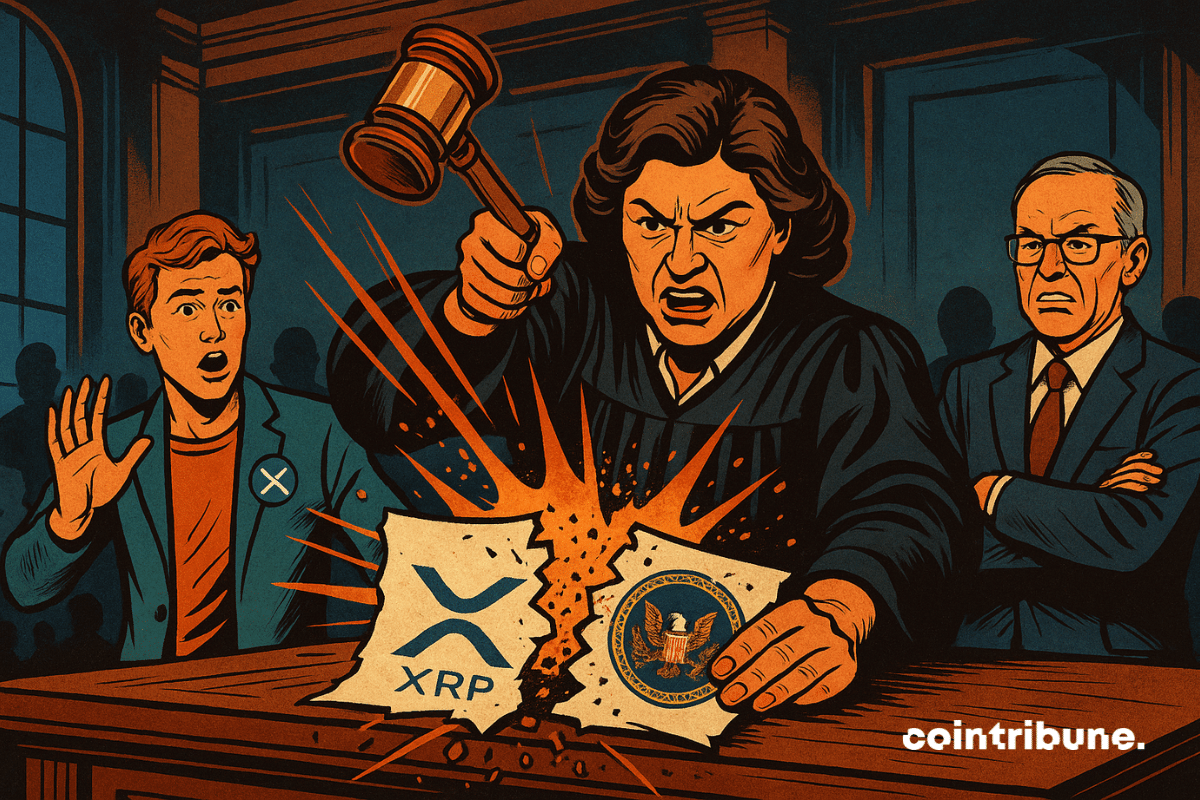
The judicial soap opera between Ripple and the dry has just taken a new step. While an amicable regulation seemed to be at hand, federal justice has dryly rejected the joint attempt of the two camps. This setback rewards uncertainty around a confrontation that has become central to the regulatory future of cryptos in the United States, and reaffirms the complexity of a clear outcome in a file followed closely by the entire industry.
In short
- American justice has rejected the agreement negotiated between Ripple and the SEC, invoking a procedural error.
- The request aimed to reduce the fine of Ripple from $ 125 million to $ 50 million and to lift an injunction in force since 2024.
- Judge Analisa Torres considered that the joint approach did not comply with rule 60, necessary to modify a final judgment.
- Experts like lawyer James Filan underline that only an explicit green light from the judge could allow a negotiated exit.
A procedural reverse for Ripple and the dry
In a decision made public on May 15, 2025, judge Annala Torres of the South District Court of New York rejected the joint request of the SEC and Ripple aimed at modifying the final judgment rendered in 2024.
This request proposed in particular the reduction of the financial sanction imposed on Ripple, from 125 million to $ 50 million, as well as the lifting of an injunction preventing it from violating the laws on securities.
The judge precise that this approach was “procedurally inappropriateAnd should have been formulated under the aegis of rule 60, a specific procedure which requires demonstrating “exceptional circumstancesTo modify a final judgment.
She cut without ambiguity:
If the jurisdiction was restored to this court, it would refuse the request as being procedurally inappropriate.
This decision follows a procedure started in 2020, in which the SEC accused Ripple of having illegally proposed uncrowded titles via the sale of the XRP.
Although Ripple obtained a significant legal victory in 2023, the Court having ruled that the programmatic sales of XRP did not constitute transactions on titles, a sanction of $ 125 million had been imposed in 2024, but suspended during the appeal.
The rejection of Deal offered on May 8, 2025 prevents any rapid resolution for the moment. To better understand what was at stake, here is what this agreement provided for:
- The abolition of the injunction: Ripple wanted to ban the prohibition to contravene the laws on securities, in force since the 2024 decision;
- A reduction in the penalty: the agreement provided for a fine of $ 50 million, against 125 million initially fixed, a reduction of 60 %, subject to the approval of the Court;
- The early end of the dispute: the compromise would have allowed both parties to put an end to their appeals before the Court of Appeal, within the framework of an accelerated procedure called “Partial referral to court».
The judge nevertheless closed this door, and stressed that these requests could not be processed outside the laws provided for by the federal civil procedure.
This rejection thus maintains the legal uncertainty over the judicial future of Ripple, despite the already acquired recognition of the non-qualification of the XRP as a financial title.
A resolution always out of reach: the implications of a judicial blockage
Since this judicial announcement, several observers of the file, including lawyer James Filan, have tried to clarify the practical consequences of this rejection. On network X, Filan recalled that the case can only be concluded if the judge “First signals its intention to remove the injunction and approve the distribution of $ 50 million to the dry».
It is only in this condition that the two parties could request a limited referral to the court of appeal of the second circuit, an essential prerequisite to ratify the agreement. In other words, as long as Torres do not give this signal, the litigation remains legally active and prevents the official closure of the dispute.
This situation obliges Ripple to maintain its call strategy, extending a procedure already almost five years long. The dry, for its part, shows by this refusal that it does not intend to give in on the procedures, even when a compromise is negotiated.
This institutional stiffening illustrates the structural difficulties in obtaining legal-regulatory agreements within the framework of the crypto ecosystem, where disputes often come up against particularly strict procedural standards. By refusing the deal, justice sends a clear message: no acceleration of procedure will be accepted outside the traditional legal framework.
Maximize your Cointribne experience with our 'Read to Earn' program! For each article you read, earn points and access exclusive rewards. Sign up now and start accumulating advantages.


