

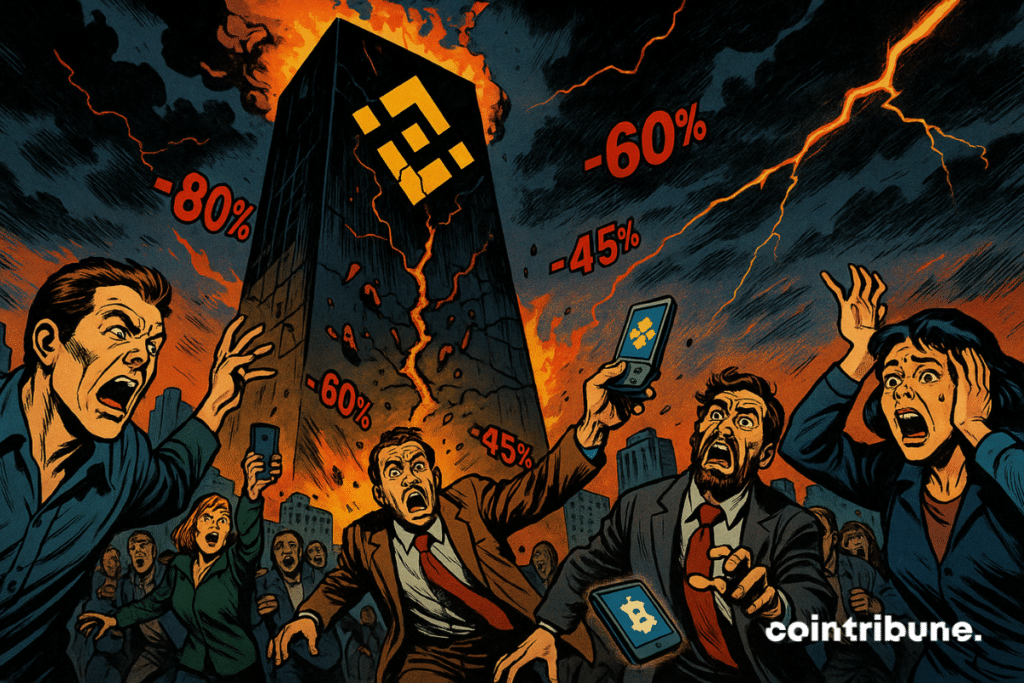
On October 10, while the markets were plummeting under the effect of a shock announcement from Washington on customs tariffs targeting China, more than 200 billion dollars evaporated in a few hours. However, beyond the volatility, it is the behavior of Binance which crystallized the tensions. The platform is accused of having frozen accounts in the midst of a panic, preventing thousands of users from taking action.
In brief
- On October 10, a global crypto crash wiped out more than $200 billion in a matter of hours.
- The origin of the panic is Donald Trump's announcement of new 100% customs duties on Chinese imports.
- Binance is accused by many users of having frozen accounts and preventing the execution of essential orders.
- Several tokens, including ENJ and ATOM, briefly displayed prices near zero on the platform.
Suspicions of freezing orders and accusations of manipulation
As markets underwent a significant correction, many Binance users were suddenly faced with account lockouts and inoperative orders in the midst of a liquidation phase.
On social networks, anger exploded: “Binance has once again proven that they are the biggest crooks in crypto”denounces a user on X, CryptoCowboy_AU, accusing the platform of having voluntarily frozen the accounts when losses were accumulating.
In the most critical minutes of the crash, several assets, including Enjin (ENJ) and Cosmos (ATOM), briefly posted extremely low prices, down to $0.0000 for one, $0.001 for the other, before rebounding just as quickly. These price anomalies reinforced suspicions of manipulation or, at the very least, of a serious malfunction of the system.
Here is the most important facts reported by users:
- The impossibility of placing or modifying stop-loss and limit orders, at a time when the markets were collapsing;
- A temporary blocking of access to user accounts, preventing any arbitration or withdrawal;
- The display of aberrant prices, particularly on certain altcoins such as ENJ and ATOM, falling to zero or close to zero values;
- The temporary freezing of order books: long and short positions would have been liquidated while the interfaces remained frozen;
- Minimalist communication from Binance, which evokes simple “overload problems” and ensures that “the funds are SAFU”without proposing compensatory measures at this stage.
Many actors denounce a situation which is not unprecedented. Binance had already been accused at the start of the year of freezing orders during a previous episode of massive liquidation. If other platforms like Coinbase or Robinhood also experienced technical slowdowns during the same event, it is Binance which focuses the majority of criticism, both for its central role in the market and for the lack of transparency.
Tragic death shakes crypto community
As investors tried to absorb losses from the crash, another piece of news further darkened the picture: Konstantin Ganich, better known as Kostya Kudo, was found dead in kyiv in his Lamborghini.
A rising figure in the Ukrainian crypto scene, this trader and influencer had built a large community around his investment advice. His death reportedly occurred at the height of the crisis, amid extreme volatility and widespread disorientation.
The death was confirmed on its official Telegram channel and relayed by Cryptology Key, one of its content partners. The exact causes of his death have not yet been made public, but the circumstances raise questions.
If no direct link has been established between the crash and this tragedy, the timing highlights the intense psychological pressure that players in the sector are under, particularly those who are publicly exposed.
Ganich's home country of Ukraine has seen rapid adoption of cryptos in recent years amid a challenging economic climate. Actively promoting trading strategies, Kostya Kudo embodied this new generation of financial influencers, torn between ambition, media exposure and increasing responsibilities towards their community. The violence of the market corrections in recent days may have reinforced these tensions, particularly among those whose image is based on an implicit promise of constant success.
Maximize your Tremplin.io experience with our 'Read to Earn' program! For every article you read, earn points and access exclusive rewards. Sign up now and start earning benefits.


