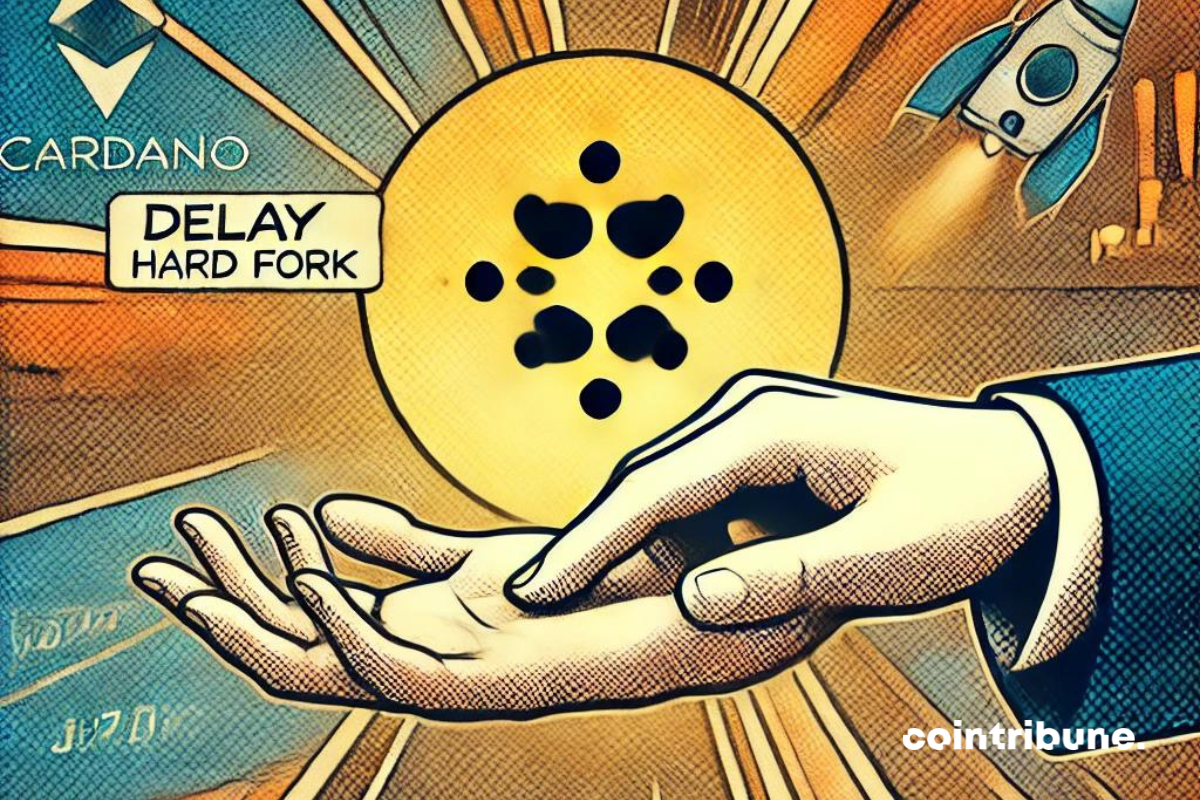
Cardano’s long-awaited Chang hard fork has been postponed. Originally scheduled for August 27, this key event, designed to strengthen onchain governance and improve smart contract security, has been pushed back to September 1. This postponement, while seemingly innocuous, raises important questions about the preparedness of the stakeholders involved and the future of Cardano in an increasingly competitive blockchain environment. Why was this delay deemed necessary, and what are the consequences?
The unexpected postponement of the Chang hard fork
Intersect, a member organization of the Cardano project, has announced the postponement of the Chang hard fork. Indeed, the update has been pushed back to allow exchanges, including Binance, to finalize the updates necessary to support this new stage of the network. Charles Hoskinson agrees. For the founder of Cardano, “Binance and a few others need more time to get their systems in order” This postponement can therefore be seen as a strategic move to ensure that the entire ecosystem is ready for Chang's adoption.
Indeed, this hard fork is supposed to introduce new features to strengthen on-chain governance and improve the security of smart contract data. It will mark a new phase in the way the community participates in network decisions. This change of governance shifts decision-making power to the community, allowing every member to play an active role in Cardano's future.
Towards an Alliance with Algorand?
While the postponement of the Chang hard fork has temporarily slowed Cardano’s momentum, Charles Hoskinson already seems to be looking to other strategic horizons. He has mentioned the possibility of a collaboration with Algorand, another leading blockchain network. According to Hoskinson, the idea would be to combine Algorand’s technologies with a “useful proof-of-work tuned to AI inference,” to create what he calls a “decentralized AI powerhouse.” The idea was welcomed with interest by Gary Malouf, Algorand’s CTO, who noted that this is not the first time such discussions have taken place between the two networks.
This prospect of an alliance between Cardano and Algorand could represent a significant step towards a new form of collaboration in the blockchain space. This alliance will then break with the tradition of fierce competition that has often marked relations between different networks. In this way, Cardano could not only strengthen its technological capabilities, but also expand its influence in the emerging field of decentralized AI. However, this will depend on the ability of the two networks to overcome technical challenges and find common ground to cooperate effectively.
The postponement of the Chang hard fork and potential discussions with Algorand show that Cardano is in the midst of a strategic transition phase. On the one hand, the network is looking to strengthen its governance and improve the security of its smart contracts. On the other hand, it is considering innovative collaborations to remain competitive in an ever-changing industry.
Maximize your Tremplin.io experience with our 'Read to Earn' program! For every article you read, earn points and access exclusive rewards. Sign up now and start earning benefits.