
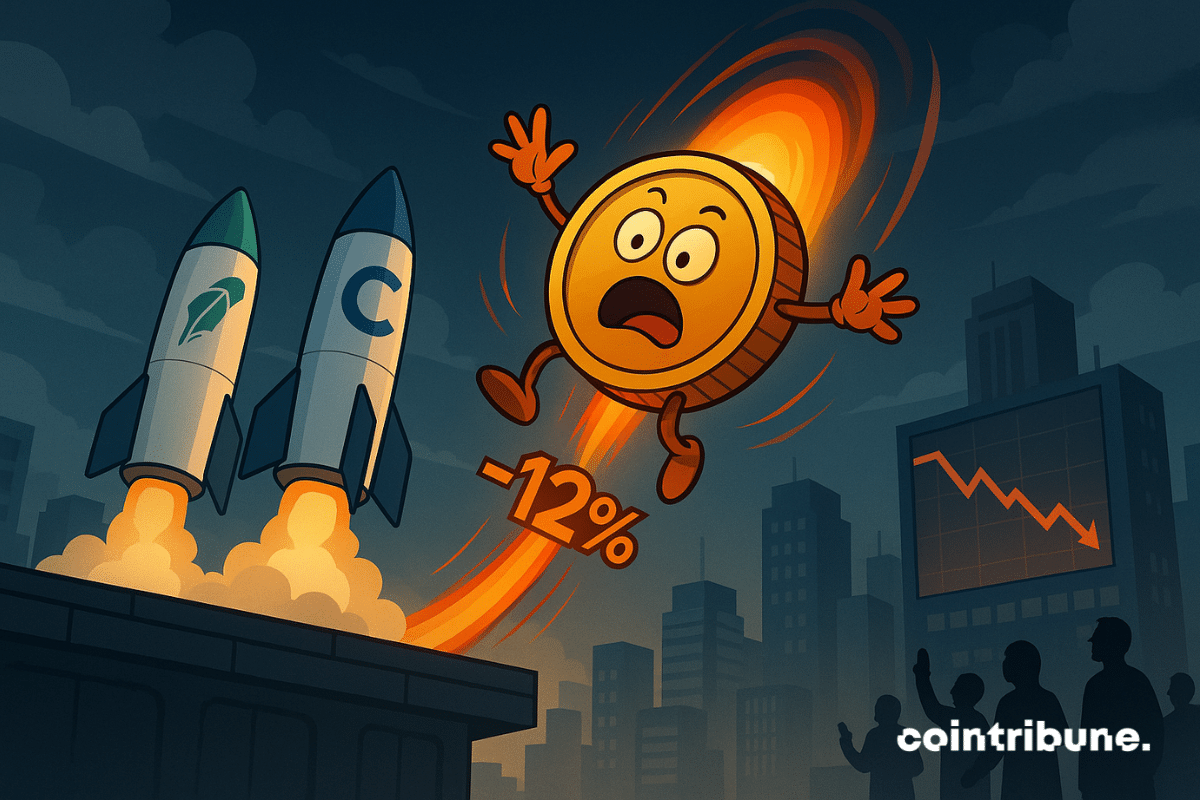
BNB, Binance's flagship crypto, is finally making its debut on two of the largest American platforms: Coinbase and Robinhood. Long excluded from mainstream markets in the United States, often for compliance reasons, the asset is reaching a major strategic milestone. Now listed on platforms accessible to millions of investors, BNB obtains formal recognition which contrasts with its past as an asset partitioned to the Binance ecosystem. This shift says a lot about the evolution of the American crypto market and the gradual normalization of certain long-controversial assets.
In brief
- The BNB crypto, issued by Binance, has just been listed on Robinhood and Coinbase, two major platforms in the United States.
- This double listing marks a strategic step forward for the accessibility of BNB to American investors.
- The launch comes after an all-time high for the token, followed by a drop of more than 20% in a matter of days.
- Experts believe that this opening reflects the growing maturity of the market and a desire to unify the crypto offer.
Robinhood and Coinbase integrate BNB: a turning point in the US markets
This Wednesday, October 22, Robinhood announced the addition of BNB to its American platform, marking a strategic turning point in the accessibility of this token to US investors, while the crypto reached a new historic high.
This announcement immediately caught the attention of the crypto community. It comes on the heels of a similar signal from Coinbase, which added BNB to its list a week earlier. Both platforms activated trading on the same day, formalizing the availability of BNB to a broad American audience.
If Coinbase is known for its relatively broad listing policy, Robinhood is much more selective. With only 41 cryptos available, the integration of BNB represents a very targeted decision and indicative of a change in strategy.
Here are the important facts supported by market data:
- The date of the listing: Wednesday October 22, on Robinhood and Coinbase simultaneously;
- Accessibility: BNB becomes tradable in the United States via the Robinhood mobile application, a first for many individual investors;
- The recent variation: a drop of 22.3% from its all-time high at $1,370, reached less than ten days ago;
- Market capitalization: approximately $149.5 billion, confirming BNB as the fourth largest crypto asset in the world;
- Accessibility history: Kraken only listed BNB last April, highlighting until then its difficult integration on American platforms
This convergence between Robinhood and Coinbase does not only represent an expansion of the crypto offering. It also marks the end of a form of implicit ostracism around BNB on the North American market. For the first time since its launch via ICO in 2017, crypto is becoming easily accessible to millions of American investors. A decision that is both symbolic and structural in the history of the token.
More than a listing: the signal of a maturing market
Beyond simple accessibility, the arrival of BNB on Coinbase and Robinhood calls into question the evolution of exchange platforms and their role in the crypto ecosystem.
For Shane Molidor, CEO of the Forgd platform, this decision responds to a strategic necessity for the two exchanges, even if it may seem paradoxical, given that Binance remains their direct competitor.
“ It is so well established in global Web3 communities that an exchange would be depriving itself by not allowing its trading“, asserts-he. This statement reveals a change in approach.
For Molidor, these decisions also reflect a form of maturation on the part of American platforms. According to him, Coinbase seeks to demonstrate its role as “impartial and bilateral marketplace”where listing criteria are based on decentralization, utility and valuation, rather than competitive considerations. The idea being to reduce the flight of users to competing platforms simply to access certain tokens.
This logic of consolidation of the offer aims to limit arbitrage between platforms, while strengthening the credibility of Coinbase with its user base and institutions. As Molidor notes, “unfortunately, in many cases, platforms are perceived as investment advisors by their communities“.
The addition of BNB, often interpreted as a seal of legitimacy, could thus strengthen its attractiveness to a more institutional public and put an end to this deep fall. In the future, these decisions could also impact ongoing regulatory discussions. The more BNB will establish itself as an asset“general public”the more it could be considered a market standard rather than a centralized tool linked to a single entity.
Maximize your Tremplin.io experience with our 'Read to Earn' program! For every article you read, earn points and access exclusive rewards. Sign up now and start earning benefits.


