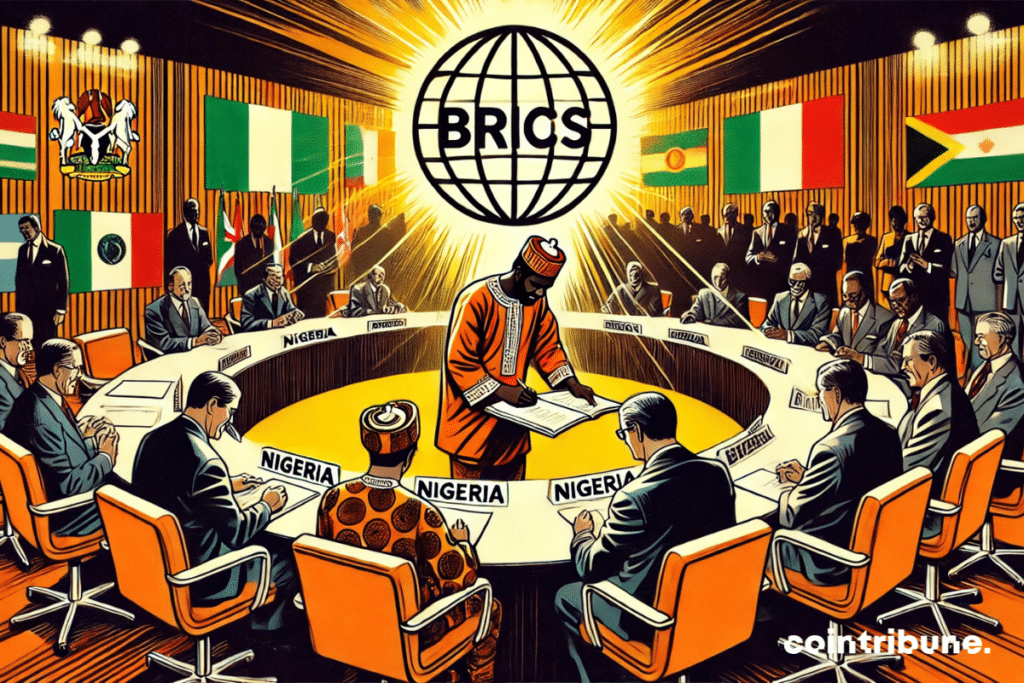
The global economic landscape is evolving rapidly, driven by alliances that reflect the ambitions of emerging countries to reshape traditional poles of influence. In this context, Nigeria, the leading economic power in Africa, joined the circle of BRICS partners. This initiative, orchestrated under the presidency of Brazil, underlines the desire of this bloc to promote strengthened cooperation between the nations of the Global South. Although this partnership does not yet confer a decision-making role on Nigeria, it reflects a growing dynamic of economic integration and a common quest for financial sovereignty in the face of dominant Western models.
A strategic partnership for Nigeria
Nigeria has officially gained BRICS partner country status, as announced by the Brazilian Ministry of Foreign Affairs. This decision is part of a strategy defined at the Kazan summit last October. Such a special status allows Nigeria to actively participate in the bloc's initiatives, even if the country does not yet have decision-making power. According to the Brazilian press release, this approach aims to include nations that share a “common vision” on major issues, such as strengthening economic cooperation and establishing financial sovereignty independent of traditional institutions.
With a population of 237 million inhabitants, Nigeria is today an essential power in Africa, both in terms of its demographic weight and its economic dynamism. This strategic position makes it a key partner for BRICS, which seeks to strengthen ties between countries in the Global South. Ahoua Don Mello, BRICS representative for West Africa, qualified this integration of “a real opportunity to strengthen South-South cooperation and build more equitable global governance”. Furthermore, this partnership marks an important step for Nigeria, but also for the bloc, which pursues its objective of extending its influence beyond its founding members, with a view to offering an alternative to the dominant economic models.
Towards financial sovereignty and prospects for Africa?
This partnership, much more than a symbol, opens up concrete opportunities for Nigeria to engage in strategic initiatives supported by the BRICS. Among these projects, the creation of a bank dedicated to members of the bloc constitutes a key objective. This establishment aims to limit dependence on Western financial institutions in order to strengthen the economic sovereignty of partner countries. Through sharing this vision, Nigeria could play a central role in the design and implementation of these financial ambitions, which would consolidate its position as a major player on the international stage.
Regionally, Nigeria's integration into the BRICS network could also boost cooperation between African countries. Alongside nations such as Ethiopia and Algeria, already partners, Nigeria could become an engine of unity and collaboration within the continent. This rapprochement could encourage other African states to join this initiative, which would thus amplify the influence of the BRICS in Africa. However, this dynamic is not without challenges. Divergent interests and priorities between bloc members could hamper certain projects. Despite these potential obstacles, the official press release emphasizes that this alliance is based above all on a “common vision” shared by its members, without imposing rigid conditions. This leaves the door open for constructive dialogue and adjustments according to the needs of each country.
Nigeria's integration as a BRICS partner symbolizes the growing ambition of emerging economies to reshape global balances. This partnership offers strategic opportunities, particularly in terms of economic cooperation and financial sovereignty, and poses challenges linked to the diversity of national priorities within the bloc. To assert itself as a credible alternative to traditional institutions, BRICS will have to strengthen their strategic coherence, but also respond to the specific aspirations of their members and partners. The evolution of this alliance will determine its future role in global governance and its impact on Africa and beyond.
Maximize your Tremplin.io experience with our 'Read to Earn' program! For every article you read, earn points and access exclusive rewards. Sign up now and start earning benefits.