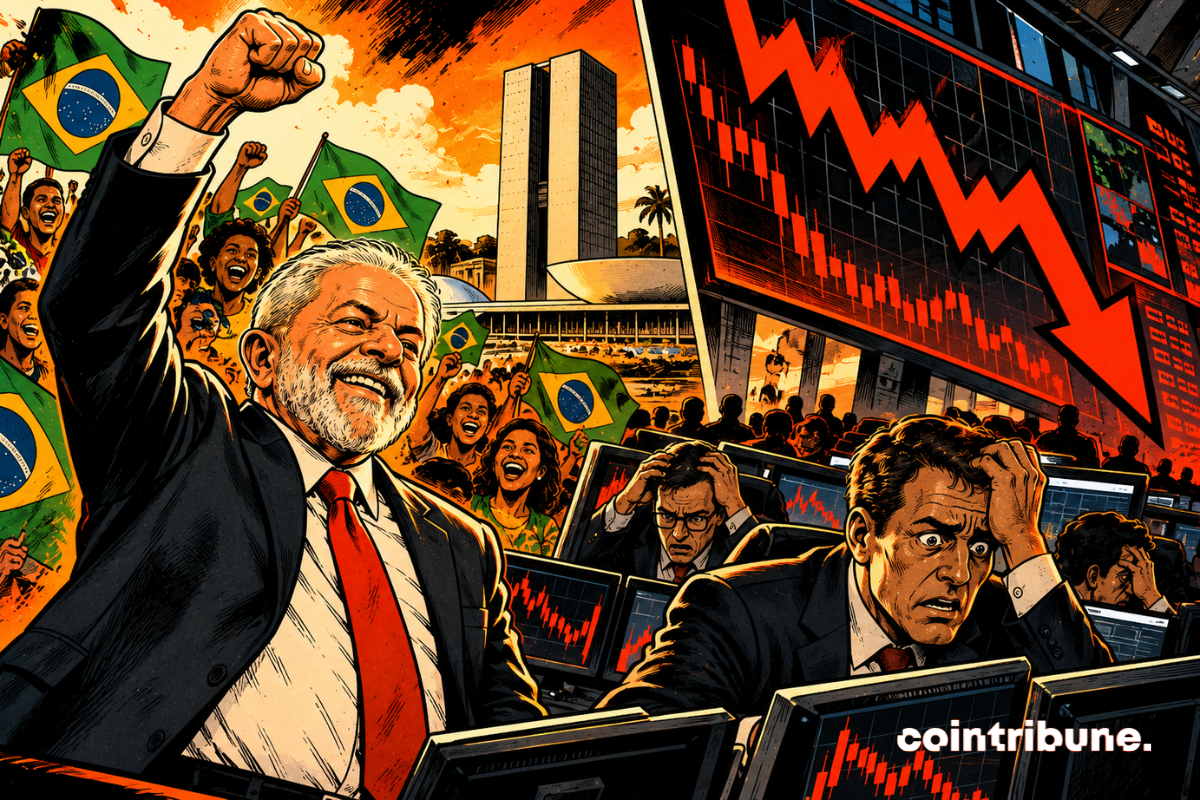
The surprise victory of Luiz Inácio Lula da Silva caused the Brazilian stock market and currency to fall. At the same time, bitcoin rose when expressed in reals, illustrating the difference between an asset’s global performance and its value in a weakened local currency.
In brief
- Lula’s surprise victory causes a brutal fall in the Brazilian stock market and the real against the dollar.
- The Ibovespa lost up to 17% during the session, while the real fell 8.1% against the dollar.
- Bitcoin is growing by 3 to 8% in reals despite a drop in its price in dollars.
- This increase is mainly explained by the depreciation of the Brazilian currency, and not by strong demand for Bitcoin.
The fall of the real changes the reading of the market
Lula won the second round of the presidential election with 51.79% of valid votes, compared to 48.21% for Flávio Bolsonaro. The result caught investors off-guard, with predictive markets giving the right-wing candidate about an 80% chance of victory.
The reaction immediately affected stocks, bonds and currencies. Investors had accumulated favorable positions in Brazil since the first round, anticipating more restrictive fiscal policy under Bolsonaro.
The main movements observed on October 26 show the extent of the shock:
- Ibovespa lost up to 17% in session;
- Trading was suspended for 30 minutes in São Paulo;
- The real fell 8.1% against the dollar at the close;
- US ETF EWZ fell as much as 26%;
- Bitcoin rose in reals despite its decline in dollars.
The gap between the Ibovespa and the EWZ ETF is particularly telling. The first measures the performance of stocks in Brazilian currency. The second is listed in New York in dollars and therefore simultaneously suffers from the decline of Brazilian companies and the depreciation of the real.
At the lowest point of the session, the combination of the two movements resulted in a loss close to 26% for the dollar investor. The same stock can thus show a lower fall in the portfolio of a Brazilian and a much greater fall in that of a foreign investor.
Bitcoin progresses in Brazilian currency
Bitcoin was trading around $80,000 during the correction in Brazilian markets, with a drop of around 1.8% over 24 hours. His behavior therefore appeared negative when observed from the United States.
The situation was different in real terms. Depending on the platforms and the time used to establish the daily price, BTC gained approximately 3% to 8% in the Brazilian currency on October 26. CoinMarketCap evaluate notably its increase from approximately 397,900 to 429,960 reals between October 25 and 26, an increase of slightly more than 8%.
This increase does not necessarily mean that Brazilians bought bitcoin en masse after the election. It comes largely from currency conversion. The local price of BTC results from two variables: its price in dollars and the value of the dollar in relation to the real.
When bitcoin loses almost 2% in dollar terms, but the Brazilian currency drops more than 8%, the currency effect can more than offset the correction in BTC. The Brazilian holder then sees the nominal value of his bitcoins increase, even if the asset depreciates on the global market.
The phenomenon also concerns gold, dollar-backed stablecoins and other international assets. Above all, it shows that a return cannot be interpreted without specifying the currency in which it is calculated.
Monetary protection, but not a guaranteed safe haven
The episode may strengthen the image of bitcoin as protection against the depreciation of a national currency. For a saver exposed only to the real, holding an internationally listed asset has effectively limited the exchange rate shock in the very short term.
This protection, however, remains imperfect. Bitcoin remains volatile and can fall faster than the local currency. A 15% fall in BTC in dollars would not be offset by an 8% depreciation of the real. Its local increase on October 26 is therefore not enough to prove its status as a safe haven.
The next test will mainly come from economic policy. Investors are awaiting the appointment of the Minister of Finance and a program capable of stabilizing the debt. Graham Stock of RBC BlueBay Asset Management estimated :
The main signal for the markets will be the next Lula administration’s commitment to budgetary discipline.
If the real stabilizes, the Brazilian bitcoin price will again depend more on its global trend. On the other hand, a new mistrust in public finances could maintain a significant gap between BTC in dollars and its value in reals.
Lula’s victory therefore does not automatically transform bitcoin into a political refuge. Rather, it reminds us that in times of monetary crisis, the currency used can profoundly modify the perception of the performance of an asset.
Maximize your Tremplin.io experience with our ‘Read to Earn’ program! For every article you read, earn points and access exclusive rewards. Sign up now and start earning benefits.