A recent article published by Bloomberg caused some ink to flow. Its author, Professor Tyler Cowen, claims that “Gold is no longer protection against difficult times”. But what is it really? This statement comes before that of the CEO of BlackRock who claims that bitcoin would be “digital gold” of tomorrow. It is now time to take a real interest in the question of whether gold is a protection. A closer examination of the arguments presented shows that gold remains linked to stock market indices with recent monetary creation, but nothing demonstrates (and implies) that it is devoid of its safe haven quality.
Gold would no longer be a cover
At least that’s what economics professor Tyler Cowen says. This assertion is based on several arguments, but they deserve to be widely open to debate.
From criticism to controversy
This argument was quickly criticized by some gold specialists, such as Otavio Costa. Critics have even had fun saying that this type of article often announces a low point in the price of gold. It must be said in this respect, in fact, that the last low point of Gold is dated June 29th. That is 1 day after this article.
Beyond superstitions, the debate has been reopened among experts on the question of gold. The recent analysis conducted by the National Bureau of Economic Research focuses on the demand behavior of Gold. But despite everything, the model developed does not seem to fully answer the problem posed.
Tyler Cowen’s Arguments
Tyler Cowen is based on several arguments. The first of these would be the instability of the price of gold in 1980, when the latter rose from $35 an ounce in 1971 to nearly $800. But this approach is all the more indefinite since the price of gold has been under structural upward pressure for years before. It follows that a free fixing of the price of gold could only be very variable in the first years. Moreover, the author continues by qualifying on the contrary Gold as being ” a little annoying “.
“The precious metal has become just another cyclical asset, no longer a useful harbinger of social and economic collapse. […] Even though it’s trading around an all-time high of $2,000 these days, gold is a bit boring and will likely remain so for the foreseeable future. »
Gold Is No Longer a Good Hedge Against Bad Times – Bloomberg
Therefore, perceiving gold as a stable asset is precisely the paramount quality for gold buyers. Still, Tyler Cowen’s second point is worth discussing. He claims that the price of gold is inversely correlated to real rates (the interest rate minus inflation). A recent study by National Bureau of Economic Research actually supports this thesis.
Gold and Real Rates
The NBER claims that “for investors, gold is an attractive non-returning asset in times of low and negative real interest rates”. According to the data studied, gold would indeed be highly correlated to negative real rates. The report adds that “When adjusted to match real 10-year US Treasury rates, the model can reproduce the major movements in the gold price time series since 2007”.
But at the same time, the report clarifies that the link between gold and real rates weakens when rates are high. It is also noteworthy that the highest correlation does not exceed 65%, which is a level of correlation comparable in the long term with that of stock market indices.
“Such high figures clearly show that long-term real rates can be considered the main driver of gold prices during periods of low rates. During periods of high rates the correlation between gold price changes and returns is generally weaker, for monthly changes the correlation disappears“.
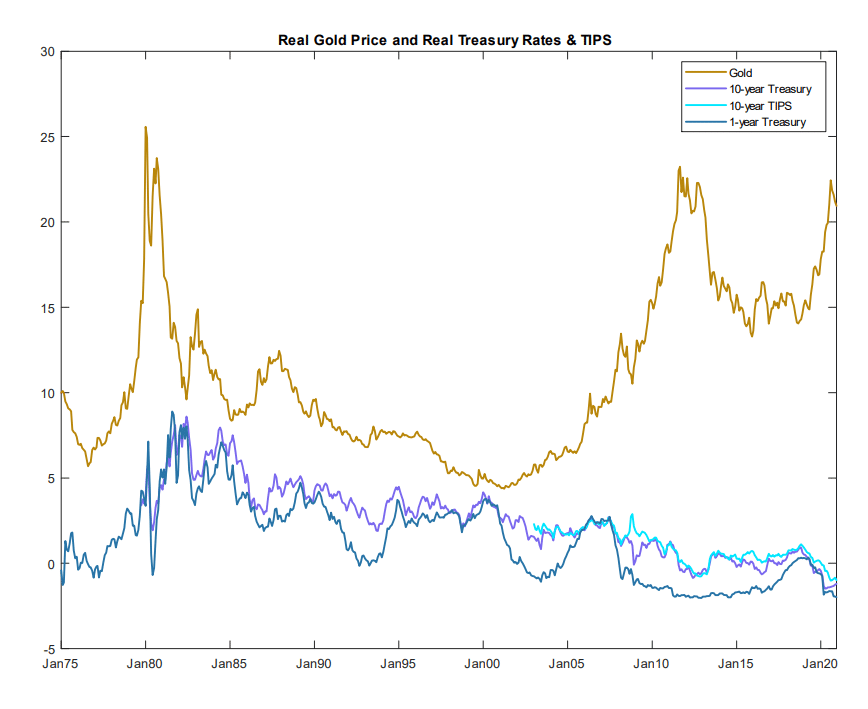
In fact, the sharp rise in real 10-year rates in the United States (from -0.4% in August 2020 to 2% in March 2023) did not have a downward impact on the price of gold. . On the contrary, the latter remained stable or slightly bearish (-1.5%). It is therefore obvious that this model does not explain everything. It often happens that this real rate/gold relationship is contradicted. While it is relevant in the presence of low interest rates, the presence of high interest rates and higher inflation drastically complicates this relationship.
Conflicting fundamentals
An essential element of the price of gold is given by the offer. Indeed, the model of negative real rates only considers the buying (demand) side of the issue. The basic assumption is that an investor will buy gold when his capital is not remunerated (or not sufficiently remunerated in the face of inflation). The importance of physical gold supply is therefore neglected.
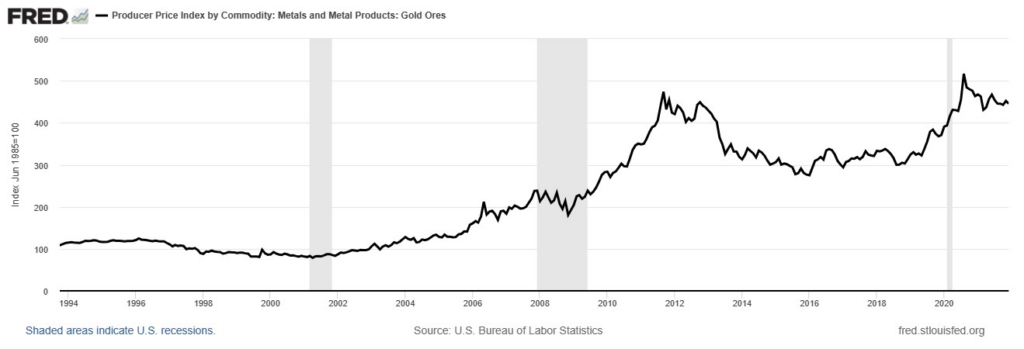
The graph above shows the producer price index for gold ores. The data clearly shows, once again, the necessary and constant correlation between the price of gold and its cost of production in the long term. We have already had the opportunity to develop this in a previous article.
Therefore, it is clear that the existence of high rates often results in the existence of high inflation. This also implies that the pressure on production costs is stronger. The importance of the offer then becomes more important, and the real rates are a less determining parameter, and often ineffective.
Is Gold “systemic”?
Therefore, if gold is sometimes correlated to real rates, this implies that gold is an asset linked to the economic system. Professor Tyler Cowen also adds that the gold price has been supported by jewelery demand in India and industrial demand in China. This is indeed verified, but the rise in the price of gold is not mainly explained by these causes. In any case, the author puts forward the idea that gold would be dependent on the financial system and the economic system. He adds.
“Gold is becoming another cyclical economic asset, and this is a large part of the reason why gold prices are no longer watched so closely or seen as useful harbingers of social collapse and economic. Instead, it is perfectly acceptable to have a high or rising gold price. […] These large shifts in the relative value of gold would be disastrous under a gold standard, but under the status quo they are not that significant. Gold, like many other commodities, is quite inelastic in short-term supply. »
Gold Is No Longer a Good Hedge Against Bad Times – Bloomberg
But once again, these arguments demonstrate the neglect of a certain number of parameters. In fact, the price of gold cannot be reduced to an inversion with the curve of real rates, as shown in recent years. Moreover, while it remains undeniable that the rise in the financial markets and the easy creation of money have contributed to the rise in the price of gold, this does not show that it is not a hedge. Countries with hyperinflation or high inflation have actually seen the value of gold increase dramatically. It is not for nothing that central banks have bought gold in record quantities these last months.
In conclusion
Ultimately, nothing shows that Gold is not “more of a hedge against hard times”. On the contrary, the sharp increase real rates in recent years has not involved the sharp drop in the price of gold. Additionally, qualifying Gold as an active ” boring “ precisely amounts to describing its main asset. In fact, we cannot reduce the evolution of the price of gold to the evolution of real rates. Indeed, the fundamental assumption of this phenomenon is that it is the buyers who make the price of gold. Consequently, the demand for Gold would be very high in a period of negative real rates. This observation is false in certain circumstances. In the long term, the demand for Gold has a more negligible effect on the price, while the presence of high rates implies the absence of correlation with the real rates!
Indeed, it has been shown that production costs have a major role in the price of gold. High inflation, or a high interest rate, has the implication of increasing the importance of supply. Therefore, Gold is not strictly dependent on the financial markets. On the contrary, it is one of the assets that have lower long-term correlations. But the existence of a link between gold and the financial system does not imply that the collapse of the financial system results in the collapse of gold. The crisis observed in many countries, and the massive purchases of gold by central banks, unanimously contradict this position.
Receive a digest of news in the world of cryptocurrencies by subscribing to our new service of daily and weekly so you don’t miss any of the essential Tremplin.io!