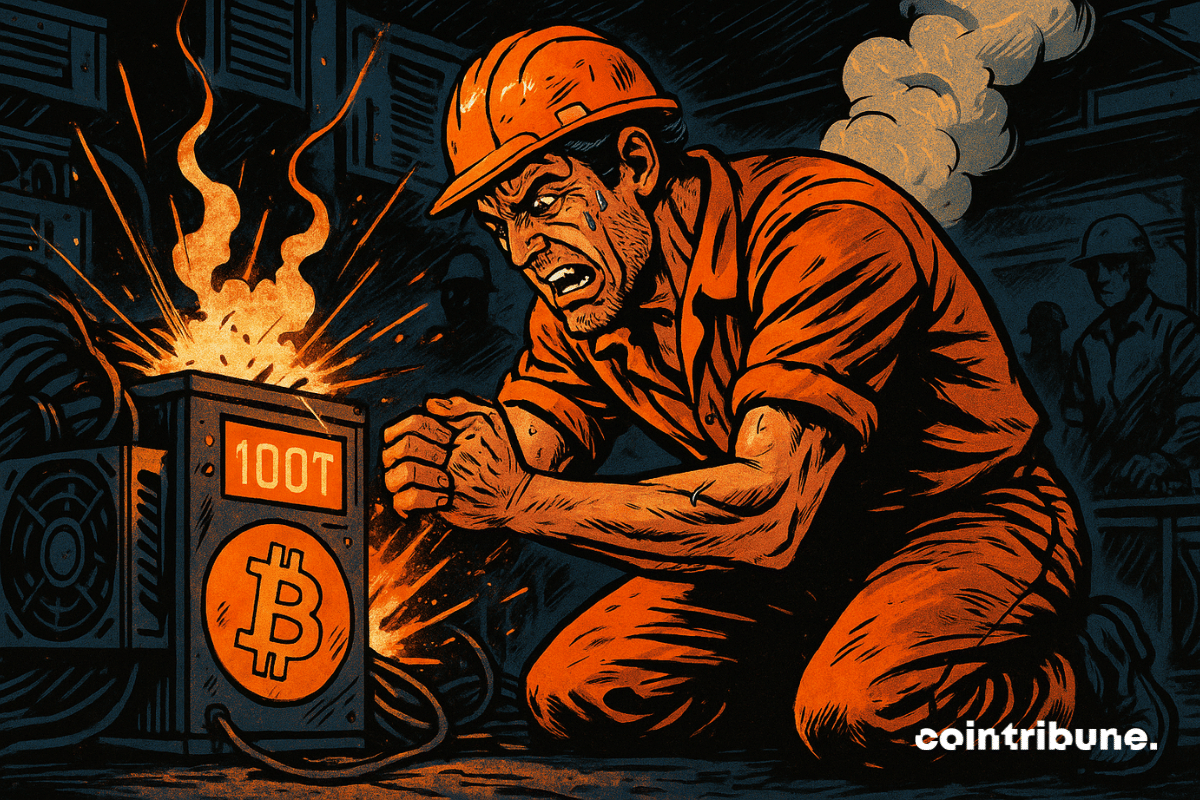
The Bitcoin network has just crossed a new course with a mining difficulty which reaches an absolute record at 127.6 trillions. If this figure shows enhanced security, it raises crucial questions about the economic balance of the sector. Between maintained profitability and frantic technological race, does this escalation mark the entry into a new era of mining?
In short
- Bitcoin mining difficulty set a new historic record at 127.6 trillions on August 3, 2025.
- The next adjustment scheduled for August 9 should make this difficulty fall by approximately 3 %.
- Miners' income jumped $ 1.66 billion in July, despite increasing technical pressure.
- This rise in the difficulty confirms the persistent attraction of Mining Bitcoin to professional actors.
A technical record that redefines mining standards
Bitcoin's mining difficulty crossed a new historic summit this Sunday, August 3, 2025. Coinwarz datait reached 127.6 trillions, a level never observed before. This record was reached in block 908,544 of the blockchain, marking a major turning point for the mining Bitcoin industry.
This flight is not the result of chance. Over the past 30 days, the difficulty jumped 9.12 %, while over 90 days, the increase reached 7.14 %. This sustained trend reflects the massive arrival of new ever -efficient equipment and the optimization of existing mining farms.
The Bitcoin protocol, thanks to its automatic adjustment mechanism, plays a safeguard role. The more the computing power (hashrate) increases, the more the difficulty is noted in order to maintain a rate of creating a block every 10 minutes. This self -regulation, specific to the network, guarantees the stability of the emission, whatever the fluctuations in the mining power.
Surprisingly, this increase in difficulty coincides with mining income at the highest since the halving of 2024. In July, minors garnered $ 1.66 billion, an unprecedented amount for more than a year. Average income by Exahash is $ 57,400 per day, up 4 % compared to June.
Major implications for the Bitcoin ecosystem
This ramp -up technique in depth redraws the economy of Bitcoin's mining. Under the effect of exacerbated competition, the least efficient players are gradually dismissed, leaving room for better equipped, more structured, often industrial operators.
A form of natural selection takes place, which accelerates the professionalization of the sector while strengthening the robustness of the network.
However, combined with a persistent institutional demand – carried in particular by ETFs, American banks or even business reserves strategies – this dynamic constitutes a powerful bruise engine. The Bitcoin Stock-To-Flow ratio, already twice that of gold, is still reinforced.
The next adjustment scheduled for August 9, however should offer a slight respite. Estimates expect a marginal drop of 0.03 %, bringing the difficulty to 127.29 trillions. A minimal technical correction, but which could temporarily relieve the margins of the least competitive minors.
Another notable point: the apparent decoupling between increasing difficulty and profitability. Despite an ever higher complexity, the income generated by minors reach heights. This suggests that industry has found a new balance, optimizing its operational costs to maintain profitability.
In short, this outbreak of the difficulty of mining illustrates the growing maturity of the Bitcoin ecosystem. It testifies to an in full change sector, where only the most experienced actors survive. This dynamic ultimately strengthens network resilience and its ability to preserve the rarity of Bitcoin in the face of growing global demand.
Maximize your Cointribne experience with our 'Read to Earn' program! For each article you read, earn points and access exclusive rewards. Sign up now and start accumulating advantages.