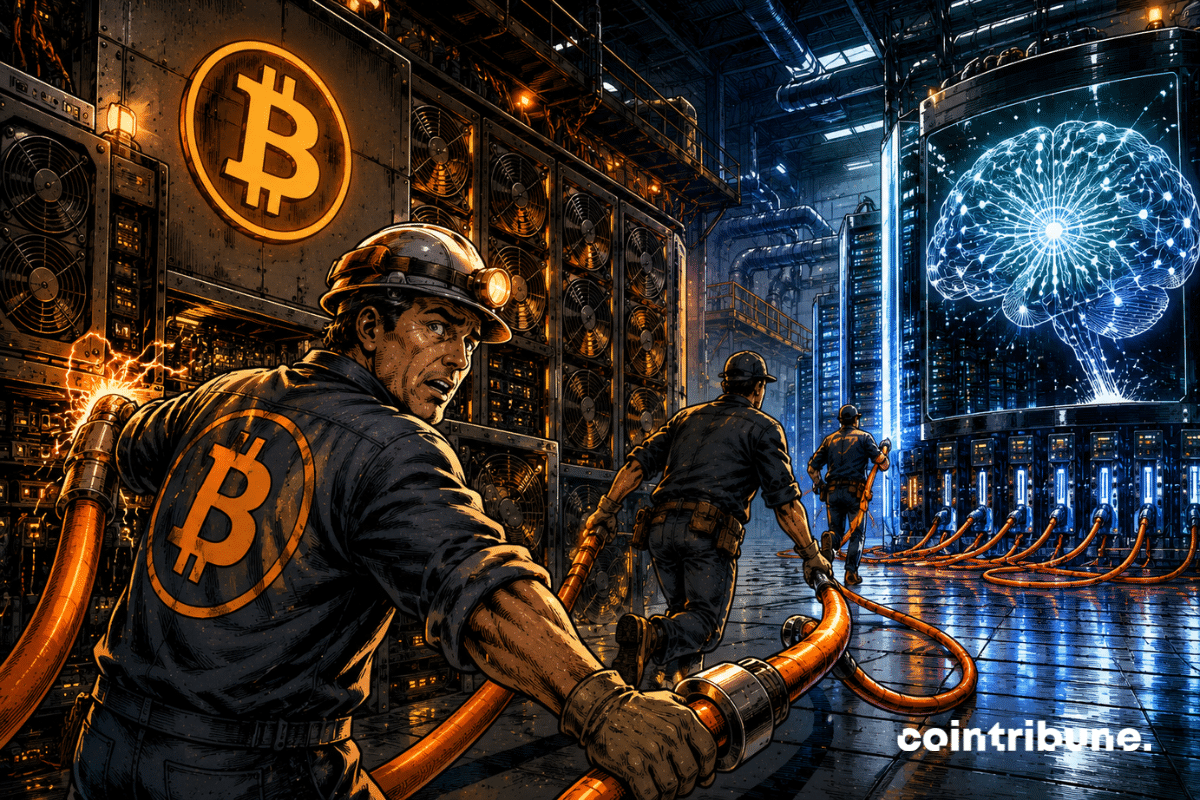
After reaching a peak at the end of 2025, the computing power which ensures the security of the Bitcoin network is going through an unusual decline. Rapha Zagury, CEO of Twenty One Capital, calls this situation the first “hashrate bear market”. This decline mainly reflects the deterioration in the profitability of mining. However, the phenomenon is accentuated by artificial intelligence, because many operators now reserve their energy infrastructures for long-term IT contracts.
In brief
- Bitcoin’s hashrate has been in a prolonged decline since its peak in late 2025.
- Mining profitability deteriorates and forces the least efficient machines to shut down.
- Contracts linked to AI and high-performance computing attract part of energy infrastructure.
- Several major mining players are already shifting their capabilities towards AI data centers.
- Decreasing the hashrate can improve margins for miners who remain active.
Bitcoin experiences its longest period under a hashrate record
This August 28, Rapha Zagury presented his analysis during the Bitcoin Asia conference in Hong Kong, so bitcoin has just closed its best August in nine years. He declared:
We are going through, I think, the first hashrate bear market in the history of bitcoin.
The hashrate evaluates the computing power mobilized by mining specialists to validate blocks. Zagury confirms in a intervention published with the SEC that this indicator was close to 1.3 zettahash per second at the end of 2025 before gradually decreasing. This is the longest period in which the network remains below its previous peak without regaining it.
Three elements can help us understand this progression:
- The average hashrate fell by 5.8% between the first and second quarters of 2026, from 1066 to 1004 EH/s;
- The daily revenue per computing unit, or hashprice, fell to $27.89 per PH/s;
- Nearly 252 EH/s of unprofitable machines would have been shut down, mainly among old equipment.
These statistics come from Hashrate Indexwhich defines profitability as the main cause of the decline. The fall of bitcoin after its peak in October 2025 reduced the revenues of mining companies, while electricity and operating costs continued to weigh on their margins.
Thus, the term “bear market” however, remains an interpretation. Bitcoin has no official threshold that allows its hashrate to be qualified in this way. Therefore, daily estimates also fluctuate depending on the speed of block production. Averages over 7 or 30 days therefore provide a more reliable reading than data from a single day.
AI-related contracts divert part of infrastructure
This situation is different from the shock triggered by the mining ban in China in 2021. At that time, the machines had essentially changed countries before coming back online. This time, certain electrical capacities would permanently leave the mining sector to power data centers dedicated to artificial intelligence.
Zagury clarified: “what we see today is very different”. For him, almost no major, reputable professional now maintains a strategy solely focused on large-scale mining.
Numerous operations support this observation. Keel Infrastructure has suspended all its American mining activities with a view to converting its sites to AI and high-performance computing. The company had $819 million in liquidity as of August 7 to finance its transformation.
Bitdeer has entered into a 16-year, $4.7 billion contract to supply 121 MW of IT capacity in Norway. As for Hut 8the company signed a 15-year lease covering 352 MW in Texas. Its contracted portfolio is now around 949 MW for AI.
These partnerships provide predictable revenue for mining, which depends on the price of the main crypto, the difficulty of the network and energy costs. They reveal a real reallocation of infrastructure, but do not prove that AI alone justifies the entire decline in hashrate.
Decline may improve margins of remaining miners
Thus, a lower hashrate does not decrease the number of bitcoins issued. The protocol immediately adjusts the difficulty approximately every two weeks with the aim of maintaining a block every ten minutes. From this perspective, mining specialists who are still active can therefore obtain a larger share of the rewards if their competitors suspend their machines.
However, such a potential improvement will depend on the price of bitcoin and the price of electricity. A rise in the hash price would put equipment back into service and attract new investments. At the same time, the multiplication of contracts relating to AI would prolong the slowdown if operators favor this revenue in the long term.
The next trend will therefore have to be confirmed by the hashrate average, difficulty readjustments and real investments from major mining operators. At the moment, bitcoin is experiencing a continued contraction, but not an immediate security crisis.
Maximize your Tremplin.io experience with our ‘Read to Earn’ program! For every article you read, earn points and access exclusive rewards. Sign up now and start earning benefits.