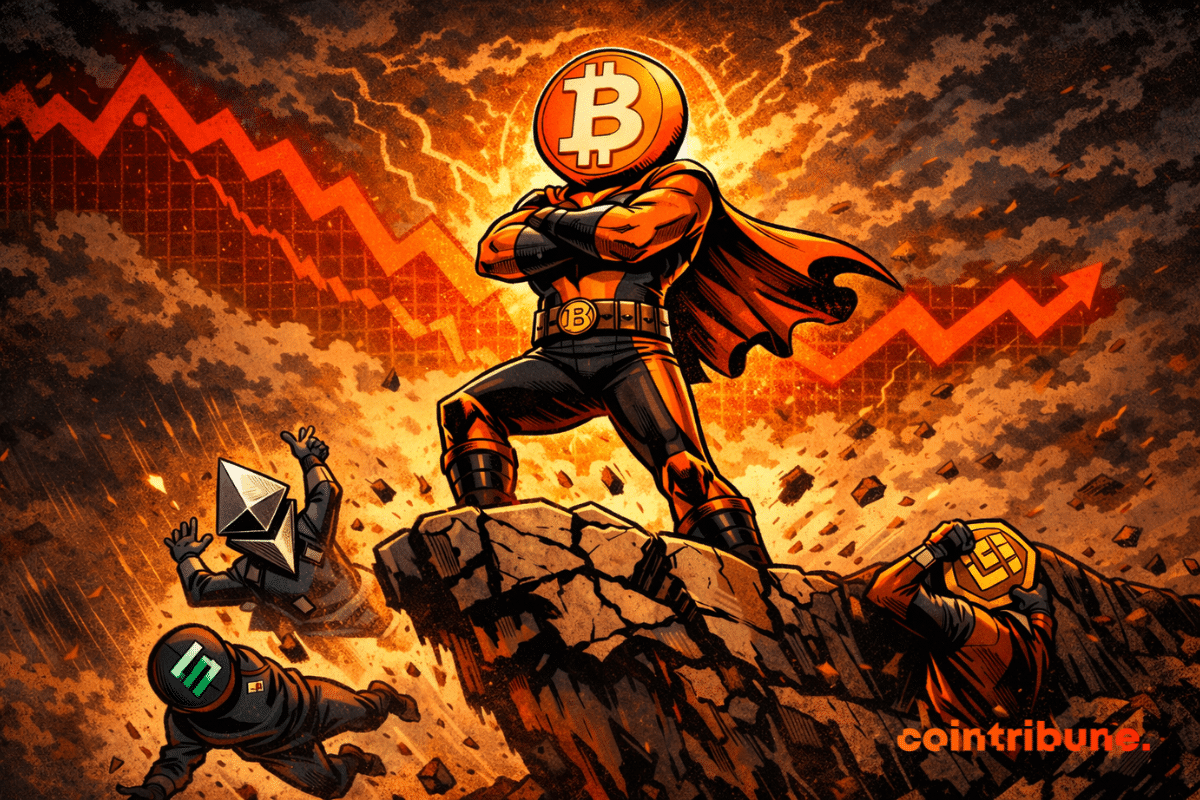
Bitcoin didn't make any noise. He simply resisted. In a crypto market that has been silently crumbling, the first crypto has fallen, yes, but it has fallen less than the rest. And in this kind of quarter, “less worst” becomes a performance. The data cited by Glassnode suggests continued relative weakness in almost all segments against BTC, as if liquidity, instead of exploring, had coalesced around the main mast.
In brief
- Bitcoin fell by around 26% in Q4, but held up better than the crypto market as a whole, which remained under pressure.
- The market remains fragile, dominated by liquidations and an unsuccessful rotation into altcoins, while BTC oscillates between $85,000 and $94,000.
- In this climate of hesitation, Michael Saylor stays the course and continues to accumulate bitcoin via Strategy.
Bitcoin in decline, but still the anchor of the crypto market
The stinging figure is clear: around 26% drop over the quarter, for a price around $86,000. On paper, it's a slap in the face. In the reality of the crypto market, this is almost a privilege. The overall market would have done slightly worse, around 27.5% over the same period. In other words, the pain is shared, but the BTC keeps the role of the less feverish patient.
And this decline has a very concrete consequence on the microstructure of the market: when a drop brought it back towards $86,700, a wave of liquidations was immediately observed, with more than 210 million dollars erased in one hour and more than 450 million over 24 hours. A sign that many positions were still too exposed to leverage.
The recent session sums up the mood: more than 4% drop in 24 hours, total capitalization down around 3.8%, and the market has fallen back below the symbolic mark of 3,000 billion dollars. Add to that a Fear and Greed still on the Fear side, and you get a crypto market where courage is rare, and where each bounce seems like a question asked too loudly in an already nervous room.
And then there is the invisible mechanism: liquidations. CoinGlass reports more than $658 million liquidated during the decline. This detail matters, because it explains why the movements sometimes seem exaggerated: when the lever jumps, it is not a rational sale, it is a trapdoor that opens under the positions.
Bitcoin dominance: the rotation has taken place, but the conviction has not returned
According to Bitcoin Vector, the first half of the year was clearly BTC led: dominance was rising, Bitcoin was playing the role of guide, and the crypto market was following the lead. Then, in the second half, the scenario turned. Dominance began to slip, and capital attempted a rotation into Ether and other majors, a classic in theory.
Except that this rotation did not give rise to new leadership. Above all, it created a gray area. Bitcoin has lost its locomotive aurawithout the altcoin market really taking over. Result: a crypto market which seeks a center of gravity and which, for lack of anything better, returns intermittently to BTC, as we return to a refuge that we criticize, but which we know by heart.
This hesitation is also seen in the price structure: bitcoin is reportedly stuck between $85,000 and $94,000, with rebounds often sold as soon as they appear. For what ? Because many buyers would have positioned themselves near October's historic high and would take advantage of the slightest rise to lighten up without too much damage.
As a result, a psychological ceiling emerges and liquidity becomes finer: it rises, it stumbles, it falls. In this context, Michael Saylor does not deviate: via Strategy, he continues his accumulation strategy and continues to buy bitcoin, banking on these withdrawal phases as entry points rather than panic signals.
Maximize your Tremplin.io experience with our 'Read to Earn' program! For every article you read, earn points and access exclusive rewards. Sign up now and start earning benefits.