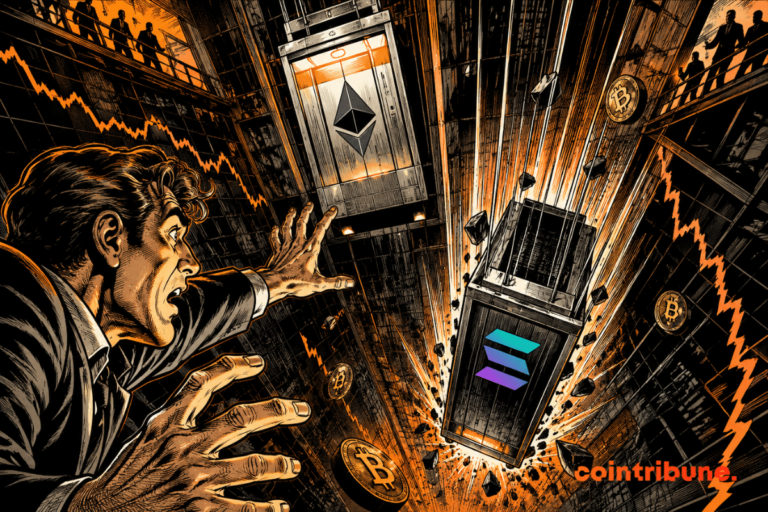
The cryptos market is experiencing a deep mutation, and Bitcoin stands out more than ever as the central element of the digital financial landscape. While the previous cycles saw the Altcoins take advantage of the boom in the BTC to gain ground, the current dynamics take an unprecedented turn. Institutional investors massively favor Bitcoin, and abandon thousands of tokens that are always more numerous. Its dominance index jumped by 15.5 % in January 2025, and reached almost 59 %, a level which illustrates a clear imbalance between the BTC and the rest of the market. This rise in power is not only due to the influx of capital. Political decisions, ETF performance and shortness of breath help to strengthen the supremacy of the King of Cryptos. Faced with these transformations, is Bitcoin in the process of definitively detaching from the traditional crypto market?

Bitcoin, an asset which has become essential for institutional
The cryptos market has an exponential inflation of new tokens, a situation that worries certain major players. Brian Armstrong, CEO of Coinbase, A deplored On the social network X (formerly Twitter) on January 26, 2025 the creation “of approximately one million tokens per week”, a figure constantly increasing, which thus calls for a reform of the process of rating cryptos in the United States . While altcoins are increasing without real control, Bitcoin follows a radically opposite trajectory, and attracts ever more substantial institutional capital.
The rapid ascent of Bitcoin is not by chance. Thus, the approval of the Bitcoin ETF opened the door to an unprecedented influx of institutional capital, which profoundly transforms the structure of the market. In the space of one year, assets under the management of Bitcoin funds increased from 1.17 billion to 39.57 billion dollars, which illustrates a massive craze of traditional investors.
This interest goes beyond private actors. Several American states, such as Wyoming, Arizona and New Hampshire, plan to integrate Bitcoin into their public reserves, a project that could redefine its status within economic policies. Such political adoption strengthens the perception of bitcoin as a strategic asset, independent of the usual speculative cycles of cryptos.
The impact is all the more visible on the market since whales continue to accumulate large amounts of BTC. This dynamic rarefies the offer and reduces the probabilities of a brutal correction. Sam Wouters, analyst at River Financial, observes that “this cycle, Bitcoin leaves crypto behind him”, while the Tuur Demeester strategist affirm Without detour in a publication on January 29 on X (ex Twitter) that “Altseason is dead”. More than a simple cyclic phenomenon, this trend reveals a major structural change: Bitcoin stands out as a full -fledged asset, detached from the rest of the crypto market.
Ethereum and Altcoins in difficulty against Bitcoin
This situation results from several factors. Ethereum's transaction fees remain high, which makes it less attractive for investors and daily users. At the same time, alternatives like Solana gain ground and offer faster and less expensive solutions. Uncertainty around the next Ethereum developments also feeds this trend. Internal debates on scalability strategies and leadership changes within the ecosystem weaken the confidence of investors.
The capital flows confirm this growing imbalance. In 2024, Bitcoin captured 90 % of institutional investments in the cryptos sector, which leaves ETHEREUM ETHEREUM. This divergence provides information on a sinister reality for ETH. If the ETH/BTC pair crosses the critical threshold of 0.030 BTC, a new decrease phase could begin, and would further weaken its status as a leader among altcoins.
In this context, a major question arises: can Ethereum still reverse the trend, or is it condemned to lose its influence for the benefit of Bitcoin? The history of the crypto market has already proven that volatility could redistribute the cards, but this time, the dynamics seem more structural than economic.
Ultimately, the ascent of Bitcoin is based on three solid pillars: massive institutional adoption, increased political support, and an altcoin market which struggles to compete. Faced with this dynamic, some analysts, such as those of Standard Charterd, plan a BTC at 200,000 dollars by the end of 2025, carried by increasing flows to ETFs and public reserves. However, this domination is not an absolute certainty. The history of cryptos has always been marked by cycles of innovation and reversal. If Bitcoin continues to integrate, its role could evolve towards that of a full -fledged financial asset, detached from the traditional crypto market. Conversely, a new generation of altcoins, carried by technological advances, could try to question its supremacy. In one case as in the other, Bitcoin has never been so dominant. It remains to be seen whether this position will be definitively acquired or disputed in the years to come.
Maximize your Cointribne experience with our 'Read to Earn' program! For each article you read, earn points and access exclusive rewards. Sign up now and start accumulating advantages.