The University of Cambridge has revised downwards its estimate of the Bitcoin industry’s electricity consumption.
The wind is turning
Over the past three months, two academic papers (including MIT) have touted the environmental benefits of bitcoin. Even Bloomberg recognizes the evidence:
The icing on the cake is that the University of Cambridge has revised the figures for its famous index downwards CBECI (Cambridge Bitcoin Electricity Consumption Index). We must welcome this questioning and emphasize that the decentralized nature of the Bitcoin network makes the task difficult.
If American miners listed on stock exchanges are full of data (type and quantity of ASIC, shares of renewable and carbon energy, etc.), the majority of miners are private and do not communicate this information.
Furthermore, knowing the geographic distribution of the CBECI hashrate is difficult. Simply relying on IP addresses collected by mining pools is not ideal for guessing miners’ share of carbon electricity. Especially since many miners do not connect to national networks.
In short, the University of Cambridge realized that it was using a wrong estimate of the proportions of new and old ASICs in its calculations. This data is crucial when we know the constant improvement in the efficiency of ASICs (+ 5,800% over the last eight years).
According to the Bitcoin Mining Council, the average efficiency of the global ASIC fleet would be somewhere around 46 joules per Terahash. The latest generation models have an efficiency of 21 J/TH.
In short, old generations of ASICs are over-represented to the detriment of new generation ASICs (lower electricity consumption). The estimate is difficult because the main ASIC manufacturer (the Chinese Bitmain) does not detail its sales by type of ASIC.
The University of Cambridge was therefore inspired by the figures published by its competitor Canaan. The latter, however, represents only a fraction (~17%) of total ASIC sales worldwide.
New figures from the University of Cambridge
We can read in the report that :
“The first and most notable divergence appears in 2021. Our previous model estimated electricity consumption of 104 terawatt hours (TWh), or 15 TWh more than the estimate using our new methodology (89 TWh).”
Here is a graph allowing you to appreciate the extent of the revision:
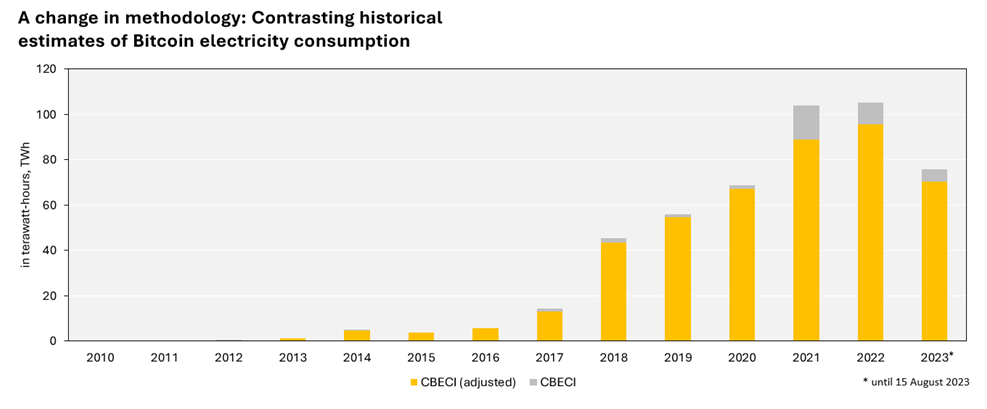
As we said above, these divergences come from a lower weighting of old ASICs which are often at the limit of profitability. Knowing that the CBECI is based on an average price of five cents per kilowatt hour.
The previous CBECI model estimated that around 12% of the network’s hashrate came from ASICs less than a year old. This contrasts sharply with data from Canaan whose Avalon A1246 ASIC (latest generation) represented 45% of the total hashrate sold from 2017 to 2021.
The new CBECI model splits the pear in two and assumes that 21% of active miners are less than one year old. So much so that the estimate of electricity consumption for 2022 has been revised downwards by 10 TWh, from 105 TWh to 95 TWh.
To put things into perspective, know that one Terawatt is enough to power 70,000 homes for a year.
Bitcoin’s electricity consumption is marginal
For the University of Cambridge, the share of Bitcoin in global electricity consumption is 0.38%.
Or 0.21% of all energy consumed in the world according to Bitcoin Mining Council. Remembering to point out that this is often renewable electricity which no one wants.
Let us end by emphasizing that the CBECI figures do not take into account the wear and tear of the machines. Nor the overclocking practiced by large American miners like Marathon.
The report also specifies that it does not take into account mitigation of CO2 emissions. According to Daniel Batten, miners who capture methane that would otherwise be flared are already mitigating 6% of the bitcoin industry’s CO2 emissions:
Facilities that recover the heat generated by ASICs are also not counted. For example to heat greenhouses in winter to produce food.
Daniel Batten estimates that the CBECI index still overestimates CO2 emissions by 67%. For him, emissions are not 57 million tonnes of CO2e/year, but 34 million tonnes. This figure is obtained by taking into account the impact of “off-grid” miners and the mitigation of methane emissions.
Receive a summary of the news in the world of cryptocurrencies by subscribing to our new service daily and weekly so you don’t miss anything of the Tremplin.io essentials!