

The link between bitcoin and different assets is a strategic indicator of the cryptocurrency market. Indeed, most of bitcoin's major lows and highs are linked to other markets. In this paper, we will study the behavior of bitcoin against the S&P 500, gold and ethereum in recent months. The important symmetry of the correlation of different assets with the price of bitcoin provides valuable indicators on the state of the market, after two months of stagnation for BTC.
The importance of the link between bitcoin and different assets
“ Thus the correlation between bitcoin and the indices is generally minimal, or even negative, in the presence of major bitcoin peaks. »
Bitcoin remains correlated to indices – Tremplin.io
In multiple articles, we have highlighted the importance of bitcoin's correlation with other assets. Indeed, bitcoin is generally highly correlated to major assets in the long term. Between 2022 and 2024, the correlation coefficient between bitcoin (BTC) and the S&P 500 exceeds 40%. Thus, some periods show a correlation of more than 60%. But over the last 6 months, bitcoin seems to be uncorrelated with most assets. Despite everything, note that, by only taking into account asset prices (rather than variations), the correlation coefficient exceeds 80%.
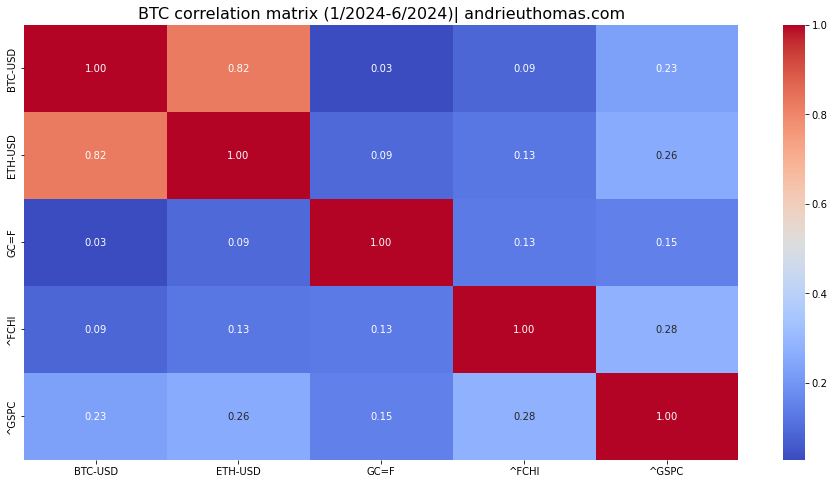
The matrix above thus shows the different correlation coefficients between assets. For example, bitcoin has been 23% correlated to the S&P 500 since January 2024. We thus see that the strongest correlation observed recently is that between bitcoin and ethereum. On the other hand, bitcoin does not seem to be correlated (neither positively nor negatively) with the evolution of gold or the CAC 40. We therefore propose to compare these correlations from a historical point of view, and to deduce the associated indications.
Correlation with the S&P 500
Bitcoin's correlation with major indices is an indicator in itself. Indeed, a high correlation between bitcoin and the S&P 500 will reflect investor behavior constrained by developments in the S&P 500. Such a market context may be due, as is generally the case, to the persistence of a bear market. Conversely, a bitcoin uncorrelated from the major indices will reflect a trajectory independent of that of the other indices. In such a case, a traditional portfolio manager could then be tempted to increase their position in bitcoin. Indeed, bitcoin would make it possible to obtain potentially significant performances with a fairly low marginal cost of risk (since it is uncorrelated).
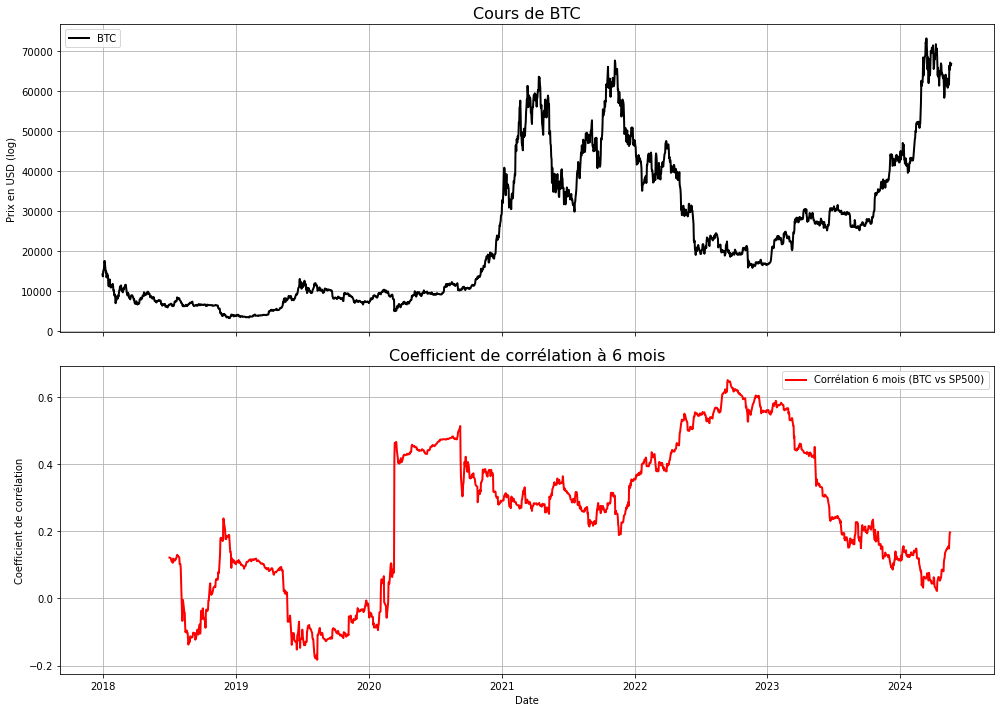
The chart above shows the price of bitcoin with the correlation coefficient over the last 6 months with the S&P 500. Since 2019, we have observed a clear symmetry between this correlation and the major peaks and troughs of bitcoin. Thus, in mid-2020 or the end of 2022, the 6-month correlation coefficient with the S&P 500 was at its maximum level while bitcoin was at major lows. Likewise, the correlation coefficient was at its minimum in mid-2019 and late 2021, which also corresponded to major highs.
Recently, the correlation coefficient reached a minimum close to 0%. This obviously signaled the risk of a major peak in the price of bitcoin. The summit remains fairly contained for the moment. Here we find the idea that the 2024 bull market has potentially lost some of its bullish potential (Has bitcoin (BTC) exhausted its bullish potential? – Tremplin.io).
Correlation with the price of gold
Studying the correlation between gold and bitcoin reveals another interesting behavioral characteristic. It is notable that the correlation between gold and bitcoin is at its highest at the start of bitcoin bull markets. Conversely, a zero or slightly negative correlation coefficient is generally accompanied by major bitcoin highs. So how can we explain this relationship?
Gold and bitcoin, contrary to many well-established beliefs, are two fundamentally very different assets (The fundamental differences between Gold and Bitcoin (BTC) – Tremplin.io). However, gold and bitcoin converge on certain characteristics.
“ Gold implies a passive concept of money (the parameters of the Gold market act on the currency independently of human will), while the bitcoin involves active design of moneyby humanly determining the parameters that set the currency. »
The fundamental differences between Gold and Bitcoin (BTC) – Tremplin.io
In this context, a close relationship between the evolution of the two assets tells us about the psychology of the market. A high correlation coefficient between the two assets will reflect the fact that investors are “looking” for bitcoin as much as gold. In this case, bitcoin appears more like a “safe haven” instrument. Conversely, a low correlation coefficient will, however, signal the speculative nature of bitcoin, outside any “safe haven” logic of the market. And thus, potential summits.
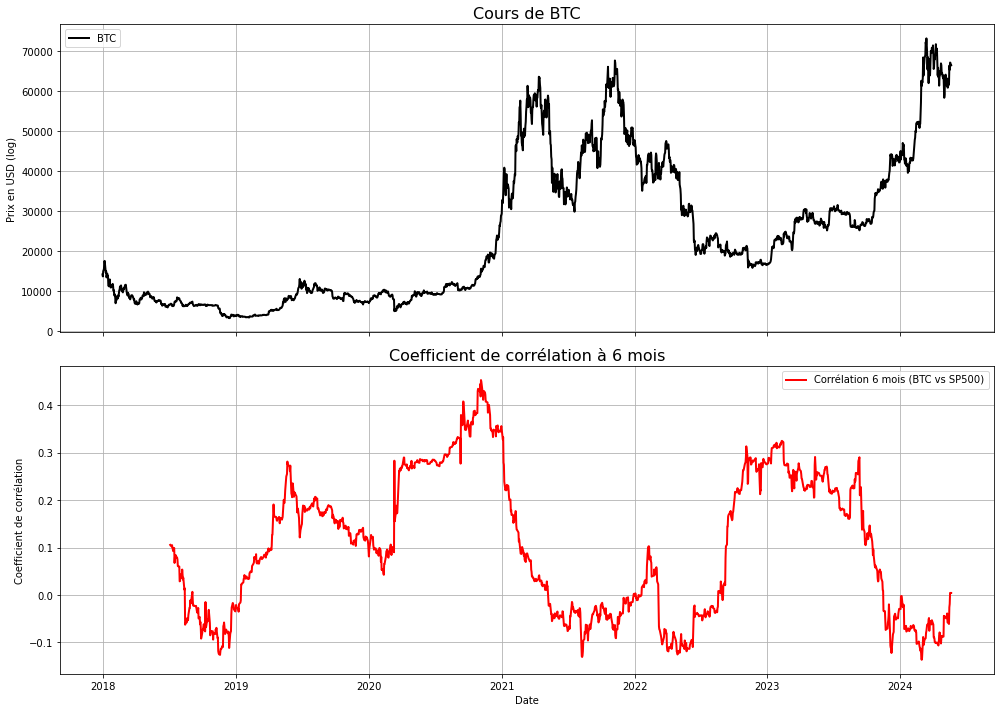
The correlation between gold and bitcoin was thus maximum at the start of 2023. With the bull market observed since 2023, the 6-month correlation of bitcoin with gold has collapsed. Again, this pattern is generally closer to that of a bull market ending.
Correlation with ETH
Let's continue our study with ethereum. We are still seeing the emergence of a behavioral configuration of bitcoin against the second largest cryptocurrency in the world. Indeed, it is often admitted that bitcoin drives bull markets, and that altcoins benefit from this movement subsequently.
We notice in our case that a high correlation coefficient between bitcoin and ethereum is conducive to translating major lows on bitcoin. Conversely, a weak correlation coefficient (prominent trough in the coefficient) is likely to reflect a sudden weakening of market strength, and major peaks. A major explanation would be that, during bull markets, the dependence of altcoins on bitcoin reduces.
Therefore, when bitcoin is completely uncorrelated from other cryptocurrencies, it can signal a bullish excess. Thus, this decorrelation can warn of the possible end of the bull market in the following 12 months. On the contrary, a maximum correlation coefficient will reflect symmetrical investor behavior across all cryptocurrencies. This type of configuration may be characteristic of general liquidation phenomena (and therefore of exhaustion of futures sellers). And with that, potential lows.
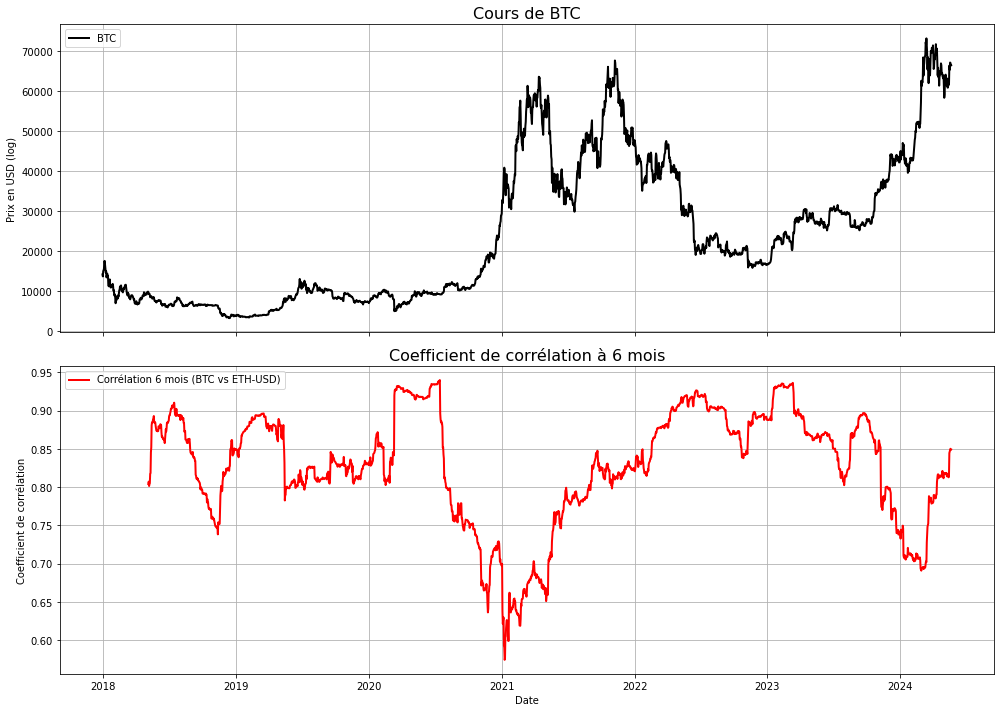
Recently, we observe a sharp decrease in the correlation between bitcoin and ethereum. This movement, without a rebound, would have signaled a risk of future exhaustion of the bull market. Since April 2024, the correlation between Bitcoin and Ethereum has nevertheless experienced a notable rebound. This could ideally reflect the continued bullish potential of bitcoin.
conclusion and perspectives
Ultimately, we have shown throughout this paper that:
- A high correlation between bitcoin and the S&P 500 generally reflected major lows. Conversely, a low correlation can be a negative signal.
- Bitcoin's correlation with gold was most notable at the start of the bull market. A low correlation between gold and bitcoin may reflect a certain market euphoria. This phenomenon then generally involves highs in the price of bitcoin.
- Bitcoin is generally highly correlated with Ethereum. However, during bitcoin's bullish excesses, ethereum can become more independent of the bitcoin price. This context often implies an exhaustion of the upward movement.
Therefore, the bull market built since early 2023 appears to respect the fundamental rules of intermarket relations. The correlation of bitcoin with most assets was highest in 2023. The subsequent bull market thus manifested itself in a sharp decrease in the correlation of bitcoin with the S&P 500 and gold, and to a lesser extent, with ethereum.
Considering the relationships described above, we therefore see that bitcoin has exhausted part of its bullish potential. The consolidation movement initiated in March 2024 has revived some potential for a rebound, but we see that bitcoin has become quite independent of the S&P 500 and gold. Historically, this signal calls for caution and the avoidance of impulsive decisions, although it does not in itself constitute a decision criterion. The evolution of the correlation of bitcoin with the major asset classes will therefore need to be closely monitored…
Maximize your Tremplin.io experience with our 'Read to Earn' program! For every article you read, earn points and access exclusive rewards. Sign up now and start earning benefits.
Click here to join 'Read to Earn' and turn your passion for crypto into rewards!


