
Fees generated on Ethereum reached $56.4 million in the 24 hours following the Binance hack on October 29, 2026. This is their highest level since April according to DefiLlama. On November 2, Lookonchain noted that an address prefixed 0x9EcA had purchased 27,553 ETH for $62.97 million, at $2,286 on average. The amounts paid by trading robots to block builders and validators are more than twice the transaction fees of Ethereum. Also, the crypto hacker paid his first ETH 16% above the market.

In brief
- Fees attributed to the Ethereum ecosystem reach $56.4M over 24 hours after Binance hack.
- MEV bots pay out 10,251 ETH to block builders in 4.5 hours.
- A crypto whale buys 27,553 ETH for $62.97M, according to Lookonchain.
- Coinbase Premium falls to -0.21, signaling relative weakness in US demand.
- The crypto exchange Binance reopens its withdrawals on November 1 after the hack of October 29.
What happened on Ethereum after the Binance hack?
Ethereum has generated $44.25 million in fees on the day of the Binance hack, then $56.4 million in the following 24 hours. According to DefiLlama, this is therefore the highest level since April.
Around $6.3 billion in customer assets were stolen on October 29, 2026. Nearly $3 billion was frozen onchain, according to Binance.
The haste of the crypto hacker explains a large part of the movement, without allowing every dollar of costs to be attributed to him. According to Bitquerya large part of the loot was in fact in stablecoins that their issuer could freeze. He therefore exchanged approximately $325 million for Ethereum in fifteen minutesbetween 8:34 p.m. and 8:49 p.m. UTC. Arbitrage bots spotted the price gaps created by these purchases and therefore paid to go first.
This game is called MEV, for maximum extractable value. It is based on a simple principle: a gain derived from the order of crypto transactions in a block. Between 8:30 p.m. UTC on October 29 and 1 a.m. UTC on the 30th, the robots paid 10,251 ETH in tips to block builders (compared to 4.6 ETH the previous night). This equates to more than 2,200 times more. Bitquery crypto analyst Gaurav Agarwal summarizes the mechanics as follows:
The only way to double the line was to pay more.
Gaurav Agarwal, Bitquery Research, on-chain survey, October 30, 2026
The block builders therefore only kept around 564 ETH of the set received. The rest was sent to Ethereum validators.
Are Ethereum fees really at their highest of the year?
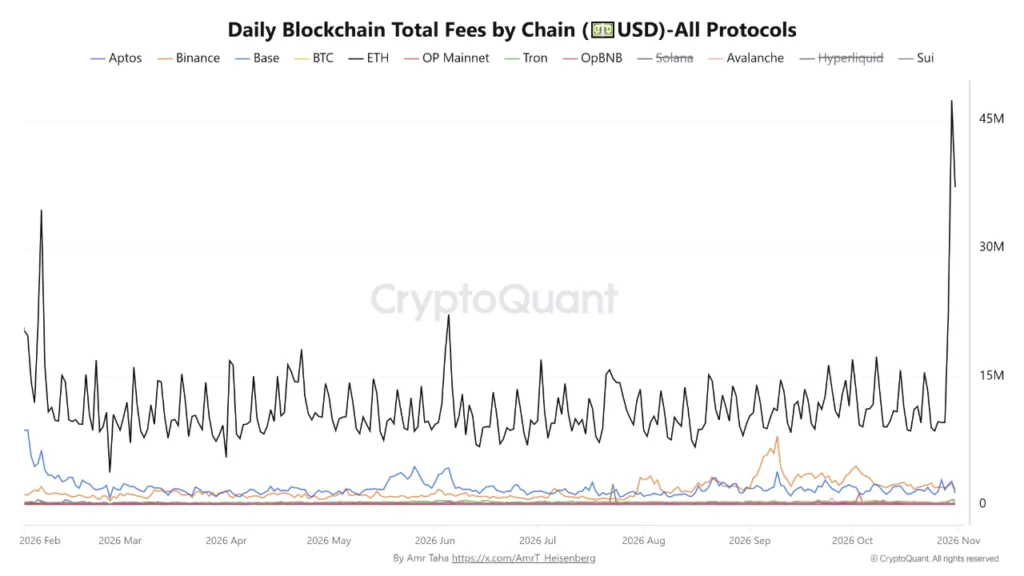
DefiLlama is talking about the highest level since April. Which assumes that April did as well, if not better. In data reported on November 2, CryptoQuant poster $47.3 million in fees on October 30. That’s 37.1% more than February’s $34.5 million. Enough to evoke a high of 2026!
However, these two series do not measure the same thing, nor on the same window. A high of the year and a high since April cannot describe the same indicator.
| Source | What is counted | Amount | Period |
| ChallengeLlama | Ethereum ecosystem fees | $44.25 million | October 29, 2026 |
| ChallengeLlama | Ethereum ecosystem fees | $56.4 million | Next 24 hours |
| ChallengeLlama | Ethereum Transaction Fees | $10.86 million | 24 hours, October 30 |
| ChallengeLlama | Titan Builder (block builder) | $24.67 million | 24 hours, October 30 |
| CryptoQuant (reported) | Ethereum Daily Fees | $47.3 million | October 30 |
| Bitquery | Amounts paid by robots to manufacturers and validators | $29.5 million | 8:30 p.m. UTC on the 29th to 1 a.m. UTC on the 30th |
That’s not all! The detail matters as much as the total. DefiLlama awards $24.67 million to Titan Buildera block builder (compared to $10.86 million in transaction fees from Ethereum itself). The $29.5 million paid by the robots to builders and validators, according to Bitquery, therefore weighs more than twice these base fees.
Decryption: at this stage, these fees mainly reflect the rivalry between crypto robots.
Who benefited from the crypto hacker’s ETH purchases?
According to Bitquery, the crypto hacker lost $119 million against market prices by converting his loot in a hurry (including $71.5 million for Ethereum alone). Crypto traders and their robots kept $59.9 million after fees, and block builders and validators $29.5 million.
On its first orders placed via UniswapX and 1inch Fusion, the crypto hacker received 122,316 ETH at $2,657 apiecewhen the market was trading at $2,284. A pool, a reserve of two assets managed by code where the price depends on their proportion, has worsened the gap. In Uniswap’s main WETH/USDT pool, Ethereum traded as much as 38% above the market as of 9:09 p.m. UTC.
Does buying 27,553 ETH change the demand reading?
Not by him alone. According to Lookonchain, the address 0x9EcA has spent $62.97 million to acquire 27,553 ETH in five hoursat $2,286 on average. An initial tranche of 16,658 ETH, paid for $37.96 million in USDC at an average of $2,279, was recorded over two hours, and the buyer continued to accumulate at the time of the statement.
The connection with the pirate is therefore clear. At $2,286, the buyer has paid Ethereum 14% less than the crypto hacker on its UniswapX and 1inch ($2,657) orders on different dates. The additional cost of $71.5 million incurred by the hacker on Ethereum even exceeds the $62.97 million spent by the crypto whale for its entire purchase.
| Buyer | Window | ETH acquired | Average price | Spent |
| Attacker (UniswapX and 1inch Fusion) | October 29, 8:34 p.m. – 8:49 p.m. UTC | 122,316 | $2,657 | $325 million |
| Market (Hyperliquid, Bitquery reference) | same window | not applicable | $2,284 | not applicable |
| Address 0x9EcA, first slice | 2 hours, taken from November 1st and 2nd | 16,658 | $2,279 | $37.96 million |
| Address 0x9EcA, accumulation | 5 a.m., statement of November 2 | 27,553 | $2,286 | $62.97 million |
The counterweight comes mainly from the United States. The Coinbase Premium, which compares the price of ETH on Coinbase and Binance, fell to -0.21 on October 29 (its lowest since February) before rising towards -0.13. A negative index signals a cheaper Ethereum on Coinbasetherefore weaker American demand.
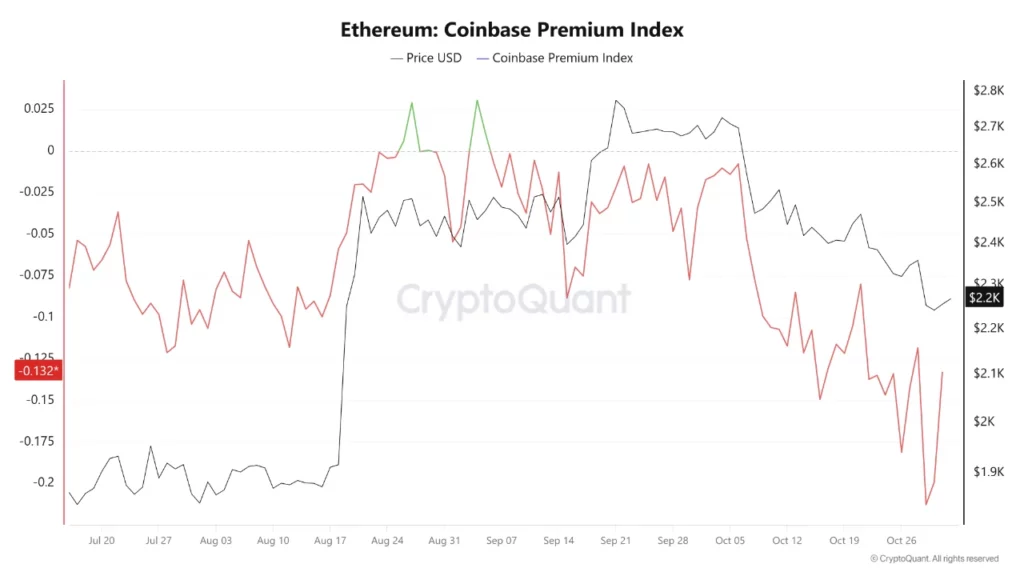
Binance nevertheless reactivated its withdrawals on November 1, with $3.64 billion in net outflows between 6 a.m. and 3:30 p.m. UTC. This represents 2.1% of its $171 billion in assets. The crypto exchange also claims to have covered 95% of the $6.3 billion stolen. For Ethereum, two benchmarks will tell whether this week was an accident or a habit: a Coinbase Premium returned above zero, which would mark the return of the American appetite for risky assets, and daily fees returned to their level before October 29.
Maximize your Tremplin.io experience with our ‘Read to Earn’ program! For every article you read, earn points and access exclusive rewards. Sign up now and start earning benefits.