

Faced with the economic slowdown and international trade tensions, the Chinese government is deploying an ambitious strategy to stimulate its domestic demand. The Council of State Affairs has just launched a “special action plan” aimed at revitalizing national consumption, considered the new growth engine to reach the objective of 5% in 2025.
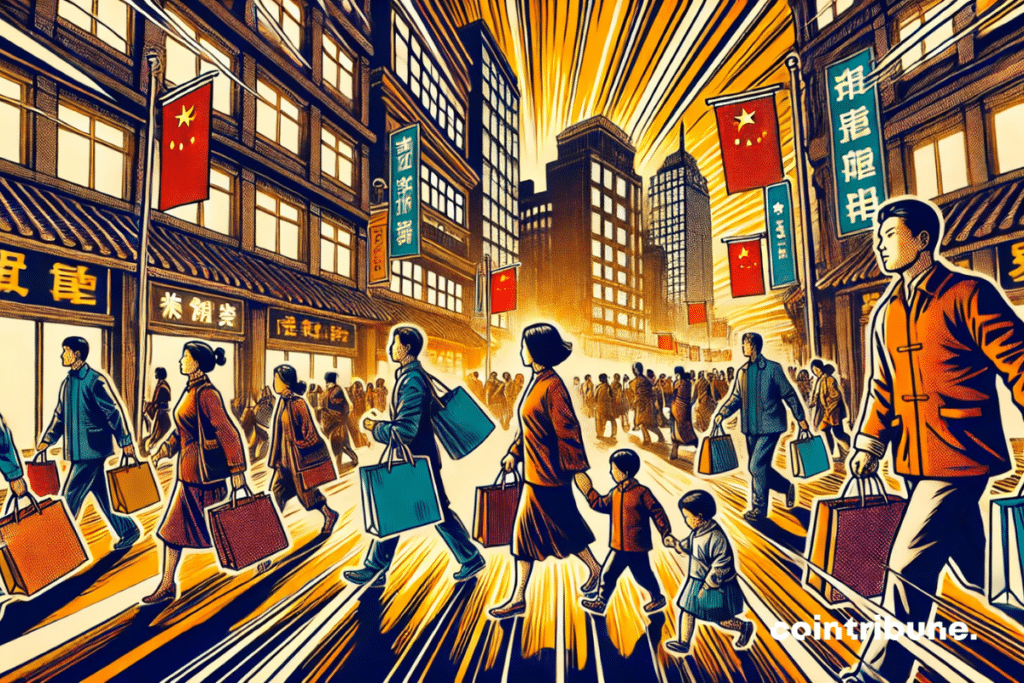
To boost its growth, Beijing stimulates domestic demand
The Chinese State Council presented a major plan at the end of February to revitalize its domestic consumption. This program, much more ambitious than previous measures, aims to “support consumption vigorously and expand domestic demand in all directions”, according to the official press release.
Beijing intends to increase the income of urban and rural populations substantially, while reforming the housing sector to improve the financial resources of farmers.
Unlike previous temporary measures, such as the 20 billion euros of coupons distributed last summer for the automotive market and household appliances, this plan attacks economic fundamentals.
What changes compared to previous plans is the structural aspect of recovery measures. We are no longer talking about simple temporary subsidies, but a lasting increase in wages.
Ariel Ying Wang, Actions manager at Gemway AM.
THE plan Also provides for a significant social component, with an increase in retirement pensions, the potential creation of a subsidized child care system, and a strengthening of the legal protection of rights to rest and the vacation of workers. Financial institutions will also be encouraged to soften the conditions for granting consumer loans.
A strategic response to American and European pressures
This strategic reorientation comes in a context of strong trade tensions with the West, following the entry into force of the new Trump taxes, which pushed Canada and China to launch the response. Since his return to the White House in January, Donald Trump has imposed an additional 20 % tax on all Chinese products, as well as an additional customs right of 25 % on imports of steel and aluminum. These measures have already affected Chinese exports, which only increased by 2.3 % in January-February 2025, well below the 4.5 % anticipated by analysts.
The European Union is not to be outdone, having imposed significant customs duties on electric vehicles imported from China, directly impacting manufacturers like Cupra, a subsidiary of Volkswagen. Wayne Griffiths, CEO of Seat and Cupra, also denounced these taxes which, according to him, “” penalize the automotive industry instead of protecting it ».
Faced with these threats weighing on its economic model traditionally driven by exports (which had reached a record of 3,400 billion euros in 2024), Beijing has no choice but to turn to its domestic market.
In parallel, the Banque Populaire de China launched a medium -term loan operation of 300 billion yuan (approximately 41.83 billion dollars) to support the banking system and maintain favorable liquidity conditions.
“The resumption of domestic consumption could counterbalance a possible drop in exports to reach the 5% growth targeted in 2025”anticipates Ariel Ying Wang. A daring bet, but necessary for the Chinese economy in the face of the opposite winds of global geopolitics.
Maximize your Cointribne experience with our 'Read to Earn' program! For each article you read, earn points and access exclusive rewards. Sign up now and start accumulating advantages.


