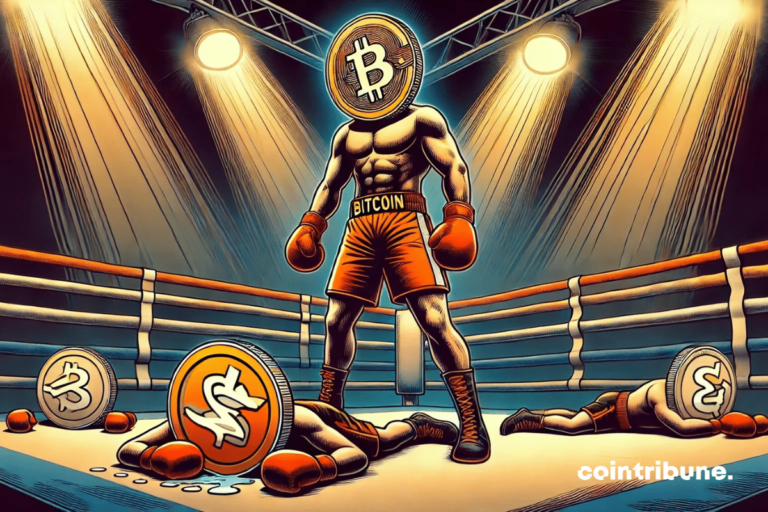
On November 26, 1998, Wei Dai, a computer scientist and cryptographer, published an essay entitled “B-Money: An Anonymous and Distributed Electronic Cash System” on a Cypherpunk mailing list. This document described the foundations of a peer-to-peer payment system based on cryptography, laying the foundations for what would become Bitcoin 10 years later.
25 years ago, Wei Dai laid the foundations for Bitcoin
Just 25 years ago, on November 26, 1998, computer scientist and cryptographer Wei Dai published an article titled “B-Money: An Anonymous and Decentralized Electronic Monetary System”
The whole idea of b-money was to use computing power as proof of work to create currency. Participants would create value by solving cryptographic problems, and this value could then be exchanged through anonymous transactions based on digital signatures.
Wei Dai also proposed decentralized governance and voting mechanisms to make decisions about the rules of the system. His visionary concepts thus laid the foundations for a self-managed electronic currency, without requiring a central authority.
However, although revolutionary, the B-Money system imagined by Wei Dai never went beyond the theoretical stage. It would be a decade before someone took up and brought his concepts to fruition.
Bitcoin: The Fulfillment of a B-Money Vision
With Bitcoin, the decentralizing vision outlined in b-money would finally become reality. Where Wei Dai’s project was only sketched out, Bitcoin provided concrete solutions to the problems of double spending or sybil attacks. Above all, its blockchain technology offered a secure and transparent mechanism for recording transaction history.
In fact, B-Money has profoundly influenced the technical and philosophical conception of Bitcoin:
- Decentralized control through a peer-to-peer network
- Transaction validation via distributed consensus
- User anonymity
- Absence of central authority or single issuer
- Money creation based on proof of work
It is therefore no exaggeration to say that without the visionary work of Wei Dai, there would probably have been no Bitcoin, at least not in its current form. Dai’s ideas thus fertilized the ground for the advent of the most famous cryptocurrency in 2008.
Is Wei Dai Satoshi Nakamoto?
The identity of Satoshi Nakamoto has sparked much speculation. Faced with this mystery, some have delved into the past of key figures from the beginnings of Bitcoin to find clues. Thus, Wei Dai was the subject of suspicion, being one of the few informed by Satoshi during the first months.
Yet despite his conceptual influence on Bitcoin, there is no indication that Dai and Nakamoto are one and the same. Dai also said that Satoshi had reinvented the notions of B-Money before discovering his work.
Regardless, the real Satoshi Nakamoto remains unidentified to this day, and his founding innovation continues to flourish. Bitcoin is therefore following its path, paved with the seminal ideas of B-Money, 25 years ago.
Beyond Bitcoin, thousands of cryptos have emerged, introducing real competition in monetary issuance. The 2020-2022 pandemic also revealed the limitations of a centralized financial system, increasing public interest in decentralized cryptocurrencies.
These offer not only a savings alternative, but also the prospect of a more democratic and transparent future for global finance. Certainly, the market is experiencing turbulence, nevertheless the movement initiated by Wei Dai’s vision of an emancipatory and decentralized digital world is not weakening. This is probably just the beginning…
Maximize your Tremplin.io experience with our ‘Read to Earn’ program! For every article you read, earn points and access exclusive rewards. Sign up now and start earning benefits.