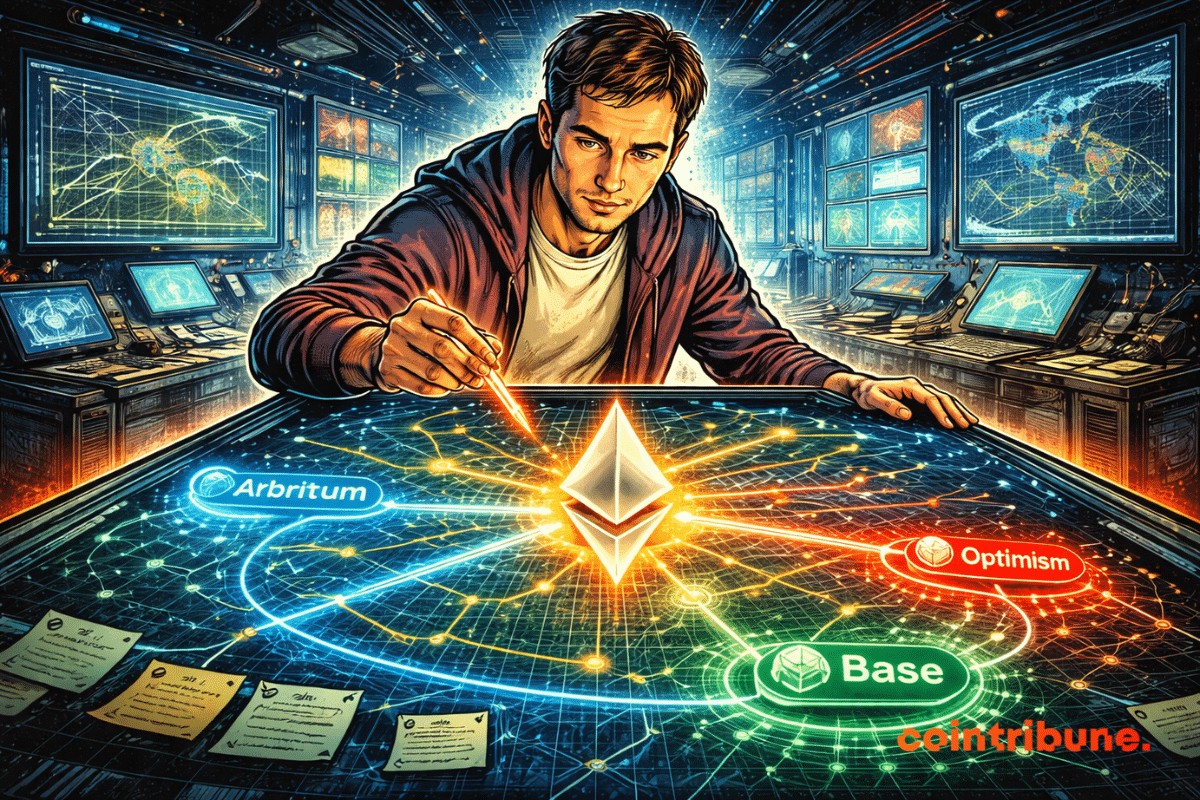
In recent months, Vitalik Buterin keeps returning to a subject that haunts him: Layer 2 (L2). Despite Ethereum's recent technical successes and its convincing updates, the network's co-founder believes that the mission of L2 must evolve. For him, the simple idea of “scaling” is no longer sufficient. He now calls for a profound overhaul: making L2s specialized environments, and not cheap copies of Ethereum.
In brief
- Vitalik Buterin believes that L2s must go beyond the role of a simple scalability engine.
- Karl Floersch criticizes the one-week delays for withdrawals from Ethereum to L2.
- Steven Goldfeder defends Arbitrum as an engine for transactions exceeding 1,000 tps compared to 40 on Ethereum.
- Jesse Pollak says Base wants to innovate while strengthening the overall Ethereum ecosystem.
Vitalik Buterin signals the end of “all-scaling”
Vitalik Buterin surprised the crypto community with a series of posts published on X. He declared that the initial vision of L2 no longer holds. According to him, the scalability of the Ethereum main network is progressing rapidly: increase in gas limitlower fees, and future integration of ZK-EVM proofs.
L2s, designed as performance engines, are struggling to keep up: dependence on multisignature bridges, slowness towards Stage 2, and incomplete security. Buterin therefore calls for specialization: rollups should explore other avenues — AI, confidentiality, institutional finance, or blockchain games.
In a clear message, Jesse Pollak sums up :
In the future, L2s can no longer just be “cheap Ethereum”. That's why, since the launch of Base, we've been committed every day to welcoming new users, developers and applications, to advancing technology, and to doing it symbiotically, to grow the entire ecosystem.
This change in tone reveals a transition: Ethereum no longer seeks to absorb everything, but to become a unifying ecosystem, where each L2 assumes its own identity while strengthening the coherence of the network.
Optimism, Arbitrum and Base: chain reactions in the crypto-sphere
Buterin's publication triggered an avalanche of responses among the major players in the crypto market.
At Optimism Foundation, Karl Floersch was enthusiastic, but lucid:
The default withdrawal time from Ethereum is one week! This is insane and must become a priority. We need to bring it back to an hour… or even ten minutes!
For his part, Steven Goldfeder, co-founder of Offchain Labs, published a dense thread : for him, scaling remains essential. He recalls that Arbitrum and Base have already exceeded 1,000 transactions per second when Ethereum peaked at 40.
Goldfeder warns: if Ethereum proves “hostile” to L2s, some companies could choose to create their own independent Layer 1s. A scenario that would cause Ethereum to lose its status as the backbone of web 3.
Finally, Jesse Pollak (Base) welcomes a “win-win” development: more power for Ethereum, more space for innovation for L2s.
Ethereum: between unity and divergence in the crypto race
Beyond technical exchanges, it is the philosophy of Ethereum that is being redesigned. Layer 1 gains power, while L2 becomes innovation laboratories.
Vitalik wants to establish a new bond of trust via the future “native rollup precompile”, a functionality intended to make ZK-EVM proof checks more secure and automated.
But the debate reveals a tension: how to preserve the unity of the ecosystem while promoting diversity? Goldfeder summarizes: Arbitrum is not Ethereum, but its closest ally.
For crypto investors, this phase feels like a maturity test. If L2s emancipate themselves without cutting themselves off from the main network, Ethereum could become the most modular system in the sector.
Otherwise, fragmentation threatens. The risk: seeing competing blocks emerge, each playing its own part of web 3.
Some key benchmarks on Ethereum and its L2s
- Current price of ETH: $2,080 on crypto markets;
- Recent transactions: up to 1,000 tps on Arbitrum and Base, compared to 40 tps on L1;
- Technical challenge: Stage 2 proofs still unsecured for major bridges;
- Outlook: increase in gas limit planned by the end of 2026;
- Crypto trend: L2s capture nearly 60% of decentralized application traffic.
Vitalik Buterin is already looking further ahead. While the question of L2s agitates the community, it is now alerting to another threat: quantum computing. According to him, this technology could endanger Ethereum's cryptographic keys before 2028. A new battle is looming, much more radical than that of “scaling”.
Maximize your Tremplin.io experience with our 'Read to Earn' program! For every article you read, earn points and access exclusive rewards. Sign up now and start earning benefits.