
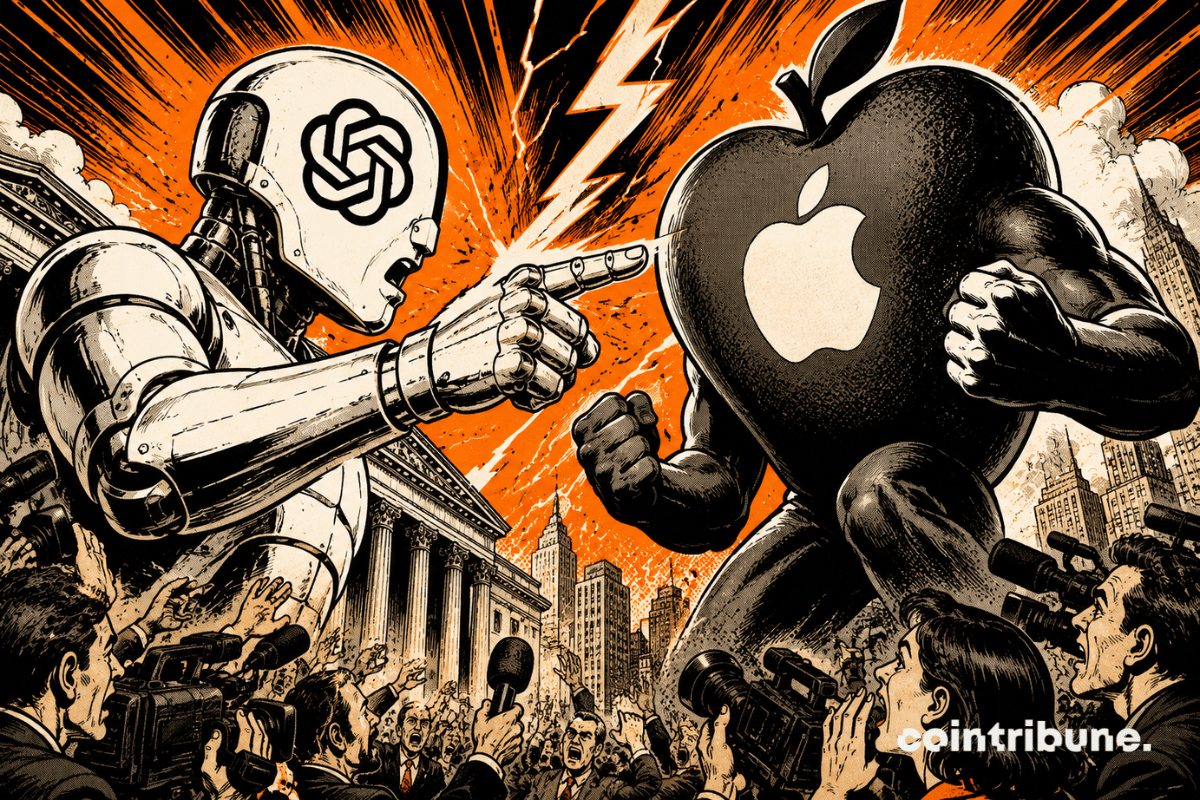
OpenAI has published emails and messages from former Apple employees to contest a business secret complaint filed in July 2026. Sam Altman’s company accuses the Californian group of having presented inaccurate facts before taking legal action.
In brief
- OpenAI releases a detailed response to Apple’s complaint and posts private discussions online to support its version.
- Apple accuses OpenAI, two former executives and io Products of misappropriating secrets related to its hardware projects.
- OpenAI claims that Apple employees continued to solicit a former engineer after his departure.
OpenAI turns legal proceedings into public battle
The dispute concerns OpenAI’s hardware strategy, which accelerated after the 2025 acquisition of Jony Ive’s start-up. This offensive is part of the race for artificial intelligence and now pushes the company to publicly defend its recruitment and data protection methods.
In a post published by OpenAI, the company accuses Apple of having confused two employees with similar names. She also criticizes him for having asserted, wrongly according to her, that his teams had not responded to requests and that Apple’s lawyers had communicated with Che Chang, the legal director of OpenAI, before filing the complaint.
OpenAI accompanies this response with emails, text messages and a detailed argument. The choice to publish these elements moves the debate out of court, while the two groups are already vying for a place in future AI-enabled consumer devices.
“ Apple is among the greatest companies of all time and has built a reputation for obsessive attention to the smallest details. This careless, aggressive and strangely personal complaint unfortunately does not live up to that reputation », writes OpenAI in its response.
Apple accuses two former employees of having retained sensitive information
Apple accuses OpenAI, former engineer Chang Liu, former design manager Tang Tan and io Products of using trade secrets linked to its equipment. The complaint links these accusations to the development of OpenAI’s hardware products after the startup was acquired from Jony Ive in 2025.
Apple says Chang Liu kept a work computer after he left. The company also accuses him of having exploited an authentication flaw to access internal systems and download confidential engineering documents.
The complaint also targets Tang Tan. Apple maintains that the former executive used confidential information to serve OpenAI’s hardware projects. She also believes that the company’s recruitment process may have encouraged candidates to bring sensitive documents.
In the Decrypt article devoted to Apple’s complaintOpenAI disputes each of these claims. The company claims in particular that Apple contacted the wrong person after mixing two employees with similar names. This error, according to OpenAI, weakens the group’s reading of the exchanges between former employees and the company.
iMessage messages at the heart of OpenAI’s defense
OpenAI published exchanges between Chang Liu and Apple employees after his departure in January. These conversations show, according to the company, that employees asked it to find files, transfer documents or answer technical questions.
OpenAI relies on these requests to support a specific thesis. Apple employees would have continued to rely on Liu’s access, while the accesses still active would have resulted from the departure process put in place by Apple, and not from a deliberate desire to keep information confidential.
The company singles out Tang Tan’s case. She claims to have reminded the former executive on several occasions that he should neither bring nor use confidential data from his previous employer. OpenAI therefore considers Apple’s request for a preliminary injunction unnecessary, as this measure could limit its activities during the proceedings.
“ Apple’s request for a preliminary injunction is based on false information and is completely unnecessary because we don’t own any of their trade secrets and we don’t want them. », writes OpenAI.
We are more interested in creating innovative products and technologies that push the boundaries.
In short, OpenAI is trying to regain the initiative thanks to three levers: the publication of private messages, the contestation of factual errors and the defense of its hardware project. Apple will now have to respond in the legal field, while the battle is part of the transformations linked to AI which are already reshaping the technology industry. The procedure has only just begun.
Maximize your Tremplin.io experience with our ‘Read to Earn’ program! For every article you read, earn points and access exclusive rewards. Sign up now and start earning benefits.


