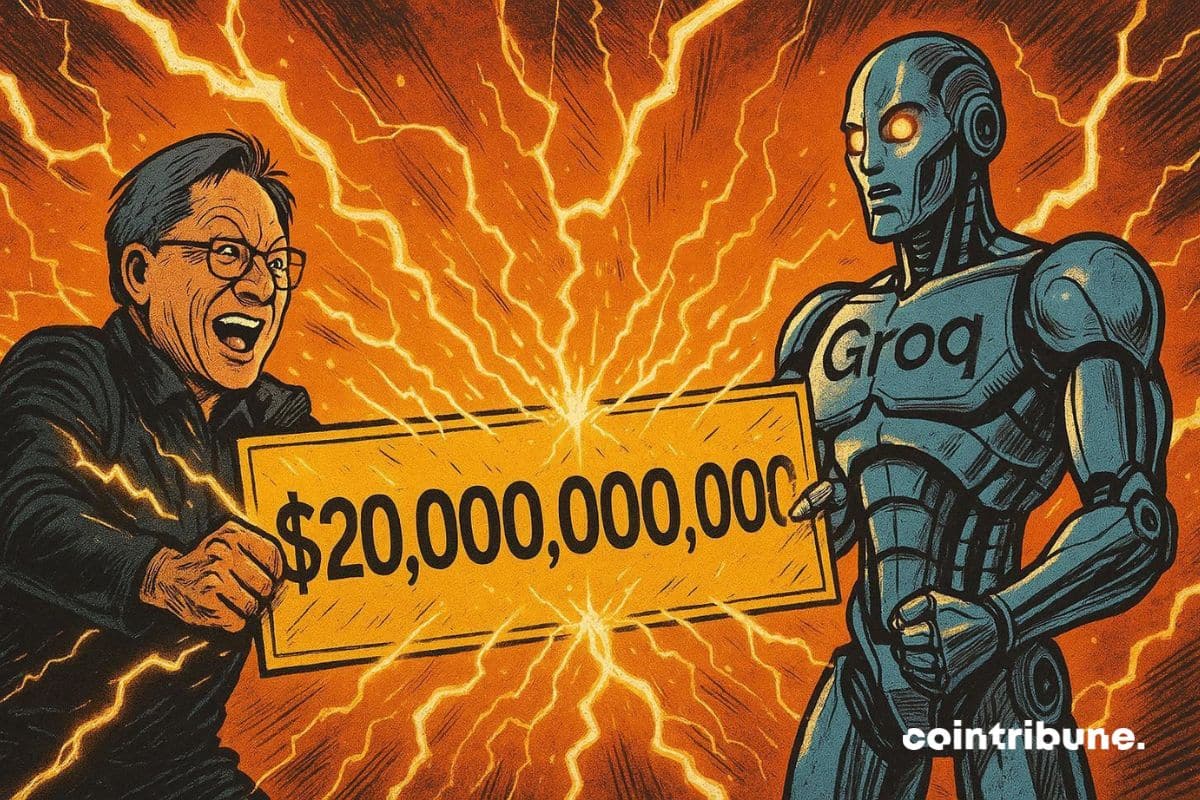
Nvidia has just struck a major blow by acquiring the assets of Groq for $20 billion. This agreement, which strengthens its dominance in the artificial intelligence (AI) chip market, could also shake up the crypto ecosystem. Deciphering the technological and financial issues and opportunities that emerge from this historic transaction.
In brief
- Nvidia acquires Groq assets for $20 billion, to strengthen its dominance in AI.
- Groq's LPU chips, 10 times faster and more energy efficient than traditional GPUs, will boost the performance of artificial intelligence infrastructures.
- Nvidia's acquisition of Groq could boost cryptos like Render (RNDR), dependent on Nvidia GPUs for decentralized computing.
AI: Nvidia seals $20 billion deal with Groq
A few months after reaching $4,000 billion in capitalization, Nvidia formalizes a $20 billion agreement to acquire the assets of Groq, a startup specializing in AI accelerators. While not a full buyout, this transaction allows Nvidia to take ownership of Groq's patents and LPU technology, as well as the company's key talent, including its CEO, Jonathan Ross. GroqCloud, the cloud arm of Groq, will continue to operate independently. But, Nvidia is now integrating revolutionary technology into its portfolio.
This agreement represents almost three times the valuation of Groq in September 2025, which stood at $6.9 billion after a fundraising of $750 million. Groq's investors include giants like BlackRock, Samsung and Cisco, which are making exceptional capital gains. For Nvidia, this acquisition of Groq is the most important in its history, with a clear objective, to strengthen its position in the artificial intelligence chip market.
Groq-Nvidia, why is this agreement a game changer for AI?
Groq became known for its LPU chips, which promise ten times better performance than traditional GPUs, while consuming ten times less energy. Developed by former Google engineers, this technology represented a serious threat to Nvidia, the historic leader in AI accelerators. With this agreement, Nvidia neutralizes this competition and consolidates its monopoly, already estimated at more than 80% in certain market segments.
Analysts agree that Nvidia isn't just dominating the market: it's looking to crush it. By integrating Groq LPUs, Nvidia can offer even more efficient solutions for data centers and language models, meeting growing demand for computing power. However, this transaction could attract the attention of regulators, after Nvidia's acquisition of Arm failed in 2022 for antitrust reasons.
Render (RNDR): the crypto that could benefit from the Nvidia-Groq agreement
Render (RNDR) is a decentralized 3D rendering and artificial intelligence platform that relies on GPUs to provide computing power. As a result, Nvidia, a key partner of Render, sees its GPUs widely used by network nodes. The deal with Groq could accelerate the development of even higher-performance chips, which would directly benefit projects like Render.
Historically, RNDR has already experienced significant increases during major technological announcements, such as its partnership with Nvidia in 2024, which caused its price to jump 60%. Therefore, Analysts estimate that RNDR could gain between 20% and 40% if Nvidia confirms increased use of its GPUs in AI projects post-acquisition.
The agreement between Nvidia and Groq marks a turning point in the race for artificial intelligence chips. For Nvidia, this is one more step towards a technological monopoly. For cryptos like Render, this is an opportunity to grow in a growing ecosystem. However, how far will Nvidia's dominance go, and what will the consequences be for smaller players?
Maximize your Tremplin.io experience with our 'Read to Earn' program! For every article you read, earn points and access exclusive rewards. Sign up now and start earning benefits.