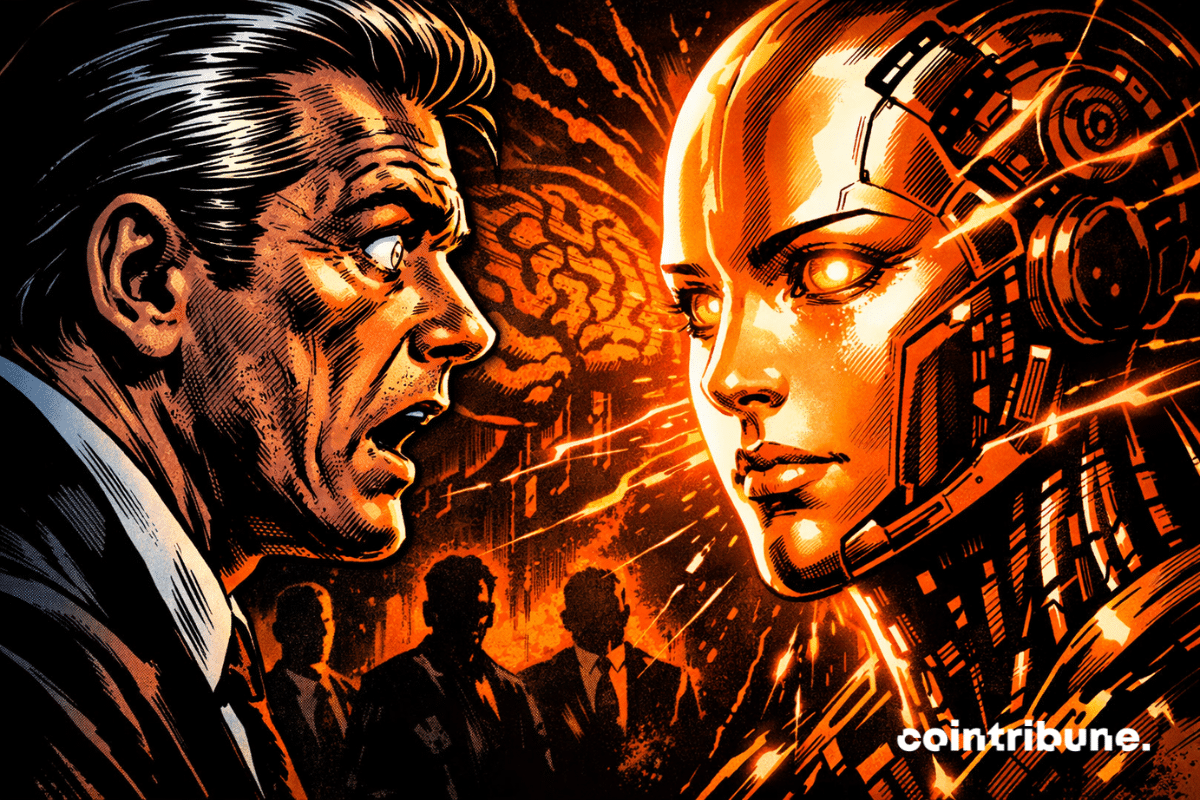
Rapid advances in artificial intelligence are forcing governments and institutions to face a much shorter path to human-level systems than previously anticipated. Industry leaders now say the gap between today's tools and artificial general intelligence is rapidly narrowing. As development accelerates, concerns about jobs, governance and economic stability are becoming central to the debate.
In brief
- AI leaders warn that human-level systems may arrive within a few years, leaving governments and labor markets unprepared.
- Self-improving AI accelerates development as engineers move from writing code to overseeing AI-generated results.
- DeepMind's Demis Hassabis puts the chance of AGI by 2030 at 50%, citing limits in creativity and scientific discovery.
- White-collar jobs face restructuring and loss of autonomy as the pressure for automation overtakes manufacturing.
Amodei says human-level AI could arrive in years, not decades
At the World Economic Forum in Davos, Anthropic CEO Dario Amodei warned that policymakers may not be ready for the speed at which advanced AI is approaching. Appearing alongside Google DeepMind CEO Demis Hassabis, Amodei argued that social systems and labor markets are unlikely to adapt at the same pace as technical progress. According to him, preparation time is decreasing rather than increasing.
Amodei reiterated his belief that human-level AI is probably only a few years old. He said his earlier projections remain valid and progress continues on a steep curve. By his estimation, superhuman abilities could arrive as early as 2026 or 2027. In his words, it's difficult to see how development could extend much beyond that time frame.
Much of this speed comes from AI systems increasingly assisting their own development. At Anthropic, Amodei said, software engineers are already moving from writing code to overseeing the results generated by AI. Engineers now spend more time reviewing and fixing code than producing it from scratch. Within six to 12 months, he suggested, AI models could handle most coding tasks end-to-end.
Several forces push this cycle forward:
- AI models now generate large portions of production-grade code.
- Engineers act primarily as reviewers rather than lead authors.
- Training improvements directly feed into faster model updates.
- Hardware limitations hamper speed more than search capability.
- Shorter development cycles compress adoption times.
Demis Hassabis of DeepMind estimates 50% chance of AGI by 2030
While acknowledging significant progress, Hassabis argued that not all fields are equally suited to automation. Industries like coding and math are easier targets because results can be quickly verified. Other disciplines, notably the natural sciences, rely on experiments that require time and resources.
Scientific discovery, he said, remains a major obstacle. Current systems can solve well-defined problems but struggle to generate new questions or theories. Producing original hypotheses, he believes, represents one of the highest levels of human creativity. AI has yet to demonstrate reliable capability in this area, and it remains unclear when — or if — this gap will close.
Due to these limitations, Hassabis reasoned that the chances of reaching AGI by 2030 are about fifty percent. He pointed to the difference between rapid calculation and real innovation as a key uncertainty. Still, both leaders agreed that economic disruption is no longer a distant concern.
White-collar jobs are increasingly exposed. Amodei has previously estimated that up to half of entry-level professional jobs could disappear within five years, and at Davos he confirmed that figure. Office work, once considered sheltered, now faces automation pressures similar to those that transformed manufacturing decades earlier.
Hassabis warned that even conservative economic forecasts can underestimate the speed of change. Five to 10 years, he said, is not a long time for companies to adapt. Institutions designed for slower transitions may struggle to respond if employment structures change suddenly.
AI is eroding workplace autonomy long before mass layoffs begin
For Amodei, the challenge extended beyond engineering to a crisis of coordination. He said governments should focus most of their attention on managing the transition. Although the risks linked to misuse and geopolitical tensions remain manageable, the margin for error is narrowing.
The main political pressures emerging from the debate include:
- Changes in work happening faster than current reskilling systems can handle.
- Regulatory gaps surrounding powerful general-purpose models.
- Growing inequality due to the automation of skilled labor.
- The concentration of AI capabilities among a small number of major players.
- Limited global coordination on safety standards.
Some labor analysts say disruption could come through restructuring jobs rather than outright replacing them. Bob Hutchins, CEO of Human Voice Media, said job roles are being broken down into smaller, more closely monitored tasks. Algorithms are increasingly managing workflows once controlled by individual workers.
According to Hutchins, this change changes the way work feels and functions. Creative and technical roles are moving from decision-making positions to auditing roles. Workers control outcomes rather than shaping projects. Over time, this process can strip jobs of autonomy and reduce wages, even if titles remain unchanged.
Rather than wondering whether machines will replace people, Hutchins felt the focus should turn to how the quality of work is being changed. As tasks fragment and supervision increases, professional identity itself may fade. Governments and employers now face a challenge that goes beyond preserving jobs to include preserving meaningful work as AI's capabilities continue to expand.
Maximize your Tremplin.io experience with our 'Read to Earn' program! For every article you read, earn points and access exclusive rewards. Sign up now and start earning benefits.