
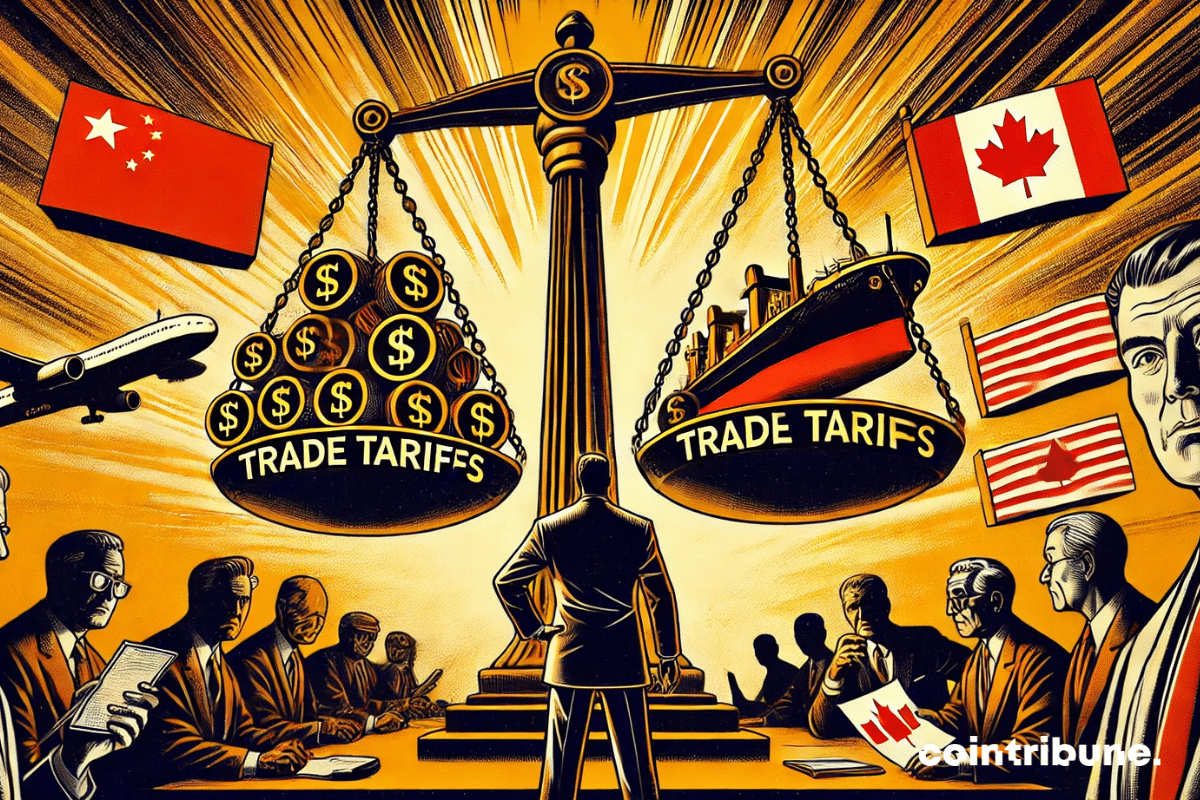
The United States revives trade tensions with its main economic partners. Donald Trump has just announced new massive taxes on imports from Canada, Mexico and China, and revives an aggressive protectionist policy. Presented as a response to the fight against fentanyl traffic and illegal immigration, this decision is integrated especially in a broader strategy which aims to renegotiate North American trade agreements and to protect American industry in the face of competition Chinese. This escalation immediately caused a virulent reaction to the targeted countries, which are already preparing retaliatory measures, which suggests a new economic showdown with still uncertain consequences.
Trump imposes massive customs taxes and justifies security action
The White House has formalized a new salvo of commercial sanctions against Canada, Mexico and China. As of February 4, Canadian and Mexican imports will be struck by customs duties by 25 %, while Chinese products will see their taxes increased by 10 % additional. According to the Trump administration, this decision responds to two major threats: the fentanyl crisis and illegal immigration.
In a press release, Karoline Leavitt, spokesperson for the White House, clarified The motivations of the American president: “The president will impose tomorrow 25 % customs duties in Mexico, 25 % on Canada and 10 % on China for the illegal fentanyl they produce and which they allow distribution in our country ». Washington accuses China of exporting chemical precursors used in the manufacture of fentanyl, Mexican cartels to organize production and Canada of not controlling its cross -border flows.
The announcement immediately caused a diplomatic outcry. Indeed, Mexico reacted strongly by the voice of its president, Claudia Sheinbaum, who denounced “slander” and rejected any collusion between her government and the cartels. Canada, for its part, expressed its dissatisfaction through its Prime Minister, Justin Trudeau, who recalled the historical and strategic ties that unite the two countries. As for China, Beijing has adopted a more measured, but firm tone. She claims that she “firmly opposed” to these new taxes and that she studied proportionate retaliatory measures.
In a few hours, this decision transformed a commercial dispute into an international showdown, which opens the way to reprisals whose magnitude still remains to be determined.
Canada, Mexico and China retaliate and threaten the American economy
Faced with this commercial offensive, targeted countries immediately retaliated, which triggers a real economic showdown. Canada has reacted and imposed customs taxes on several American products, including fruit juices, furniture, shoes and sports equipment, for a total amount of 102 billion euros. Justin Trudeau, in an official statement, justified this decision and said it was necessary to protect the Canadian economy. He also urged his fellow citizens to favor local products, and calls for national solidarity in the face of trade tensions with the United States.
On the side of Mexico, the posture quickly evolved. While the government of Claudia Sheinbaum first tried to maintain an open dialogue, the Mexican president finally opted for a firmer response. She has ordered The immediate application of new customs tariffs on American imports, and indicates that other reprisal measures would follow. In an offensive statement, she also returned the accusations of Donald Trump, and said that the United States is facilitating drug trafficking through the sale of cartels. According to her, Washington should focus on reducing fentanyl consumption on its own territory, rather than looking for scapegoats abroad.
China, on the other hand, reacted with caution, but firmness. Beijing denounced a trade war without winner, and believes that these customs sanctions would only worsen international tensions. Indeed, the Chinese government warned that it was considering targeted retaliatory measures, especially in the strategic sectors of electronics and automotive. In parallel, the Chinese authorities have announced that an official complaint against Washington would be filed with the World Trade Organization (WTO), in order to challenge the legality of these new taxes.
With these chain reactions, economic tensions between the United States and its main business partners are intensifying. The risk of prolonged escalation is looming, which leaves uncertainty over the long -term consequences of this trade war.
Towards prolonged economic instability
This new commercial escalation could have deep economic repercussions on both sides of the border. According to Oxford Economics, the United States risks a loss of 1.2 point of growth, while Canada and Mexico could switch to recession. The impact would be particularly strong on the North American automotive industry, which is based on an integrated supply chain between the three countries. In addition, with the increase in customs duties, production costs could fly away, which would increase prices for consumers and increased financial pressure on companies in the sector.
In the short term, this trade war could weaken the American economy rather than strengthen it. If Canada and Mexico decide to diversify their economic alliances, they could turn to the European Union or China to reduce their dependence in the United States. Such a strategic realignment would weaken the dominant position of Washington in North America and would limit its ability to dictate the rules of regional trade. In addition, the uncertainty surrounding these tensions could cool international investors. Such a situation would encourage companies to postpone or review their expansion projects, which would slow down the entire economic activity on the continent.
If the situation continues to degenerate, this commercial crisis could go beyond the simple framework of customs exchanges to become a major geopolitical issue, which would modify the dynamics of power between the great global economic powers.
While Donald Trump intensifies his protectionist policy, trade tensions are threatening to lead to an prolonged economic crisis. The impact of these sanctions is already beginning to be felt, and the first reprisals of Canada, Mexico and China suggest an even more marked escalation. Thus, the question is no longer only to know who will give in first, but how far everyone is ready to go before returning to the negotiation table. If no compromise emerges, this trade war could reduce global economic balance in depth and weaken the dominant position of the United States on the international scene.
Maximize your Cointribne experience with our 'Read to Earn' program! For each article you read, earn points and access exclusive rewards. Sign up now and start accumulating advantages.


