
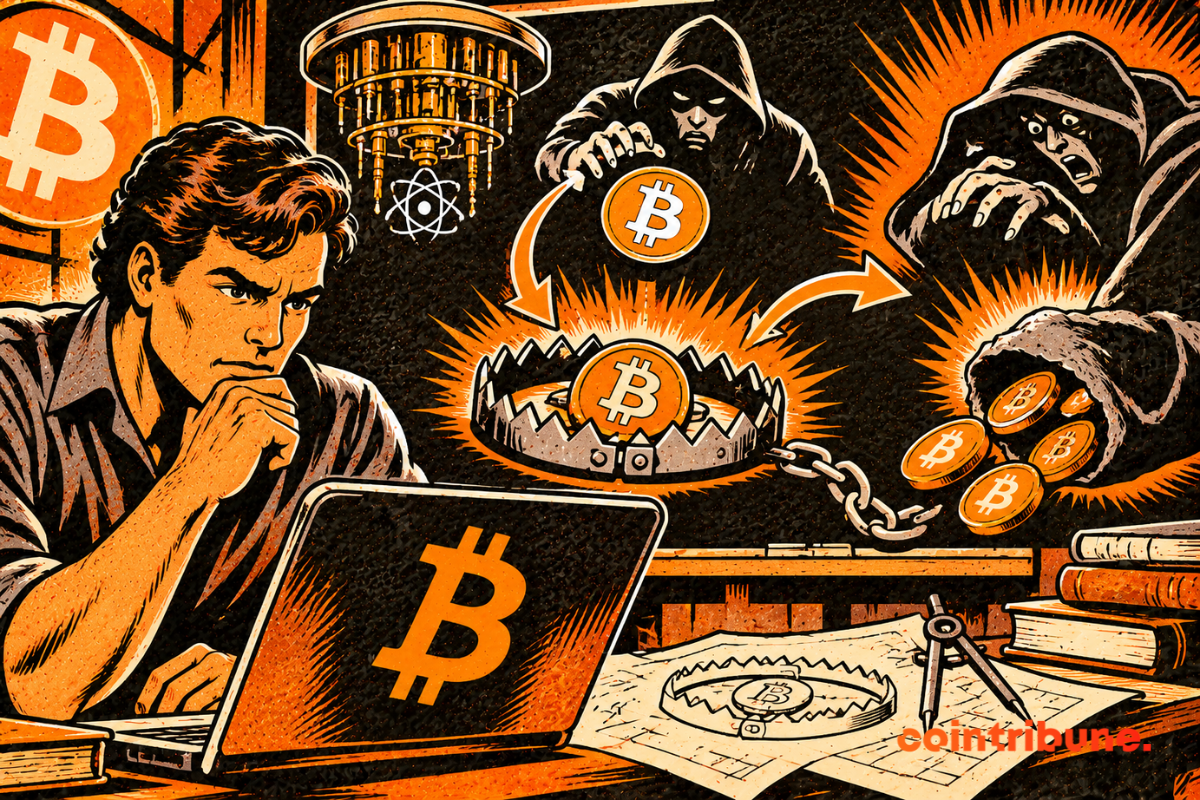
Bitcoin Core developer Cory Fields proposes to make any quantum theft financially risky thanks to “mines” cryptographic assets and a security deposit. However, this mechanism reveals a deeper problem. The network would not be able to distinguish a quantum hacker from the real owner of an old wallet.
In brief
- Cory Fields proposes a trap to make quantum Bitcoin thefts financially risky.
- Hackers would have to post collateral in BTC, which they could lose if challenged.
- Legitimate owners would be subject to the same requirement, at the risk of having their funds blocked.
- Some old bitcoins could be destroyed to discourage their theft.
- Still experimental, this proposal raises major questions about the security and property rights of Bitcoin.
The trap does not recognize the owner’s thief
The scenario is based on bitcoins whose public key is already visible on the blockchain. A sufficiently powerful quantum computer could, in theory, start from this public key to find the private key allowing the funds to be spent.
Cory Fields proposes changing the rules after the emergence of a credible quantum threat. Anyone wishing to move bitcoins held in an old format would need to provide equivalent collateral from a quantum attack-resistant wallet.
The envisaged operation can be summarized in several stages:
- Before the “Q-Day”the owner creates a quantum output containing secret proof of possession of his old key;
- After “Q-Day”, moving 1 vulnerable BTC would require providing 1 additional BTC as collateral;
- The 2 BTC would be locked for a period of up to thirty days;
- The original owner could reveal their proof during this period;
- He would then recover his bitcoin and seize the hacker’s collateral;
- Without a valid challenge, the funds would be released after the deadline expires.
There ” mine “ would remain invisible until activated. An attacker would therefore not be able to know if the wallet he is targeting contains prepared proof. To steal a BTC, he would risk losing his own bitcoin provided as collateral.
Fields estimated that this uncertainty could discourage attacks. The system even encourages some owners to voluntarily leave vulnerable funds in order to attract a hacker and recover their deposit.
The problem is that the blockchain does not know the real identity of the person signing a transaction. After a quantum breakthrough, both the real holder and the hacker could produce a valid private key. The protocol should therefore apply the same guarantee requirement to both.
Protecting an old bitcoin might require owning two
This symmetry creates a considerable obstacle for honest holders. A person with all their savings in an old 10 BTC wallet would need to find an additional 10 BTC, already placed in a quantum-secure format, to move their funds.
The mechanism would thus protect property by temporarily imposing a doubling of the capital mobilized. Large holders and platforms could probably provide this guarantee. Individuals, heirs or owners returning after several years risk being stuck.
The preparation of the ” mine “ must also occur before quantum computers are able to break current keys. It would therefore not be useful to people who have already lost their private key or to holders who died without having transmitted their access.
This limit particularly concerns old bitcoins attributed to Satoshi Nakamoto and many inactive wallets. For these funds, Fields discusses auctions in which participants would place hidden bids on vulnerable exits in advance.
When a hacker attempts to move these bitcoins, bidders could recover all or part of their collateral. The corners initially targeted could, however, be destroyed, without returning to their historic owner. The objective would no longer be to return the funds, but to make their theft economically useless.
This choice poses a sensitive question: should the network allow an attacker to seize accessible parts with a valid signature, or accept their destruction to protect the credibility of the system? The answer goes beyond cryptography and directly concerns property rights over Bitcoin.
A governance battle before a single line of code
The proposal is neither deployed nor formalized in the form of an improvement ready for adoption. Fields presents it explicitly as a series “thought experiments” and leaves until later the description of the mechanisms necessary for activation by soft fork.
Several essential elements do not yet exist. Bitcoin should first have a standardized quantum output format. It would then be necessary to define when old transactions become subject to the new rules, the exact amount of the guarantee and the length of the waiting periods.
Auctions raise other difficulties: distribution of seized collateral, treatment of losing bids, possible remuneration of miners and criteria authorizing the destruction of vulnerable bitcoins.
Adoption would above all require sufficiently broad agreement within the ecosystem. Freezing, slowing down or conditioning the spending of certain bitcoins would modify the rights their owners currently enjoy. Even achieved by soft fork, such a development would be politically delicate.
Fields’ proposal therefore provides less of a ready-made solution than a change of method. Rather than just looking for a new quantum-resistant signature, it uses game theory to make the attack too costly.
While the United States is accelerating on quantum, its main merit is also its weakness. It demonstrates that it is possible to trap a hacker without knowing his identity, but at the cost of constraints imposed on all holders of old bitcoins. Before facing a quantum computer, Bitcoin will therefore have to resolve a human question: who can modify the conditions allowing an owner to spend their own funds?
Maximize your Tremplin.io experience with our ‘Read to Earn’ program! For every article you read, earn points and access exclusive rewards. Sign up now and start earning benefits.