

US Senator Cynthia Lummis reignites debate over bitcoin’s quantum security and accuses Democrats of sacrificing asset protection when rejecting the CLARITY Act in the Senate. This political exchange of arms comes as the crypto sphere increasingly questions the resistance of its foundations in the face of the future rise of the quantum computer.

In brief
- Cynthia Lummis accuses Democrats of blocking the CLARITY Act despite incorporating quantum security standards.
- Michaël van de Poppe recalls that if bitcoin gives in to a quantum computer, the world’s banking and digital infrastructure would be threatened.
- Ledger dampens alarm over a recent mathematical study on elliptic curves and highlights the speed of advances in AI.
Crypto: Cynthia Lummis pins Democrats on rejection of the CLARITY Act
Republican Senator Cynthia Lummis addresses the legislative impasse surrounding the CLARITY Act. This major American bill on regulating the crypto market was blocked during a vote in the Senate in September 2026 (49 votes to 50). According to Cynthia Lummis, the Republicans had nevertheless integrated into the text demands formulated by the Democrats themselves around quantum security.
As the deadline for the end of the legislature threatens to force Congress to start from scratch in January 2027, the elected representative from Wyoming denounces ona political decision that leaves crypto holders exposed to the cyber threats of tomorrow:
Democrats have called for changes to post-quantum crypto standards that protect Americans’ digital assets from next-generation hackers. We have integrated them into Clarity. Democrats decided they didn’t care enough about protecting Americans’ savings from tomorrow’s cyberattacks when they voted against the bill.
Quantum computer: beyond bitcoin, the entire financial infrastructure is at stake
This controversy around quantum risk goes far beyond the borders of Capitol Hill and is fueling lively discussions among crypto market analysts. For Michaël van de Poppe, raising the specter of the end of bitcoin because of its supposed vulnerability to a quantum computer amounts to forgetting that almost all modern digital systems are based on similar cryptographic principles.
The analyst emphasizes that if the security of bitcoin were to be broken, the crisis would be systemic and would first hit traditional banks, consumer applications and citizens’ private data.
Ledger assesses bitcoin in the face of quantum threat
Recently, researchers from Zhejiang University (Shuchang Liu, Bingsheng Zhang and Kui Ren) published a study. Drawing on work from OpenAI, they propose a deterministic algorithm in subexponential time to solve the problem of discrete logarithm on elliptic curves (the mathematical mechanism on which the ECDSA and Schnorr signatures of Bitcoin are based), without even requiring a quantum computer.
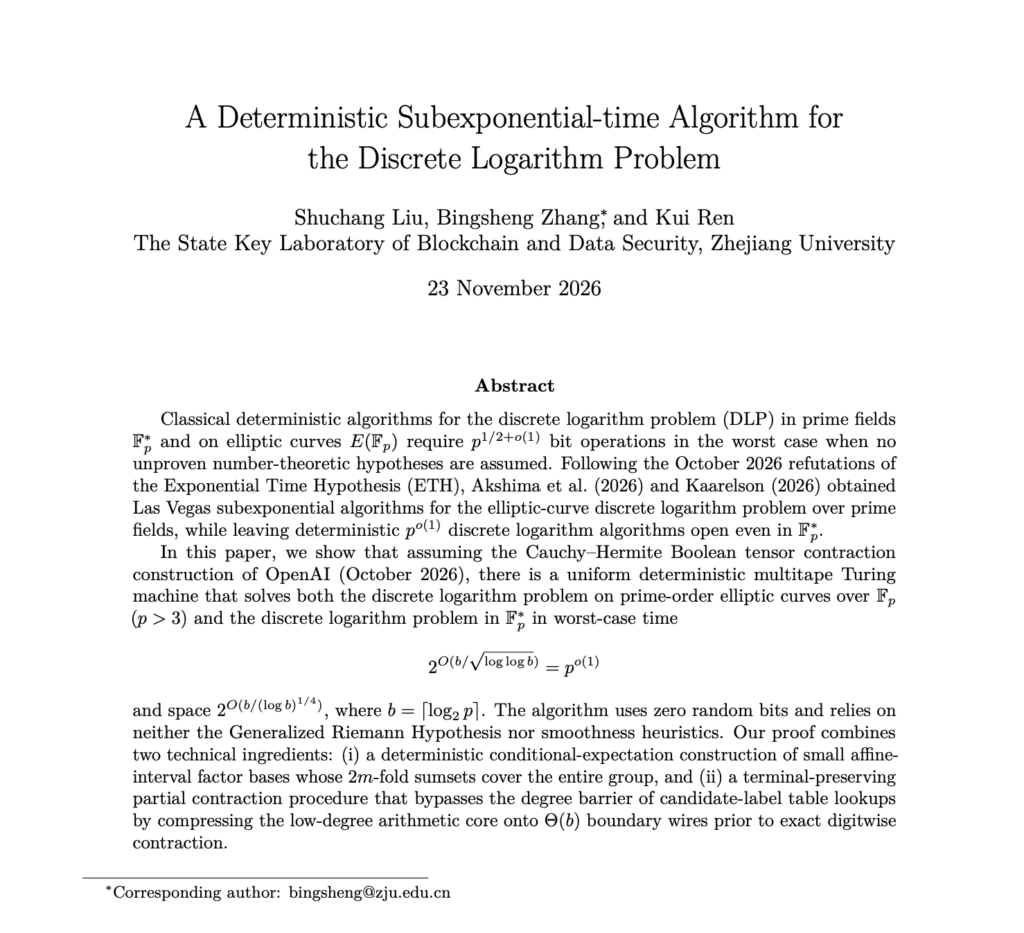
Asked about this publication, the technical director of Ledger, Charles Guillemet, wanted to rule out any immediate panic. He calls for not to underestimate the pace of discoveries linked to artificial intelligence.
| Analysis factor | Assessed risk level | Technical details and conclusions |
| Zhejiang University Study | Theoretical | New deterministic algorithm on elliptic curves based on work from OpenAI |
| Impact on Bitcoin keys (256 bits) | Almost zero in the short term | The algorithm only outperforms known attacks for extraordinarily large key sizes |
| Current security benchmark | Intact | The classic algorithm Pollard’s rho remains the most effective general attack known against Bitcoin |
| AI acceleration | Vigilance required | Mathematical research progresses in weeks instead of years |
Between the political blockage of the CLARITY Act denounced by Cynthia Lummis and the acceleration of crypto research observed by Ledger, quantum security is becoming a priority strategic project. If Bitcoin’s (BTC) current defenses hold up against immediate threats, the ability to anticipate the quantum computer era will determine lasting trust in the crypto ecosystem.
Maximize your Tremplin.io experience with our ‘Read to Earn’ program! For every article you read, earn points and access exclusive rewards. Sign up now and start earning benefits.