
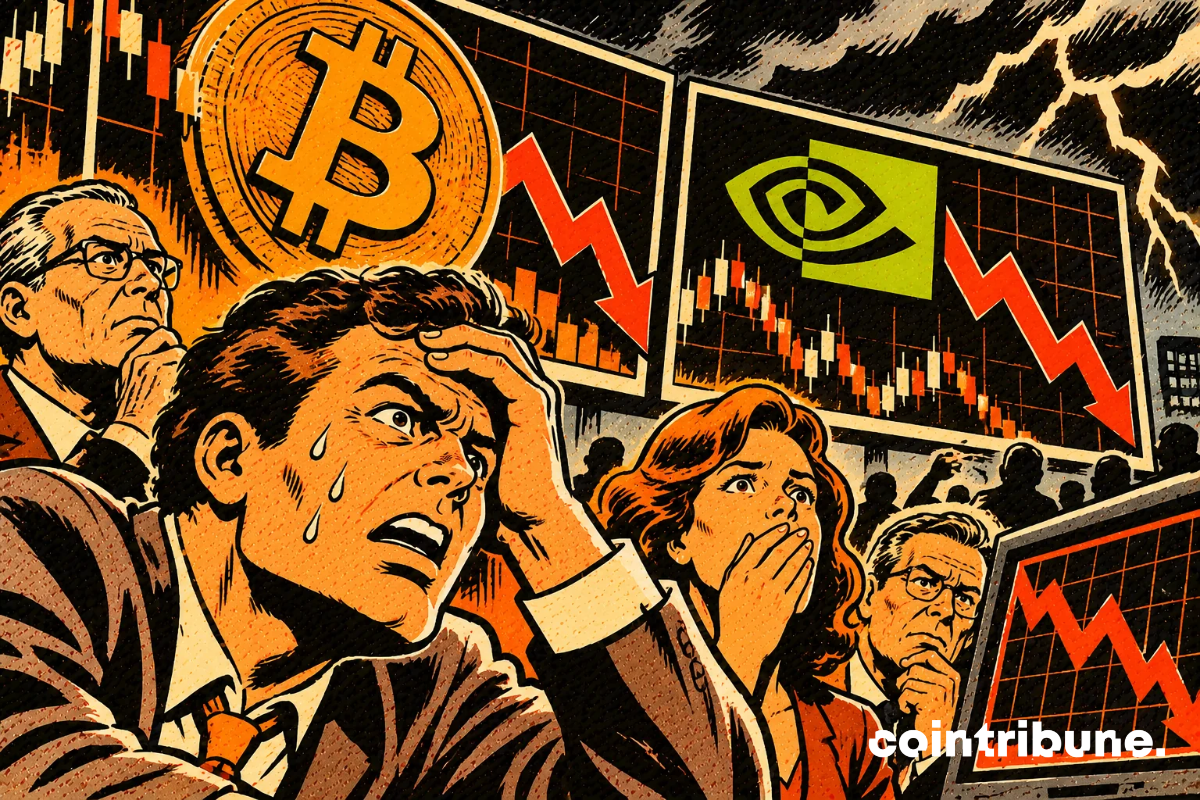
The return of Jensen Huang at the head of Nvidia briefly breathed new life into the cryptocurrency market. But the enthusiasm generated by the semiconductor giant will not have resisted a new wave of sales. Bitcoin has fallen back below $60,000, revealing a fragility that goes beyond simple price fluctuations. Behind this reversal lies a deeper problem: the market’s difficulty in transforming good news into real sustainable demand.
In brief
- Bitcoin falls back below $60,000 after briefly benefiting from Nvidia’s rebound.
- The surge on Wall Street reveals the fragility of demand in the crypto market.
- Arthur Hayes believes that a collapse in US stocks could encourage a return of liquidity from the Fed.
A spectacular rebound that reveals the limits of demand
This Monday, November 23, bitcoin regained color after the announcement of the return of Jensen Huang to the helm of Nvidia. The first cryptocurrency had risen to around $64,600, benefiting from the euphoria that had gripped the technology markets. However, this improvement quickly lost its strength.
This Tuesday, November 24, BTC fell back to $59,600, erasing the gains recorded after the announcement concerning Nvidia. This relapse revealed several weaknesses:
- A dependence on external catalysts: the market reacted positively to an announcement concerning a technology company, without a comparable change being observed in the fundamentals specific to bitcoin;
- Demand is still insufficient: buyers have not managed to sustainably maintain the price above $64,000;
- A market vulnerable to leverage: liquidations exceeded $850 million on crypto markets in 24 hours, according to data reported by The Kobeissi Letter;
- Persistent technical resistance: investors who recently bought bitcoin are getting closer to their cost price and can take advantage of rebounds to sell.
The last element deserves particular attention. According to Glassnode, the consolidation of acquisition prices of short-term holders is now an area of resistance. A sustainable return above $65,000 would be necessary to demonstrate that demand is sufficiently absorbing the profit taking of these investors.
Nvidia is making progress, but bitcoin can no longer keep up
The contrast between the two markets is particularly revealing. While Nvidia surged 31.6% on Monday, adding about $955 billion to its market capitalization, bitcoin failed to maintain its lead. The S&P 500 also gained 4.7%, while the Nasdaq rose 6.5%.
This difference in behavior raises questions about the nature of buyers present on the crypto market. If investors had truly regained their appetite for risk, bitcoin should logically have benefited more sustainably from the improvement in sentiment on the financial markets.
However, the rise in prices seems to have benefited short-term speculative operations more than an accumulation sufficiently solid to support prices. The liquidations recorded during the turnaround illustrate this fragility. In the span of an hour, approximately $70 million in positions were liquidated, including nearly 67 million long positions.
The situation is also complicated by the macroeconomic environment. The dollar remains firm, while expectations regarding US monetary policy continue to weigh on risky assets. Markets are particularly monitoring upcoming inflation data and expected decisions from the US Federal Reserve. Under these conditions, a rise in technology stocks is no longer necessarily enough to cause a lasting recovery in the crypto market.
Arthur Hayes sees stock market euphoria as a threat to cryptos
Arthur Hayes’ reaction brings another dimension to this situation. The co-founder of BitMEX believes that Nvidia’s spectacular progress could paradoxically constitute bad news for investors in cryptocurrencies.
In a post on X, he said:
Nvidia’s surge is the worst thing that could happen to our cryptocurrency investments. We need US stock markets to collapse for the Fed to start printing money again.
This statement reflects a particular reading of the functioning of markets. For Hayes, a significant correction in US stocks could force the Federal Reserve to ease monetary policy and inject more liquidity into the financial system. An environment historically favorable to speculative assets, including bitcoin.
Conversely, a sustained rally on Wall Street could reduce pressure for monetary support. Cryptocurrencies would then risk remaining deprived of a macroeconomic catalyst capable of restarting their progress.
Hayes had also mentioned the possibility of bitcoin returning to around $50,000 if the Nasdaq continued its correction. This scenario remains a personal anticipation, and not an acquired development.
For the next sessions, the threshold of 65,000 dollars therefore constitutes a particularly important level. Its reconquest would make it possible to measure the capacity of buyers to absorb the sales of holders in the short term. Conversely, a persistent inability to find this zone would fuel concerns about the solidity of the market.
The real issue is ultimately no longer whether bitcoin can bounce back after a bad session. It involves determining whether investors are still willing to buy sustainably, even when traditional markets cease to provide them with reasons for hope.
Maximize your Tremplin.io experience with our ‘Read to Earn’ program! For every article you read, earn points and access exclusive rewards. Sign up now and start earning benefits.


