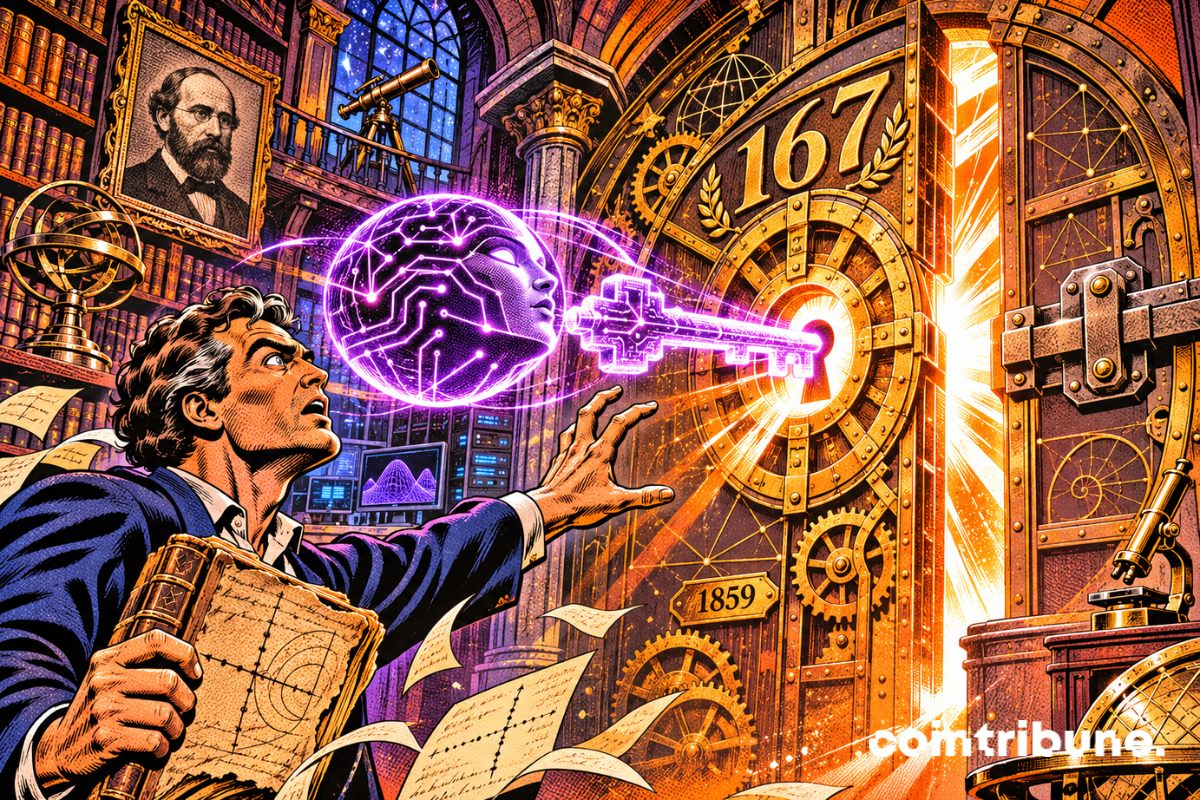
Anthropic may have reached a historic milestone in mathematical research. On November 20, 2026, Levent Alpöge, a mathematician working for the company, announced that he and Claude had discovered a proof of the Riemann hypothesis, formulated in 1859. This problem, which remained unsolved for 167 years, is associated with a reward of one million dollars. The announcement comes the day after Anthropic’s record IPO. However, the evidence still needs to be examined by independent specialists.
In brief
- An Anthropic researcher claims to have demonstrated the Riemann hypothesis with Claude.
- The demonstration is based in particular on 17 million lines of mathematical code.
- The announcement comes a day after Anthropic’s historic IPO, which raised $81 billion.
Anthropic announces possible historic mathematical breakthrough
Levent Alpöge believes he has solved one of the most famous problems in mathematics. Friday, November 20, this Anthropic researcher published a four-page document on his personal website. He claims to have worked for several weeks with Claude to construct a proof of the Riemann hypothesis.
Artificial intelligence had already solved a 25-year-old cryptographic puzzle linked to the NSA. This time, the challenge is much greater. Formulated in 1859 by the German mathematician Bernhard Riemann, the hypothesis concerns the distribution of prime numbers.
These numbers, like 2, 3, 5 or 7, are only divisible by themselves and 1. Their distribution follows complex mathematical properties that researchers have been trying to understand for centuries.
Riemann had established a link between this distribution and a particular mathematical function, called the zeta function. His hypothesis states that all non-trivial zeros of this function have a real part equal to 1/2.
The statement seems short. However, his demonstration has resisted the best mathematicians for 167 years. Alpöge claims to have gone further. According to him, the method developed with Claude would also make it possible to demonstrate the generalized Riemann hypothesis, a version extending the problem to other mathematical functions. The researcher recognizes that Claude surpassed him in certain final stages of reasoning. He published the technical elements of his demonstration in order to allow their examination.
A Claude demonstration of 17 million lines to check
The announcement is based on particularly voluminous computer work. Alpöge has released approximately 17 million lines of code in Lean, a language used to formalize and verify mathematical proofs.
The researcher also explains having generated more than 250,000 pages of documents during the process. Lean makes it possible to translate reasoning into instructions subject to rigorous logical rules. Its use provides an additional means of controlling certain stages of a proof.
But the work still needs to be examined independently. Recent advances in these tools had already raised concerns among leading mathematicians, particularly about the future place of human researchers in scientific discovery.
The Clay Mathematics Institute still classifies the Riemann hypothesis as an unsolved problem. The institute selected seven major mathematical challenges in 2000, with a million-dollar reward for each.
The allocation rules are strict. A proof must be published in an eligible scientific publication, obtain general recognition from the mathematical community and survive a period of at least two years after this publication.
An ad posted on a personal site is therefore not enough. Martin Bridson, president of the Clay Mathematics Institute, believes that this statement could be of historical importance, while emphasizing that understanding and evaluating it will take time. For Alpöge there is also a lot of work to do. The researcher admits that he has not yet personally mastered all the mathematical fields involved in this immense demonstration.
Anthropic unveils this discovery just after its IPO
The calendar particularly attracts attention. On November 19, Anthropic completed the largest IPO in history, raising approximately $81 billion at a valuation close to $1.5 trillion.
The next day, one of his researchers announced a possible demonstration of the Riemann hypothesis with Claude. Alpöge himself recognizes the delicate nature of this coincidence. In his document, he explains that he obtained his decisive results on the night of Sunday, November 15. He then contacted Dario Amodei, general manager of Anthropic, to discuss the conditions of a public announcement.
The researcher rejects any interpretation that he chose this date to serve the financial interests of the company. No public evidence demonstrates manipulation of the calendar for stock market purposes. This announcement nevertheless comes during a period of strong investor attention to Anthropic.
Even before the IPO, crypto traders were betting on a valuation higher than the official price of $83 per share, notably through derivative contracts traded on Hyperliquid. A recognized mathematical discovery could strengthen Claude’s scientific reputation. It would also provide a major example of the use of artificial intelligence in fundamental research.
However, it would be premature to deduce a quantifiable commercial advantage or a future increase in Anthropic shares. At the moment, the company has a considerable scientific announcement, accompanied by a demonstration for specialists to examine. If it withstands this examination, Claude will have participated in the resolution of a problem which has mobilized several generations of mathematicians.
Maximize your Tremplin.io experience with our ‘Read to Earn’ program! For every article you read, earn points and access exclusive rewards. Sign up now and start earning benefits.