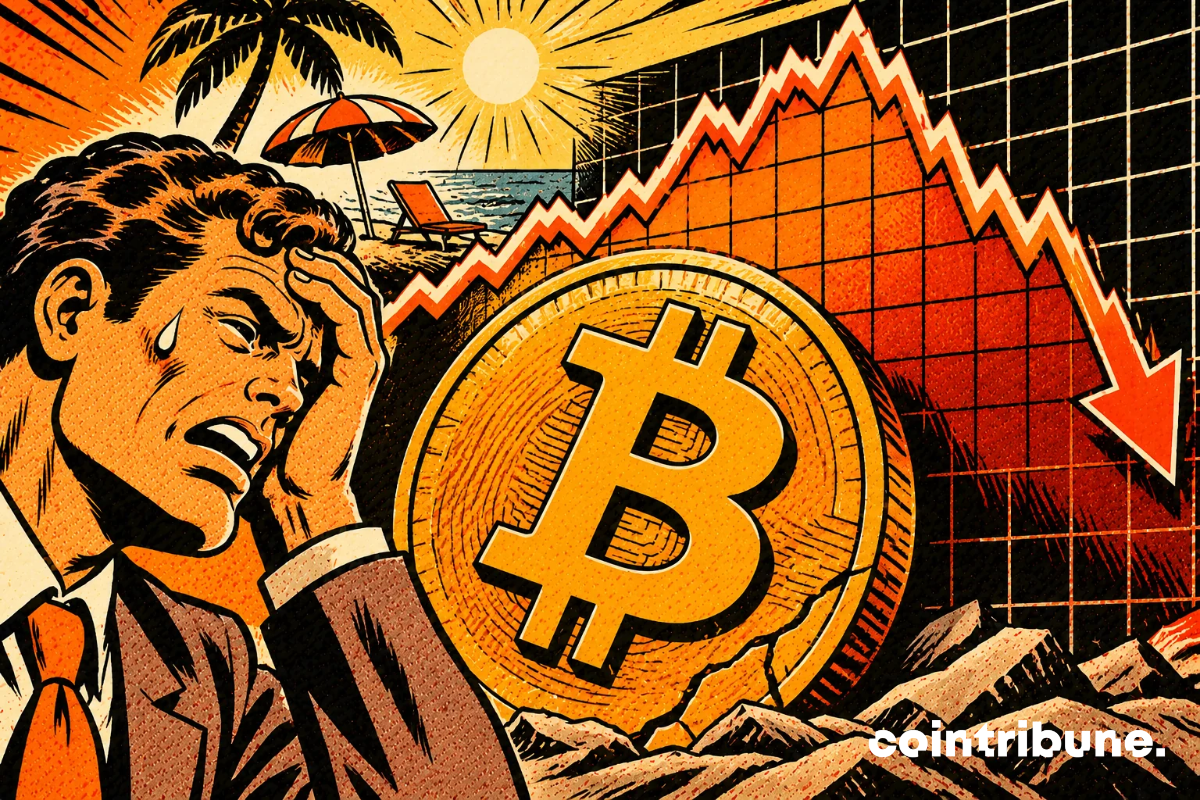
Bitcoin fell to its lowest level in twelve weeks, erasing most of its summer rebound. However, the Fed has not yet decided on any increase in December. The market is already correcting the easing scenario on which part of the recovery was based.
In brief
- Bitcoin falls to $65,900, its lowest level in twelve weeks, and erases most of its summer rebound.
- Expectations of a Fed rate hike in December are increasing pressure on the crypto market.
- The strengthening of the dollar and massive outflows from Bitcoin ETFs worsen the correction.
- Despite an RSI in the oversold zone, the bearish trend persists and exposes BTC to a further decline towards $64,000.
- The upcoming inflation data and Fed decisions will be decisive for a sustainable recovery of Bitcoin.
Bitcoin returns to August levels and erases its rebound
Bitcoin fell to around $65,900 on November 14, down 4.5% over twenty-four hours and 9.5% over one week. Ether is trading near 1850 dollars, while Solana fell back below 80 dollars.
BTC remains around 16% above its late June low near $59,000. It has nevertheless lost nearly 21% since its autumn peak around $86,000. Several elements explain this reversal:
- Core inflation rose 0.3% in October;
- The Fed maintains its rates between 3.75% and 4%;
- The markets almost unanimously anticipate an increase in December;
- An increase of 50 basis points is no longer completely excluded;
- Bitcoin ETFs have had six withdrawal sessions in a row.
Federal Reserve Governor Christopher Waller supports a hike of at least 25 basis points at the Dec. 8-9 meeting. He estimates that a 50-point hike should be considered if underlying monthly inflation reaches 0.3% or more. However, this condition materialized.
“More vigorous action from the FOMC may be necessary”he declared in his official speech. This position remains personal and does not constitute a collective decision by the Fed.
The dollar regains control of the price of bitcoin
The markets are not waiting for the December meeting to react. Rate contracts assigned, as of November 13, a probability of 91.9% to an increase of 25 basis points, compared to 8.1% for an increase of 50 points.
This revaluation strengthened the dollar. Its index rose above 103, its highest level since April 2025. A stronger greenback tightens global financial conditions. Dollar-denominated assets are becoming more expensive for foreign investors, while U.S. bonds offer a more attractive yield.
Bitcoin does not pay interest or dividends. When the return on assets considered less risky increases, the opportunity cost of holding them increases. Its price then depends more on the arrival of new capital and the appetite for risk.
This mechanism explains why BTC can decline even before an official decision. Monetary policy acts first through expectations: bond rates, the dollar and portfolios readjust as soon as investors believe in a change in trajectory.
ETF exits amplify this movement without being the sole origin. U.S. products saw approximately $1.49 billion in withdrawals between November 5 and 12. However, they retain nearly 55.5 billion cumulative net entries, which does not allow us to speak of general institutional abandonment.
The current decline shows above all that ETFs now transmit macroeconomic changes more quickly to the crypto market. Investors can reduce their exposure to bitcoin with the same ease as they sell a tech stock or index fund.
The next rebound will depend more on inflation than the RSI
Bitcoin’s Relative Strength Index fell to 25.4. An RSI below 30 generally signals an oversold market and may precede a technical rebound. However, the ADX reached 25.3, indicating that the downtrend remains sufficiently structured to continue.
The first support was around $67,650. Its breakout would expose a lower zone near $64,000. On the upside, BTC should reconquer $70,815 then $72,775 before facing greater resistance between $74,355 and $75,937.
However, these levels will not be enough to rebuild the summer rally. A lasting rebound would also require an improvement in the macroeconomic scenario: slowing inflation, easing of the dollar or reduction in expectations of rate hikes.
Two meetings therefore become more important than the RSI. The minutes of the October Fed meeting will be released on November 18, followed by PCE data on November 25. They will make it possible to assess whether the central bank is moving towards an ordinary increase or a more aggressive tightening.
Bitcoin is no longer just waiting for the Fed’s decision. He is already trading the risk that it confirms what the markets have anticipated. To regain its summer rally, it will therefore not only have to attract buyers: it will also have to survive an environment where the dollar and rates once again become the dominant assets.
Maximize your Tremplin.io experience with our ‘Read to Earn’ program! For every article you read, earn points and access exclusive rewards. Sign up now and start earning benefits.