

The bitcoin market is going through a delicate phase, marked by a drop in liquidity and a decline in institutional demand. In its report dated November 11, 2026, Glassnode describes an environment where capital is gradually leaving the market, despite some signs of accumulation. Investors face increasing pressure, while derivatives markets show more defensive strategies. Between cash outflows, options positions and cautious forecasts, the prospects for recovery remain difficult to establish over the long term.

In brief
- Glassnode sees $14.2 billion contraction in stablecoin supply in 30 days.
- US spot Bitcoin ETFs see $1.6 billion in net outflows over 20 sessions.
- Only 35% of bitcoins held in the short term currently remain in profit.
- Options are showing $33 billion in open interest, while defensive positions are growing.
- On Polymarket, the chances of reaching $100,000 in November do not exceed 1%.
Glassnode sees liquidity contraction in the bitcoin market
In its report entitled “Running on Empty”, published on Wednesday November 11 on X, Glassnode describes a weakened market structure. Several factors are now limiting the recovery of bitcoin. The decline in available liquidity, the decline in US demand and the losses of recent investors are weighing on the outlook. This combination reduces the resources likely to sustainably support the price of BTC.
Glassnode notably highlights that the price has fallen below the break-even threshold for short-term holders, established at $75,600. A large proportion of recent buyers therefore hold loss-making positions. At the same time, the bitcoin market remains less efficient than stocks, which highlights its lack of dynamism. The firm also observes a reduction in capital likely to support further progression.
THE defiLlama data on stablecoins reinforce this diagnosis. Their total supply fell by $14.2 billion in just 30 days, its fastest decline since June 2022. At the same time, US spot ETFs saw $1.6 billion in net outflows over twenty sessions. The BTC premium displayed on Coinbase also remains negative. It reached its largest discount since February, according to Glassnode observations.
Short-term holders are under increasing pressure
The deterioration of market conditions particularly affects investors who have purchased in recent months. According to Glassnode, only 35% of bitcoins held in the short term currently remain in profit. This proportion contrasts with that observed at the September peak, when almost all of these positions posted gains. The reversal therefore places a significant proportion of recent buyers facing latent losses.
The firm also identifies a significant concentration of bitcoin positions acquired at levels above current prices. This oversupply extends to $83,600 and could pose a hurdle during a possible rally. These potential sales then risk limiting price progression. The market must absorb this pressure before any recovery.
However, the situation presents some elements of support. Glassnode notes that the recent decline has eliminated a large portion of leveraged long positions near current prices. Furthermore, buy orders now exceed sell orders in the order book. Some players take advantage of lower prices. However, it is not enough to confirm a lasting return of demand.
Liquidity levels outline several sensitive areas for bitcoin
Analysis of the order book allows us to better understand the levels that are currently focusing operators’ attention. Glassnode spots large buy orders between $68,000 and $72,500. This area could attract part of the demand if the price of BTC continues to decline. However, the presence of pending orders does not guarantee their execution.
Further down, the data shows a concentration of liquidations between $59,500 and $62,600. This area could become important if a new wave of sales causes additional liquidations. Conversely, available liquidity above current prices remains relatively low up to $84,000. Short positions present a concentration of liquidations around $87,500.
Glassnode also identifies three important benchmarks for evaluating the bitcoin market. The first corresponds to the acquisition cost of short-term holders, set at $75,600. The second is at $77,500 and represents the actual market average. Finally, the election day closing price reaches $77,800. These three levels constitute references to follow a possible change in trend.
Options Traders Heighten Protections Despite Bullish Interest
Coinglass data provide additional insight into the positioning of professional bitcoin investors. Options open interest reaches 439,966 BTC, worth approximately $33 billion. Call options represent 55.72% of this outstanding amount, compared to 44.28% for put options. The put/call ratio thus stands at 0.79. This distribution indicates that bullish exposure maintains a slight advantage over all open contracts.
Deribit concentrates several of the main current positions. Its November call option with a strike price of $81,000 has 8,305.9 BTC outstanding. The December 25 $80,000 call option comes next with 8,113.9 BTC. The $100,000 contract is also a large position, with 6,612.7 BTC.
Recent bitcoin volumes, however, provide a more defensive signal. Over the last 24 hours, options trading reached 45,210 BTC. Put options accounted for 50.32% of this volume, compared to 49.68% for calls. Activity was mainly focused on the November 12 and 13 expiries, with strike prices between $72,000 and $75,500. Deribit put contracts at $72,000 and $73,000 notably recorded 730.3 and 715.8 BTC.
Derivatives activity declines after several periods of strong growth
Certain contracts nevertheless recorded significant volumes despite this more cautious orientation. The $100,000 Deribit call option, expiring on November 27, totaled 868.3 BTC. A $50,000 put option, expiring on December 25, also reached 673.8 BTC. These exchanges show that investors continue to take positions on different scenarios. They combine the search for opportunities and protection against unfavorable movements.
Transaction volumes on Deribit also confirm this drop in activity. By September, they had reached around $11.5 billion. During the decline observed this month, they returned to around $5 billion. This difference shows a significant decrease in trading on bitcoin derivatives. It accompanies the general slowdown observed in bitcoin, even if the available data does not make it possible to establish a direct relationship between these two developments.
Options contracts thus maintain a relatively balanced distribution between bullish and bearish positions. However, recent volumes give more room for protection strategies. Close maturities and strike prices located around current prices concentrate a significant portion of trading. Investors therefore seem to be carefully watching the next current movements. This caution contrasts with the high price targets still present in some longer-dated contracts.
Prediction Markets Show Cautious Outlook for End of 2026
Prediction markets provide a third reading of the bitcoin situation. On Polymarketthe market devoted to possible prices in November attracted 5.17 million dollars. It covers 28 different targets and assigns a 91% probability to a move above $75,000. This probability drops to 62% for $77,500 and to 39% for $80,000. Estimates therefore become progressively less favorable as targets increase.
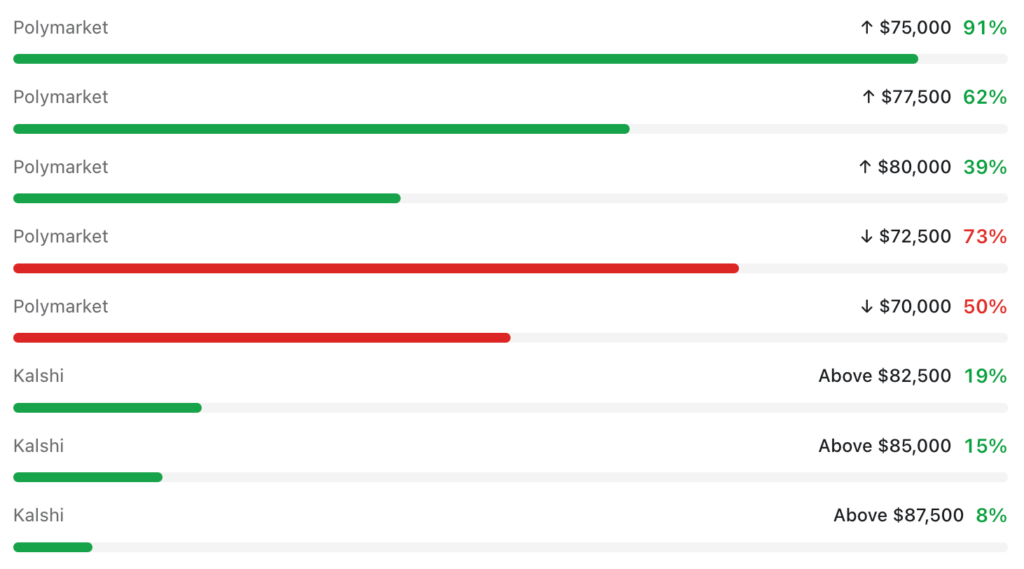
Predictions for lower thresholds also show some caution. Participants assign a probability of 73% to passing through $72,500. This estimate reaches 50% for $70,000 and 18% for $65,000. On the other hand, the chances of reaching $100,000 during the month of November do not exceed 1%. These figures reflect the expectations of participants, without constituting a guarantee of future movements.
Polymarket dedicated to targets before 2027 shows similar results. It totals $84.26 million in volume. The odds reach 61% for $70,000, 34% for $65,000, and 20% for $60,000. On the upside, participants assign 18% to $90,000 and 6% to $100,000. The $250,000 goal remains below 1%.
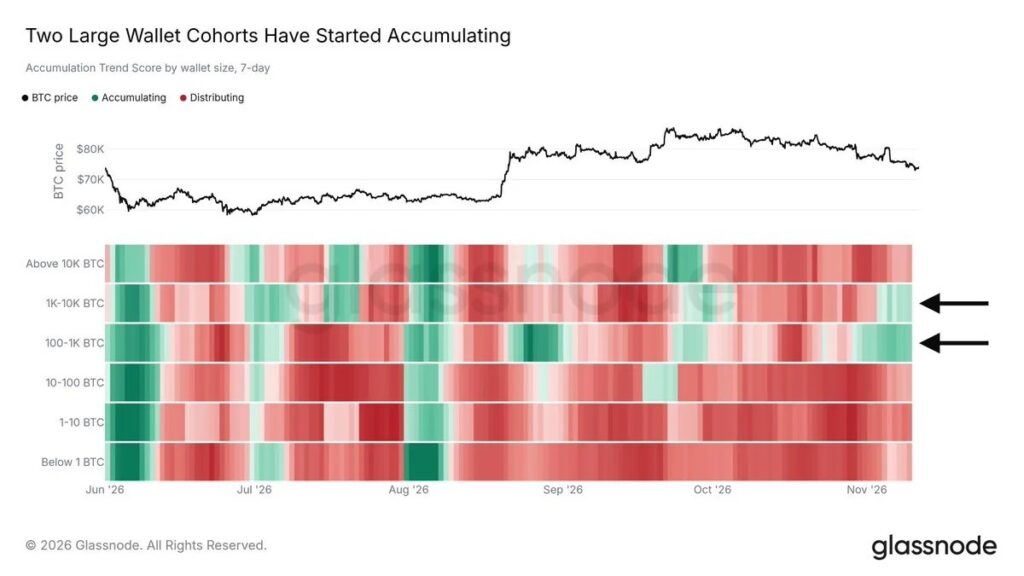
Glassnode data, options activity and prediction market forecasts thus depict a market under pressure, but not an inevitable collapse. ETF outflows and stablecoin contraction signal a withdrawal of available capital. However, some intermediate portfolios resume their purchases and buy orders exceed sell orders in the book studied. For the coming weeks, the evolution of flows, the behavior of recent holders and the reaction around technical thresholds will be decisive. A recovery in bitcoin will depend on the return of demand capable of absorbing potential sales.
Maximize your Tremplin.io experience with our ‘Read to Earn’ program! For every article you read, earn points and access exclusive rewards. Sign up now and start earning benefits.


