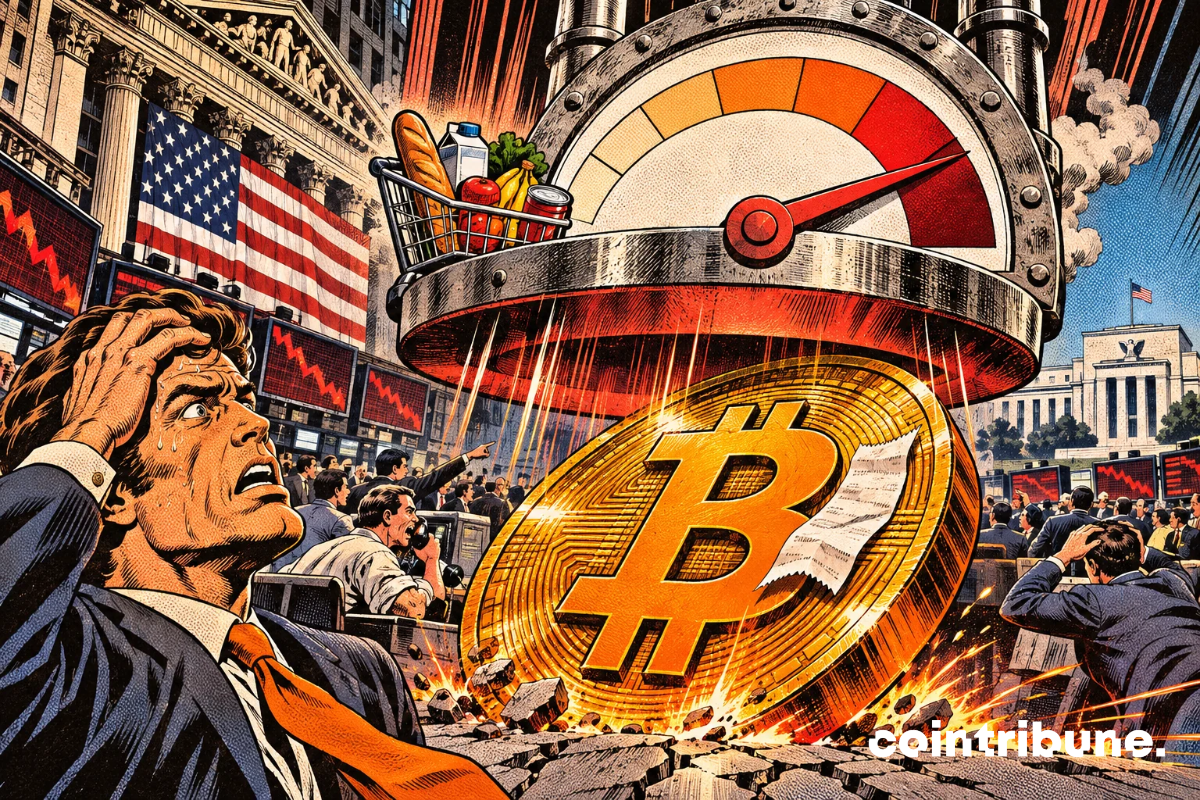
Bitcoin fell towards $73,600 on November 10, 2026 after the publication of higher-than-expected US inflation. The consumer price index (CPI) increased by 0.4% in October, against 0.3% expected. Core inflation also exceeds forecasts. Investors are now anticipating another rate hike from the Fed in December, with the possibility of more tightening than expected.
In brief
- US inflation reached 0.4% in October, compared to 0.3% expected by economists.
- Bitcoin falls to around $73,600 after the CPI publication.
- Markets are expecting the Fed to hike rates in December, potentially by 50 basis points.
Why is 0.4% US inflation worrying bitcoin?
The US Bureau of Labor Statistics (BLS) released its inflation figures on November 10. Consumer prices increased by 0.4% in October, after increasing by 0.6% in September. Inflation therefore slows down over one month. The problem comes from the forecasts.
Economists expected an increase limited to 0.3%. The result exceeds their estimates by 0.1 percentage point. Bitcoin, already facing several unfavorable factors for the month of November, is thus subject to new macroeconomic pressure.
Core inflation, which excludes food and energy prices, also reached 0.3%. The forecast was for 0.2%. This indicator particularly attracts the attention of the American Federal Reserve. It makes it possible to better observe inflationary pressures which persist beyond variations in energy products.
The October result extends that of the previous two months. Core inflation had already increased by 0.3% in August and September. Housing prices also increased by 0.3%. They contribute to more than 30% of the monthly increase in the general index.
Food increases by 0.5%, while energy increases by 0.7%. The latter, however, jumped 5.2% in September. Another peculiarity of the report: the BLS does not publish an annual inflation rate for October. The interruption of federal activities in October 2025 prevented the collection of the data necessary for this comparison. The last annual measurement available for the general index therefore remains that of September, at 3.7%.
How did bitcoin react to the CPI release?
The market reaction was rapid. Before the report was released at 8:30 a.m. New York time, bitcoin was trading around $74,300. Investors were already watching the American figures after several difficult sessions.
A few minutes after the announcement, BTC fell towards $73,600, accentuating its previous losses. Other readings showed a temporary passage around $73,400, before stabilizing in the upper part of $73,000.
Bitcoin was already trending downward before the CPI figures. The announcement therefore accentuated an existing movement rather than alone causing the entire correction. The fragility of the market does not start from Tuesday. In October, bitcoin lost 7.32%, ending three consecutive months of progress. After briefly exceeding $87,000 at the start of the month, it ended October around $77,000.
The first part of November did not make it possible to sustainably return to the abandoned levels. $74,000 is now a price threshold monitored by traders. A return above this zone could accompany stabilization, without being enough to confirm a bullish reversal.
Conversely, continued sales below the levels reached on Tuesday would leave the market exposed to a further correction. The reaction is not just about bitcoin. Futures contracts for major U.S. indexes also fell after the report.
The Nasdaq 100 was down about 1.15% and the S&P 500 was down nearly 0.5% at the time of CoinDesk’s first publication. Investors then reduced their exposure to several interest rate-sensitive assets.
Why might the Fed raise rates in December?
The inflation report comes at an important time for US monetary policy. The Fed is due to hold its last meeting of the year on December 8 and 9, 2026. Before the publication of the CPI, investors were already anticipating a further increase in its key rates.
Tuesday’s figures reinforce these expectations. Christopher Waller, Governor of the Federal Reserve, had indicated the day before that a rate hike could remain necessary in December, even with relatively moderate inflation.
He had also raised the possibility of a 50 basis point increase if the new data showed inflation high enough. The 0.3% result for core inflation is precisely the level that fueled this discussion.
The markets immediately adjusted their expectations. According to Reuters, investors briefly assigned a probability of around 15% to a 50 basis point hike in December. A 25 basis point increase remained the dominant scenario.
However, the Fed has not announced any decision. The central bank also examines employment, financial conditions and changes in economic activity before changing its rates. On November 6, American statistics reported 165,000 job creations in October, with an unemployment rate of 4.1%.
This data does not suggest an immediate collapse of the labor market. For monetary policymakers, this resistance could leave more room to combat inflation. The next meeting will also be special: the November CPI report must be published on December 10, i.e. after the Fed’s decision.
American officials will therefore have to make a decision without having this new comprehensive measure of consumer prices.
How can rising rates weigh on Bitcoin?
Bitcoin does not directly depend on Fed decisions to function. Its issuance, network and maximum supply remain independent of US monetary policy.
Investor behavior is different. When interest rates rise, bonds and certain investments considered less risky become more attractive. Investors can then reduce their positions in technology stocks and cryptocurrencies.
The bond market reacted immediately to the CPI figures. The yield on US ten-year bonds rose to around 4.93% after the publication, with an increase of around 6.5 basis points.
That of two-year securities gained around 14 basis points to reach 4.69%. These movements reflect a rapid reassessment of the monetary outlook. A stronger dollar may also make it more difficult for bitcoin to advance, particularly as international investors seek more liquidity in U.S. currency.
This is not an automatic relationship. Bitcoin has already risen during certain periods of high rates. But rate hikes can reduce appetite for volatile assets, particularly when markets are already fragile.
Another thing to watch are US Bitcoin ETFs. Their flows provide information on part of institutional demand, even if they do not represent all purchases and sales on the market.
Monetary expectations also add to technical uncertainties. Analyst Benjamin Cowen had recently raised the possibility of a new low for bitcoin, based in particular on market configurations observed during previous cycles. His scenario remains a hypothesis based on technical analysis. The publication of the CPI does not confirm such a forecast. However, it adds difficulty to the recovery of prices.
What conditions would allow bitcoin to rebound?
Bitcoin must first find buyers capable of stabilizing prices after the correction.
A sustainable return above $74,000 would be a first sign of improvement from the reaction seen on Tuesday.
The market should then recover to higher levels to regain momentum comparable to that of September.
Investors will also follow the next American indicators.
A moderation in inflationary pressures could reduce expectations about the size of future rate hikes. Conversely, new figures higher than forecasts risk maintaining caution.
The December decision remains particularly important.
A 25 basis point increase would be different from a 50 point move. Jerome Powell’s comments on the 2027 outlook could also weigh on markets.
The behavior of bonds and the dollar will make it possible to measure the reaction of investors.
Bitcoin could also benefit from a return of net inflows into ETFs, if institutional demand strengthens.
These conditions do not guarantee immediate progress. Some of the Fed-related expectations are already priced in.
Stock market developments will also play a role. A stabilization of the Nasdaq could accompany an improvement in sentiment on cryptocurrencies.
Bitcoin-specific factors remain important.
Sales by listed companies, movements of large portfolios and liquidity available on exchanges can accentuate or attenuate short-term variations.
The scenario of a rebound therefore does not depend solely on the next Fed press release.
The October correction had already shown the market’s difficulties in maintaining its gains. Tremplin.io notably explained why the 7.32% drop in October complicated the outlook for November. With US inflation higher than expected and bond yields rising, Bitcoin now has less macroeconomic support to regain lost levels. The rebound remains possible, but the next monetary decisions and the effective return of buyers will weigh on its solidity.
Maximize your Tremplin.io experience with our ‘Read to Earn’ program! For every article you read, earn points and access exclusive rewards. Sign up now and start earning benefits.