
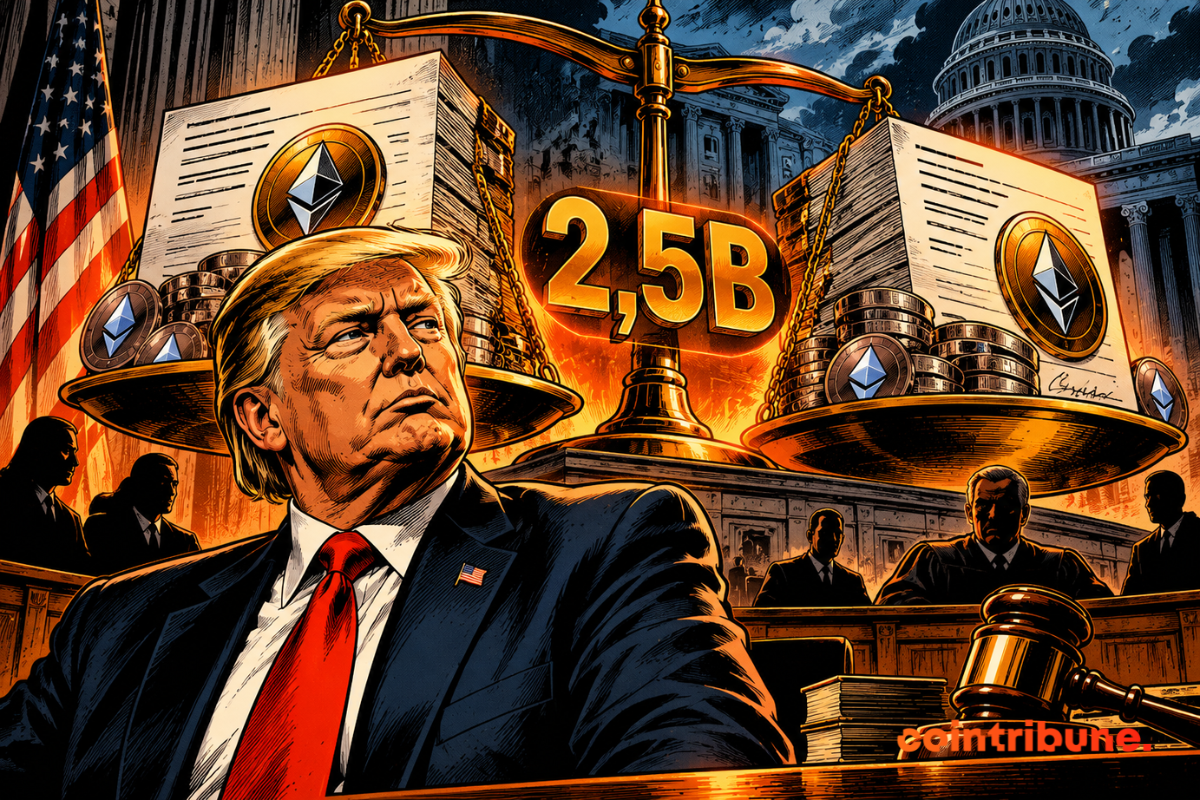
Donald Trump and World Liberty Financial face a new complaint surrounding their crypto activities. Circle shareholder J. Benjamin Greenberg claims two UAE-linked crypto operations allowed the president and his companies to illegally profit from foreign payments. The disputed transactions represent 2.5 billion dollars: 500 million for 49% of World Liberty and 2 billion invested in Binance via the USD1 stablecoin.
In brief
- Circle shareholder sues Trump and World Liberty Financial.
- Two UAE-linked crypto transactions totaling $2.5 billion are targeted.
- Circle dissociates itself from the complaint, while World Liberty rejects the accusations.
Two $2.5 billion crypto deals at the heart of the complaint
The suit was filed Thursday in federal court in Washington. J. Benjamin Greenberg, Circle shareholder and former employee of the company, is suing Donald Trump, World Liberty Financial, several affiliated companies as well as Steve Witkoff, American special envoy to the Middle East.
The first crypto agreement was already known. Days before Trump’s inauguration in January 2025, a company backed by Sheikh Tahnoon bin Zayed Al Nahyan agreed to buy 49% of World Liberty for $500 million.
Tahnoon is national security adviser to the United Arab Emirates. Half of the price, or $250 million, was to be paid immediately. Previously released financial documents indicated that a significant portion of that sum was expected to go to entities linked to the Trump family.
The complaint claims that Donald Trump then received income related to this operation after his return to the White House. No court has yet established that this income was illegal.
USD1 and Binance put crypto back at center stage
The second transaction involves MGX and Binance. In 2025, the Abu Dhabi fund invested $2 billion in Binance. The operation was carried out with USD1, the stablecoin launched by World Liberty Financial. The choice of this stablecoin had considerably strengthened its visibility in the crypto ecosystem. Binance has since further developed its ties to USD1.
Greenberg believes that this transaction financially benefited World Liberty at the expense of Circle, the company behind USDC. The complaint therefore takes the form of a derivative action. Greenberg is acting as a shareholder and seeking relief on behalf of Circle.
Circle, however, distances itself. The company claims it did not initiate, direct or authorize the procedure. The filing also does not say that Trump personally received the $2 billion invested in Binance. Instead, the plaintiff argues that the choice of USD1 generated revenue and strengthened World Liberty’s crypto business. The nuance is important.
Trump’s crypto activities now in court
The legal heart of the complaint is based on the Foreign Emoluments Clause of the US Constitution. This provision limits the ability of a U.S. president to accept certain benefits from foreign governments without Congressional approval.
Greenberg is asking the court to consider certain profits from disputed crypto transactions to be prohibited foreign benefits. In particular, he demands an accounting of the payments concerned, the restitution of profits which would be deemed illegal as well as damages and interest.
The deal comes as crypto already occupies an important place in Trump’s financial activities. His businesses and investments related to digital assets have contributed significantly to the growth of his fortune. World Liberty Financial denies the accusations. The company claims to respect American laws and points out that none of its employees work for the federal government. The White House also disputes the existence of a conflict of interest. The court will now have to determine whether Greenberg can demonstrate harm to Circle and whether the revenues from these crypto operations can actually fall within the constitutional clause.
Maximize your Tremplin.io experience with our ‘Read to Earn’ program! For every article you read, earn points and access exclusive rewards. Sign up now and start earning benefits.


