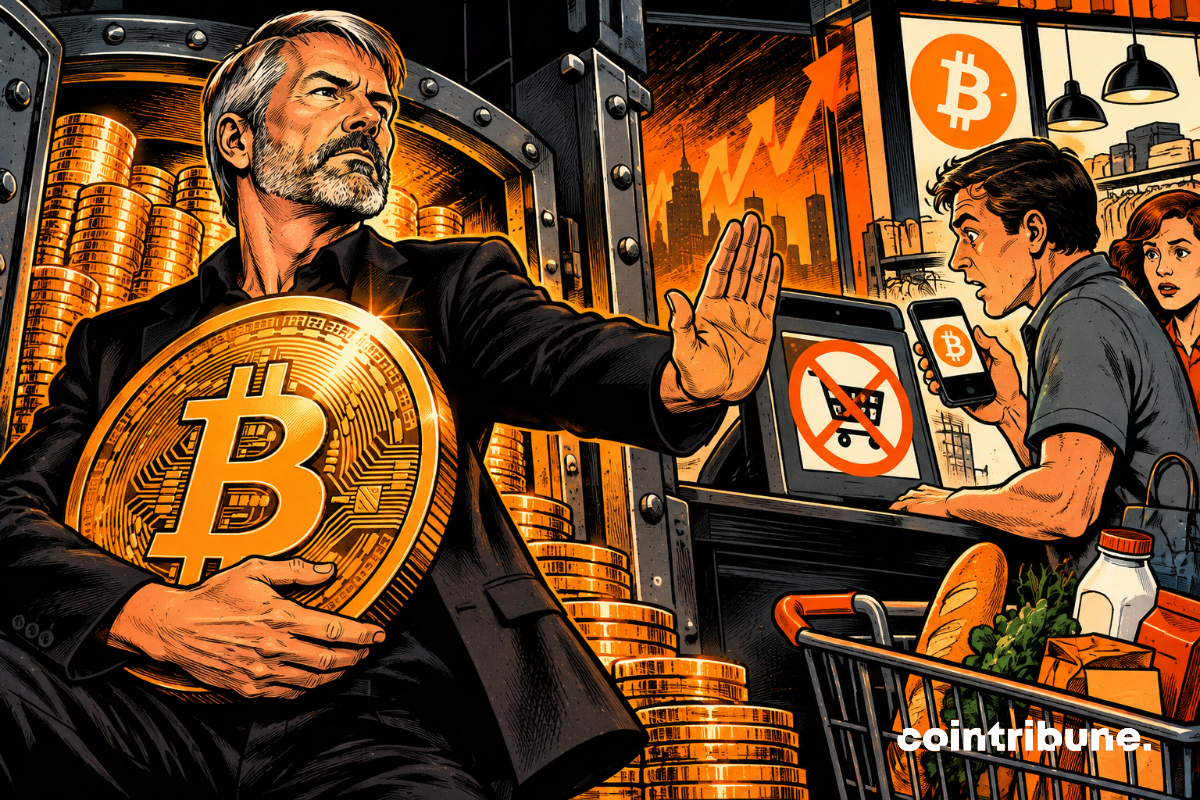
A study published by the Bank for International Settlements estimates that Bitcoin does not have the necessary architecture to become an everyday currency. Michael Saylor comes to a close conclusion, but defends a different solution: keep BTC as capital and build credit products on top of this asset.
In brief
- The BIS believes that Bitcoin cannot become an everyday currency without a credit system and public guarantees.
- Michael Saylor considers BTC as digital capital rather than a means of payment.
- It proposes to build private credit products backed by bitcoin.
- The BIS favors the support of central banks to guarantee financial stability.
- The bankruptcies of Celsius, BlockFi and FTX are a reminder of the risks of credit backed by cryptos.
BIS deems Bitcoin unsuitable for everyday payments
The economist Iñaki Aldasoro published a study on October 14 entitled “Money and the Architecture of Trust”. This 43-page document presents currency as promises that relies on trust, credit and the support of public institutions.
While the market has just plunged again, the author believes that a currency cannot function on a large scale without banks, deposit insurance and a lender of last resort. He considers that bitcoin refuses this organization, because it does not depend on any issuer and its offer cannot adapt to economic needs.
His reasoning is based on several main ideas :
- Money makes it possible to definitively settle an obligation;
- Credit constitutes a promise of future payment;
- Banks create means of payment through credit;
- The central bank provides liquidity in times of crisis;
- The state and deposit insurance distribute possible losses;
- Bitcoin has no equivalent public mechanism.
“Bitcoin aspires to become a currency without the architecture that allows the currency to function”, writing Iñaki Aldasoro. According to him, its limited supply of 21 million units prevents the system from responding to a sudden increase in demand for liquidity.
The economist also recalls the difficulties encountered in El Salvador and the Central African Republic after the adoption of BTC as legal tender. In both countries, its daily use has remained limited. This observation, however, is not enough to demonstrate that Bitcoin can never be used for payments in other contexts.
The document also constitutes a personal analysis. The BIS clarifies that the views expressed are those of the author and do not necessarily represent its official position or that of its member central banks.
Michael Saylor sees BTC as digital capital
Michael Saylor no longer presents bitcoin as a currency intended to directly pay for each purchase. The executive chairman of Strategy considers it above all as rare digital capital, comparable to a reserve asset on which financial products can be built.
Its position therefore partially matches that of the study. Both approaches recognize that BTC does not yet fulfill the role of everyday currency or unit of account. Salaries, contracts and prices remain mainly expressed in national currencies.
Saylor, however, wants to develop a private credit layer on top of bitcoin. Users would keep BTC as their base asset, while preferred stocks, bonds or less volatile digital currencies would be used for payments and seeking yield.
“Digital capital forms the basis of digital stocks and digital credit”he declared. In particular, he defends a product indexed to the dollar, which would combine credit instruments linked to bitcoin with cash equivalents.
This organization recalls the historical role of gold. The metal remained in the vaults, while the banks issued debts used for payments. The BIS study describes this model as a “credit superstructure”but she does not consider that Bitcoin can replace gold or central currency in this system.
The disagreement concerns trust and crisis management
The BIS and Michael Saylor agree on the need for a credit layer. They differ, however, on the institution responsible for guaranteeing its stability.
For Aldasoro, large-scale trust requires public support. A central bank can inject liquidity when private lenders withdraw. The state can also protect deposits and prevent an isolated bankruptcy from destabilizing the entire system.
Saylor prefers a private organization. In his model, shareholders and holders of the riskiest products absorb variations in bitcoin as a priority. Each instrument then offers a different level of performance and protection.
Recent history, however, calls for caution. Celsius, BlockFi and FTX had already built credit businesses around cryptos before their collapse in 2022. Their demise showed that a debt backed by a digital asset can fail if leverage, governance or reserves are poorly controlled.
The debate is therefore no longer just about bitcoin’s ability to pay for a coffee. It concerns the solidity of the intermediaries who will transform a volatile asset into usable credit. The scarcity of BTC can support its role as a reserve, but it guarantees neither the solvency of issuers nor the security of the returns offered.
Maximize your Tremplin.io experience with our ‘Read to Earn’ program! For every article you read, earn points and access exclusive rewards. Sign up now and start earning benefits.