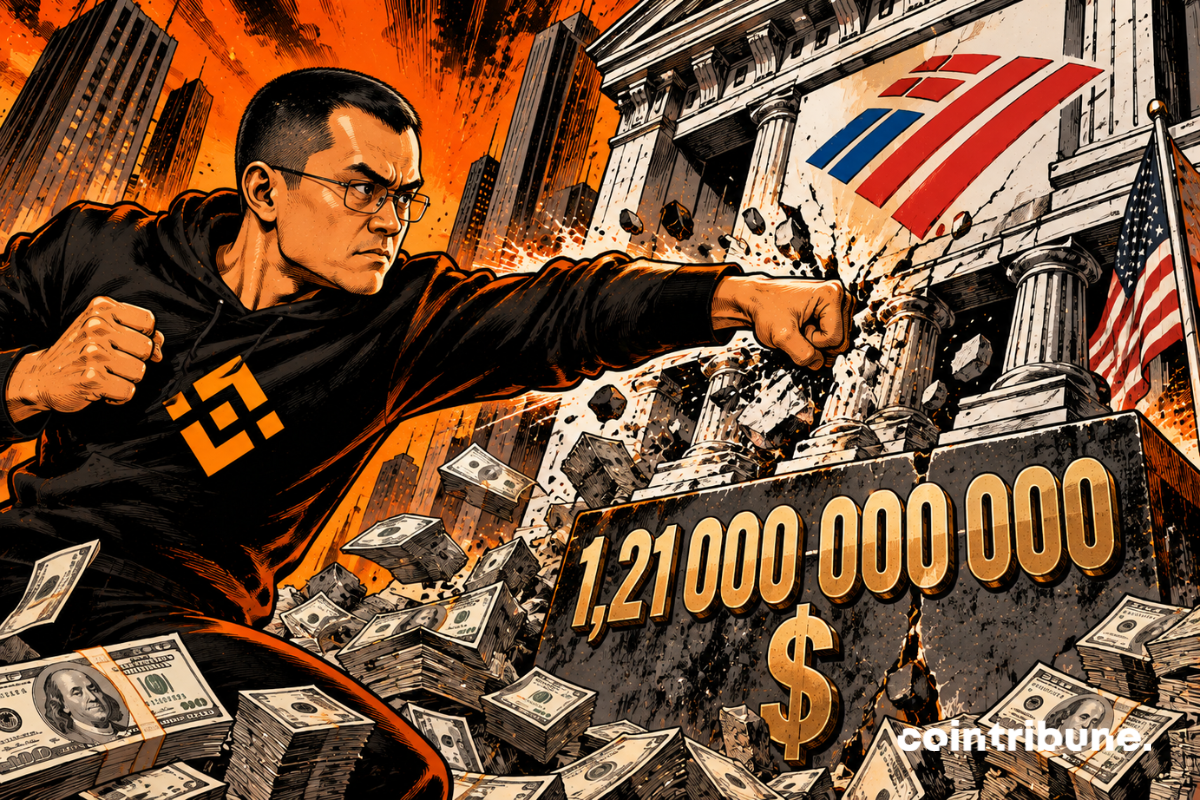
Changpeng Zhao reacted strongly to the sanction of more than $1.21 billion imposed on Bank of America for its anti-money laundering failures. The founder of Binance particularly points to the absence of criminal proceedings against the bank’s directors, even though he himself had spent four months in prison for an offense linked to his platform’s compliance system.
In brief
- Bank of America faces a $1.21 billion sanction for serious breaches of its anti-money laundering obligations.
- CZ denounces the absence of criminal proceedings against the bank’s directors, despite the extent of the failures observed.
- The founder of Binance recalls his own conviction, which earned him four months in prison for compliance-related breaches.
- This case rekindles the debate on the differences in treatment between the leaders of large banks and those of the crypto industry.
A historic sanction against Bank of America
The US Department of the Treasury announced on October 13 a series of measures against Bank of America. Authorities blame the second-largest bank in the United States for failing to timely detect, review and report more than $5 billion in suspicious transactions.
The case is based on several major breaches :
- More than $1 billion was for priority national security risks;
- Some transactions had possible links to Chinese money laundering networks;
- Other flows were associated with the southwest border of the United States, fraud or drug trafficking;
- The bank allegedly failed to properly monitor trillions of dollars of transactions;
- The problems persisted despite a cease and desist order issued in December 2024.
The Financial Crimes Enforcement Network, or FinCEN, set a penalty of $1.2 billion. The Office of the Comptroller of the Currency also issued a record fine of $750 million.
However, these two amounts should not be added together. The OCC penalty will be deducted from that imposed by FinCEN. A separate $11.6 million settlement was also reached for 475 apparent violations of U.S. sanctions, including on Russia, Iran, terrorism and drug trafficking.
CZ is ironic about the absence of criminal prosecutions
Changpeng Zhao commented on the matter on X, emphasizing the treatment reserved for Bank of America officials. He wrote:
Nobody went to prison. No house arrest. No deferred prosecution agreement. No one was even charged. Water under the bridge. Ahead !
This statement directly echoes his own legal journey. In November 2023, Binance pleaded guilty in the United States to several violations, including anti-money laundering legislation and economic sanctions rules. The platform had agreed to pay more than $4.3 billion.
CZ, for his part, admitted to having failed to maintain an effective anti-money laundering program within Binance. He resigned as general manager, paid a personal fine and served a four-month prison sentence.
His message therefore suggests the existence of different treatment between leaders of the crypto industry and those of the traditional banking sector. However, it does not prove, in itself, a legal inequality: the two cases are based on distinct procedures, people and criminal qualifications.
In the Binance case, the Department of Justice initiated criminal proceedings and obtained Zhao’s personal confession. The measures against Bank of America were announced by financial regulators as part of administrative settlements. No authority has indicated, at this stage, that a criminal investigation targeting an executive of the bank has been opened.
Controls deemed “deficient and ineffective”
The US Treasury believes that Bank of America favored its revenues to the detriment of its compliance system. The establishment would have relied too much on requests from law enforcement or other financial institutions, instead of detecting suspicious transactions itself.
The OCC describes its anti-money laundering program as “deficient and ineffective”. According to the regulator, the bank had known for several years that certain alerts were not correctly transmitted to internal investigators, without making sufficient corrections.
Bank of America admitted to willfully violating certain Bank Secrecy Act obligations as part of the agreement with FinCEN. It will now have to entrust an independent third party to review transactions that have escaped its systems, then report suspicious transactions discovered.
The bank claims to have invested several billion dollars in its compliance technologies and mobilized thousands of employees against financial crime. “Financial crime compliance is a serious matter, and it’s up to us to get it right”said the bank.
A comparison that revives the debate between crypto and banks
CZ’s intervention goes beyond the case of Bank of America alone. It fuels an old debate in the crypto industry: do the American authorities apply more severe sanctions to the managers of digital platforms than to those responsible for large banks?
However, the bank penalty remains considerable. It constitutes the third largest ever announced by the US Treasury and the heaviest in the history of the OCC. It will also reduce Bank of America’s quarterly profit by about $1.2 billion.
The difference highlighted by CZ therefore concerns less the financial amount than individual responsibility. Despite sustained failures and more than $5 billion in suspicious transactions reported late, no Bank of America executive has been charged. It is precisely this gap between institutional sanction and personal consequence that the founder of Binance seeks to place at the center of the debate.
Maximize your Tremplin.io experience with our ‘Read to Earn’ program! For every article you read, earn points and access exclusive rewards. Sign up now and start earning benefits.