
Exchange-traded funds linked to cryptocurrencies are going through a period of strong capital outflows. In two sessions, American ETFs on bitcoin and Ether lost almost a billion dollars, while trading volumes increased significantly. This development reflects a rapid change in institutional flows. While several products continue to attract investment, withdrawals now dominate major fund categories and raise questions about the near-term trend of the market.

In brief
- US spot bitcoin ETFs see $244.13 million in outflows in one day.
- Fidelity concentrates the bulk of withdrawals with $197.09 million withdrawn from its FBTC fund.
- Ether ETFs suffered $72.54 million in outflows, for an eighth consecutive session of decline.
- Bitcoin and Ether funds accumulate nearly $965 million in outflows in two days.
- XRP and NEAR are attracting capital despite the widespread decline in investment in crypto ETFs.
Bitcoin ETFs suffer new massive withdrawals
On Thursday, U.S. bitcoin-related spot ETFs saw $244.13 million in net outflows. This new decline continues the significant withdrawals observed the day before. Fidelity’s FBTC fund concentrates the bulk of sales, with $197.09 million in outflows according to Sosovalue data. This development places the manager among the main contributors to the daily decline in institutional investments.
Other products also suffered significant withdrawals during the session. Ark and 21Shares’ ARKB lost $20.29 million, while Bitwise’s BITB saw $17.71 million in outflows. Grayscale’s GBTC saw a decline of $8.20 million. For its part, BlackRock’s IBIT recorded $5.54 million in withdrawals, confirming the scale of outflows from several major funds.
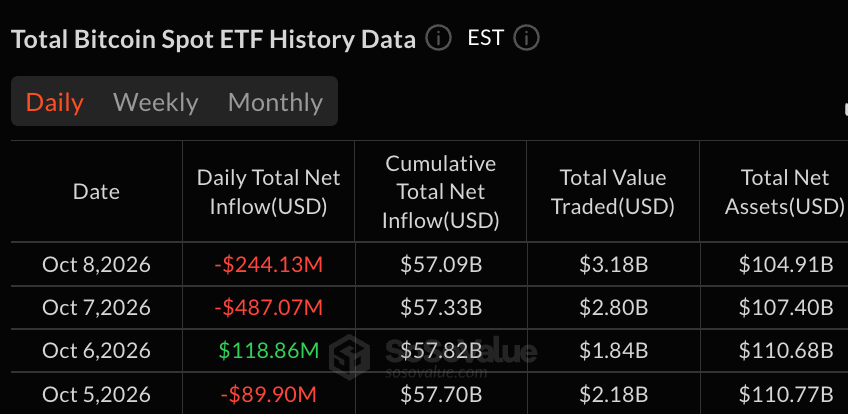
Franklin’s EZBC, however, bucked the trend, with $4.71 million in net inflows. Despite this contribution, negative flows largely dominated the entire market. The total trading volume of these funds reached $3.81 billion, while their net assets fell to $104.91 billion. This combination of high volumes and persistent outflows shows that investors are actively adjusting their positions.
The spot market also reflects this development. Bitcoin is down more than 4% over seven days and was recently trading below $82,800. After an accumulation phase observed in September, institutional flows therefore take a more cautious direction. The next sessions will determine whether these withdrawals continue or whether investors are regaining interest in American funds.
Ether records eight consecutive release sessions
US spot Ether ETFs lost $72.54 million on Thursday, extending their withdrawal streak to eight consecutive sessions. This trend confirms the difficulties encountered by products linked to the second cryptocurrency on the market. BlackRock’s ETHA concentrated most of the outflows, with $71.12 million less. Grayscale’s ETHE fund also lost $6.12 million on the day.
Several other products have undergone buyouts, including those of 21Shares and VanEck. However, some funds have attracted new capital despite this general trend. Fidelity’s FETH saw $5.50 million in inflows, while Morgan Stanley’s MSSE gained $1.32 million. These positive movements were not enough to compensate for the withdrawals observed on other products.
Trading volume on Ether-linked ETFs reached $1.92 billion. At the same time, their net assets declined to $15.64 billion. Over two sessions, funds associated with the two main cryptocurrencies accumulated around $964.5 million in outflows. The scale of this movement highlights a rapid shift in institutional allocations.
The price of Ether also suffered a more pronounced decline than that of bitcoin. Over seven days, it has fallen more than 9%, most recently reaching around $2,485. This development accompanies the withdrawals observed on American financial products. If the outflows are prolonged, investors will need to jointly monitor ETF flows and price action to better understand the direction of the market.
XRP and NEAR still attract capital despite the decline
Despite the exits affecting the main fund categories, certain products continue to attract investments. XRP ETFs recorded $8.17 million in inflows on Thursday. Franklin’s XRPZ concentrated all of this new capital. The trading volume reached $65.44 million, while the net assets of these funds stood at $1.56 billion.
ETFs linked to NEAR also had a positive session. Bitwise’s NRR fund, launched the previous weekattracted $4.04 million. Its net assets closed at $59.86 million, or about 1% of NEAR’s market capitalization. These inflows contrast with the withdrawals observed on several other products and show that capital movements remain different depending on the assets.
However, these results are not enough to reverse the general trend of crypto ETFs. Inflows into XRP and NEAR remain limited compared to the amounts withdrawn from funds associated with bitcoin and Ether. Investors therefore seem to distribute their positions unevenly between different digital assets. The next flow data will allow us to verify whether this demand is maintained during the following sessions.
At the same time, the sector continues its development in new markets. In Thailand, the regulatory authority has published a frame authorizing locally listed crypto ETFs, with initial coverage of bitcoin and Ether. This regulation is due to come into force on October 16. This development broadens the possibilities of access to financial products linked to cryptocurrencies, while the American markets are experiencing a period of significant outflows.
Zcash, HYPE and Solana continue to face withdrawals
Other ETF categories also ended the session in the red. Funds associated with Zcash lost $18.66 million, primarily through Grayscale’s ZCSH. Their net assets thus fell to 655.95 million dollars, below the threshold of 700 million. Despite this drop, cumulative net inflows remain positive, at $181.84 million.
HYPE ETFs also saw outflows, with $9.70 million withdrawn from 21Shares’ THYP. For their part, the Solana ETFs experienced a fourth consecutive session of withdrawals, with $3.32 million in net outflows. Bitwise’s BSOL lost $5.26 million, while Morgan Stanley’s MSOL and Invesco’s QSOL funds attracted more modest amounts.
These movements confirm that the pressure does not only concern the two main cryptocurrencies. Several categories of funds are undergoing redemptions, although some products continue to attract capital. The differences between assets show that flows do not follow a uniform path across the market. It will therefore be necessary to examine the next sessions to determine if the withdrawals extend further or if certain categories regain positive dynamics.
In the short term, US spot ETF flows will remain an important indicator of market developments. If outflows persist and volumes remain high, institutional caution could continue to weigh on prices. Conversely, a sustainable return of net inflows would signal a possible stabilization of demand. Bitcoin will thus evolve in a context where the next financial data will help measure the ability of investors to resume their positions.
Maximize your Tremplin.io experience with our ‘Read to Earn’ program! For every article you read, earn points and access exclusive rewards. Sign up now and start earning benefits.