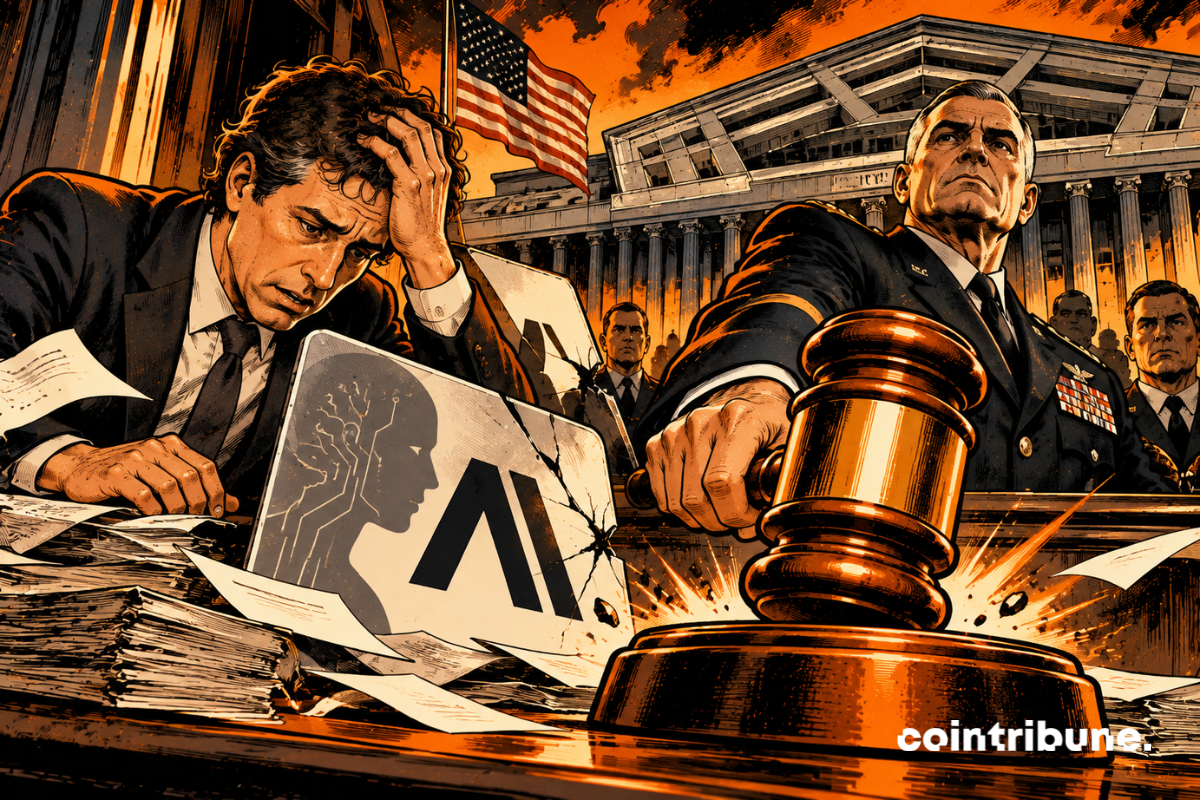
Claude’s exclusion from Pentagon systems and contracts has just been validated by an American appeals court. This new setback weakens Anthropic as it approaches an IPO that would value it at $2,000 billion, but it does not end the legal battle.
In brief
- A US appeals court validates Claude’s exclusion from certain Pentagon systems and contracts.
- The conflict is based on two restrictions maintained by Anthropic, related to autonomous weapons and mass surveillance.
- Two opposing court rulings remain in effect, leaving Anthropic with several options for recourse.
- This setback comes as the company prepares a possible IPO, with a valuation mentioned around $2,000 billion.
Anthropic loses a two-to-one decision
On September 25, the federal appeals court for the District of Columbia rejected the appeals filed by Anthropic, despite the stay obtained last March. Two out of three judges indicated that the Pentagon could characterize the company as “supply chain risk”.
This decision allows the ministry to continue removing Claude from its systems. It also prohibits military contractors from using Anthropic products when working for the Pentagon.
The main elements of the judgment emphasize the scope of this setback:
- The decision was adopted by two judges to one;
- Claude must disappear from the relevant military systems;
- Restrictions target Pentagon-related contracts;
- Anthropic is still studying possible legal consequences.
Judge Gregory Katsas found that the department had “sufficient grounds” to conclude that Claude’s continued integration could present a risk covered by the law. This court also has rejected Anthropic’s arguments based on free speech and due process.
Two restrictions on Claude sparked the conflict
Anthropic had already authorized the American government to use Claude for the analysis of foreign intelligence, the design of military systems and the conduct of certain offensive cyber operations. However, the company had maintained two bans.
The first concerned fully autonomous lethal weapons, capable of selecting and attacking a target without human intervention. The second concerned the mass surveillance of American citizens. For its part, the Pentagon had demanded a contract allowing all uses in accordance with the law.
Last February, negotiations failed. Thanks to on-chain data, CEO Dario Amodei estimated that autonomous weapons were not yet reliable enough and that mass surveillance remained incompatible with democratic values, even when it could be legal.
The ministry had especially feared that Anthropic could transform Claude’s safeguards and disrupt an operation in progress. Indeed, the court statement that the model had already refused certain government requests, including requests for classified documents and sensitive health research.
The Pentagon therefore mentioned a 2018 federal law intended for supply chain security. Such legislation allows an agency to exclude a technology when it believes a vendor would monitor, disrupt or modify its operation.
Two opposing court decisions remain in force
The September 25 verdict does not represent an automatic reversal of Anthropic’s victory in California on August 27. Indeed, federal judge Rita Lin had qualified another Pentagon measure as illegal retaliation and specified that the company had not benefited from the required guarantees.
The Washington court had examined a separate procedure, based in particular on the 2018 law. Its majority judge that the Pentagon had correctly informed Anthropic. In addition, he had offered him the opportunity to challenge his exclusion.
Justice Karen Henderson disagreed with this interpretation. According to her, the majority gives the government too broad a power to force technology suppliers to accept its conditions or risk being considered national threats.
Anthropic recalled that the Californian judgment remained favorable to it. The company says it is reviewing its next options. In addition, she would request a new examination of the case or try to refer the case to the Supreme Court, without having yet announced her strategy.
The 2,000 billion IPO remains a hypothesis
This setback comes as Anthropic prepares its IPO. The company has officially filed a confidential draft Form S-1 with the SEC on 1er June. However, it did not confirm the price of the shares, nor the amount sought, nor its future valuation.
The operation could raise up to 100 billion dollars and value the creator of Claude around 2,000 billion dollars. Nvidia is expected to discuss an investment of up to 10 billion, but the two groups have not confirmed these negotiations.
Anthropic was still valued at $965 billion after its May fundraising. Going to 2,000 billion dollars would therefore require more than a doubling in a few months.
Exclusion from military markets does not directly threaten all of its business activities. However, it adds a regulatory risk that future investors will have to assess, particularly for public contracts and relationships with defense suppliers.
Maximize your Tremplin.io experience with our ‘Read to Earn’ program! For every article you read, earn points and access exclusive rewards. Sign up now and start earning benefits.