

In 2026, Kaspa ceased to be “just” a fast payments network. After the Crescendo hard fork brought the network to 10 blocks per second in 2025, the Toccata update added native smart contracts, KRC-20 tokens, and zero-knowledge (ZK) verification in late June 2026. This leaves the question that every follower of the project is really asking: what next? The answer is three points: DAGKnight, the rise to 100 blocks per second and VProgs, plus a layer 2 ecosystem taking shape, not without friction. Here’s what the next updates are about, and what they don’t yet prove.

In Brief
- Kaspa is a proof-of-work blockchain built on a BlockDAG architecture (the GHOSTDAG protocol), launched fairly at the end of 2021 without pre-mining or ICO.
- Already delivered: Crescendo (10 blocks per second, 2025) and Toccata (end of June 2026), which transformed Kaspa into a programmable layer 1 (native contracts, KRC-20, ZK, the SilverScript compiler).
- Coming soon: DAGKnight (a new adaptive consensus) with a ZK bridge between layer 1 and layer 2, the gradual increase to 100 blocks per second (planned for 2027), and VProgs for native and composable contracts.
- As of September 18, 2026, KAS was trading around $0.035, for a capitalization of almost $1 billion, with approximately 96% of the supply already in circulation (issuance almost complete).
- Recent friction: an exploit in late September 2026 on Kasplex Layer 2 reignited criticism from a co-founder, Shai Wyborski, over the security and governance of the ecosystem; Kaspa Layer 1 was not affected.
Where is Kaspa at the end of 2026?
Kaspa is a PoW cryptocurrency built on a BlockDAG, a directed acyclic graph in which several valid blocks coexist in parallel rather than competing, thanks to the GHOSTDAG protocol. The result is high throughput without sacrificing decentralization. The network has been operating at 10 blocks per second since the Crescendo hard fork (2025), made possible by rewriting the software in Rust.
The recent turning point is Toccata. Activated at the end of June 2026, this update transformed Kaspa from a fast payments chain into a programmable layer 1: native contracts via conventionsKRC-20 tokens integrated into the protocol, ZK verification opcodes and SilverScript compiler to facilitate development. On the market side, KAS was trading around $0.035 on September 18, 2026 (capitalization close to one billion), with a fair launch, no pre-mining, and an issue close to the end of its curve. The technical basis is therefore in place; the next step is to bring it to life.
DAGKnight: the next leap in consensus
This is the most awaited update. DAGKnight (DK) is a next-generation consensus protocol, based on a 2022 research paper by Kaspa researchers Michael Sutton and Yonatan Sompolinsky, designed to extend or replace GHOSTDAG. Its distinctive feature: it is “parameter-free” and adaptive. Where the current system relies on fixed assumptions about network latency, DAGKnight dynamically adjusts to real-world conditions, which should enable faster finality (block target time in the range of 25-40 milliseconds) and better resilience to disruptions, with Byzantine fault tolerance up to 50%.
According to the roadmap published by the projectDAGKnight is expected to ship with a ZK bridge between layer 1 and layer 2 in a single hard fork. The timeline, however, calls for caution: initially considered for the third quarter of 2026, it is now more often mentioned for 2026-2027, and the team acknowledges that the topic was pushed back after the Crescendo effort. Takeaway: DAGKnight is structural, but it is also the milestone whose date has moved the most.
Towards 100 blocks per second
Kaspa has no plans to stop at 10 blocks per second. The roadmap foresees a gradual increase in throughput, in stages (around 25, then 40, and finally 100 blocks per second), targeted for a hard fork in 2027, with resilience mechanisms designed so that payments continue to work even in the event of a network partition. The logic is “horizontal” scaling: rather than increasing the size of each block, the network processes more blocks in parallel. If successful, this increase in throughput would bring confirmations down to just the limit of internet latency.
VProgs: native and composable contracts
Still in the research stage, VProgs (“virtual programs”) aim to give Kaspa native smart contracts capable of running in parallel while remaining synchronously composable, a tricky point for decentralized finance and complex applications. The stated goal is to offer large-scale programmability without breaking the BlockDAG performance model. This is in-depth in-depth work, expected in 2027, to be followed more as an orientation than a precise deadline.
Igra and Kasplex: the application layer is taking shape
Alongside the protocol, the Layer 2 ecosystem is being established. Projects like Igra (an EVM-compatible Layer 2 built on Kaspa’s BlockDAG) and Kasplex are maturing the application layer, with KRC-20 tokens as the first testing ground. The idea is familiar but consistent: Layer 1 provides speed, security and settlement, while Layer 2 hosts some of the application activity. It is this combination, a rapid foundation plus an active ecosystem, that will determine whether the recently added programmability translates into real use. This is also, for the moment, where the risks are concentrated.
Behind the scenes: the Kasplex exploit and Shai Wyborski’s warning
At the end of September 2026, a signature bypass vulnerability in Kasplex’s KRC-20 off-chain token indexer allowed attackers to mint, without possessing the private keys, 186 million ZEAL tokens and approximately 54.4 billion NACHO, via the Igra Labs EVM layer and Kasplex Layer 2, before selling them on the Zealous Swap DEX. According to specialized media (KuCoin, ChainCatcher), the value of the affected pools fell from 94% to 99.6%. Crucial point for accuracy: Kaspa’s Layer 1 consensus and unbridled assets were not affected, with the flaw being in a Layer 2 component rather than the base protocol. Igra suspended iKAS withdrawals, and Zealous Swap said it needed to fix and reindex its indexer.
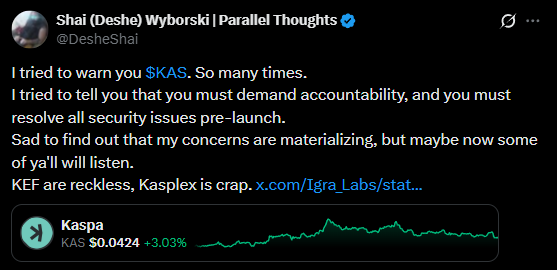
It is in this context that Shai Wyborski (@DesheShai)’s public post should be read. As a reminder: co-author of the PHANTOM and GHOSTDAG research which is the basis of Kaspa, doctor in quantum cryptography, and first contributor to the project. Since April 2026, he had moved away and publicly expressed his distrust towards part of the ecosystem. According to the CaptainAltcoin media coverage, he pointed out the rivalry between three programmability projects (Kasplex’s ZK-EVM, Igra and the core team’s vProgs), criticized the core leaders (Michael Sutton and Yonatan Sompolinsky) for their hostility towards Igra, judged that Kasplex was hiding protocol details and fees, and feared dependence on funding from Kaspa Eco Foundation (KEF) and personal grudges. direct decisions to the detriment of the community. His wording reflected his position: he cannot work with people he does not trust.
After the exploit, Wyborski maintained that his warnings were coming true, saying he had repeatedly flagged the need to address security issues before any launch, and abruptly calling KEF reckless and Kasplex a bad project. These are his opinions, expressed publicly; they target ecosystem entities (KEF, Kasplex, Igra) distinct from Layer 1 of Kaspa, and the parties concerned communicate on the incident on their side. Notably, he did not cross out the basic protocol, the performance of which he praised elsewhere.
Things to watch out for (and warnings)
A note of honesty is in order. Kaspa’s track record is credible and his performance history real (Crescendo, then Toccata, were delivered), but three caveats remain.
- First, deadlines slip: DAGKnight is the example, pushed back several times.
- Second, having the capacity is not the same as using it: several analyzes note that on-chain activity remains low relative to available throughput, a classic case of “build it and they will come” whose outcome is not assured.
- Third, as the Kasplex exploit and internal criticism remind us, the security and governance of the Layer 2 ecosystem is a work in progress in its own right, separate from the robustness of Layer 1.
The right way to follow Kaspa is therefore not to aim for a price, but to check three things: the effective landing of the DAGKnight and ZK branches in the development repository, the materialization of the application request on Layer 1 and Layer 2, and the way in which the ecosystem corrects its defects and clarifies its governance. The next verifiable technical step will be for the DAGKnight job and ZK bridge to reach the testnet and then activate via hard fork.
This article is informational and does not constitute investment advice. Crypto markets are volatile; the figures cited are dated and change quickly. Update schedules are indicative and subject to change. Statements attributed to named individuals are their public remarks; the presumption of innocence and good faith applies to the entities mentioned.
FAQs
An adaptive “parameter-free” consensus protocol intended to extend or replace GHOSTDAG on Kaspa, for faster finality and better resilience to real network conditions.
The project mentioned 2026-2027, often accompanied by a ZK bridge between Layer 1 / Layer 2. The calendar has already been pushed back; no date is guaranteed.
Activated at the end of June 2026, it made Kaspa programmable: native contracts (conventions), KRC-20 tokens, ZK verification opcodes and the SilverScript compiler.
Co-author of the PHANTOM/GHOSTDAG research and one of the first contributors to Kaspa, he left in 2026 out of distrust in the governance of the ecosystem; after the Kasplex exploit, he maintained that his security alerts were confirmed. His statements reflect his personal opinion.
The flaw affected Kasplex’s KRC-20 indexer (Layer 2) and the Igra Labs bridge, not Kaspa’s Layer 1, whose consensus and unbridged assets were not affected.
Yes. Kaspa retains its PoW core (the kHeavyHash algorithm) and its 2021 fair launch, without pre-mining or founder allocation; updates do not change this base.
Maximize your Tremplin.io experience with our ‘Read to Earn’ program! For every article you read, earn points and access exclusive rewards. Sign up now and start earning benefits.


