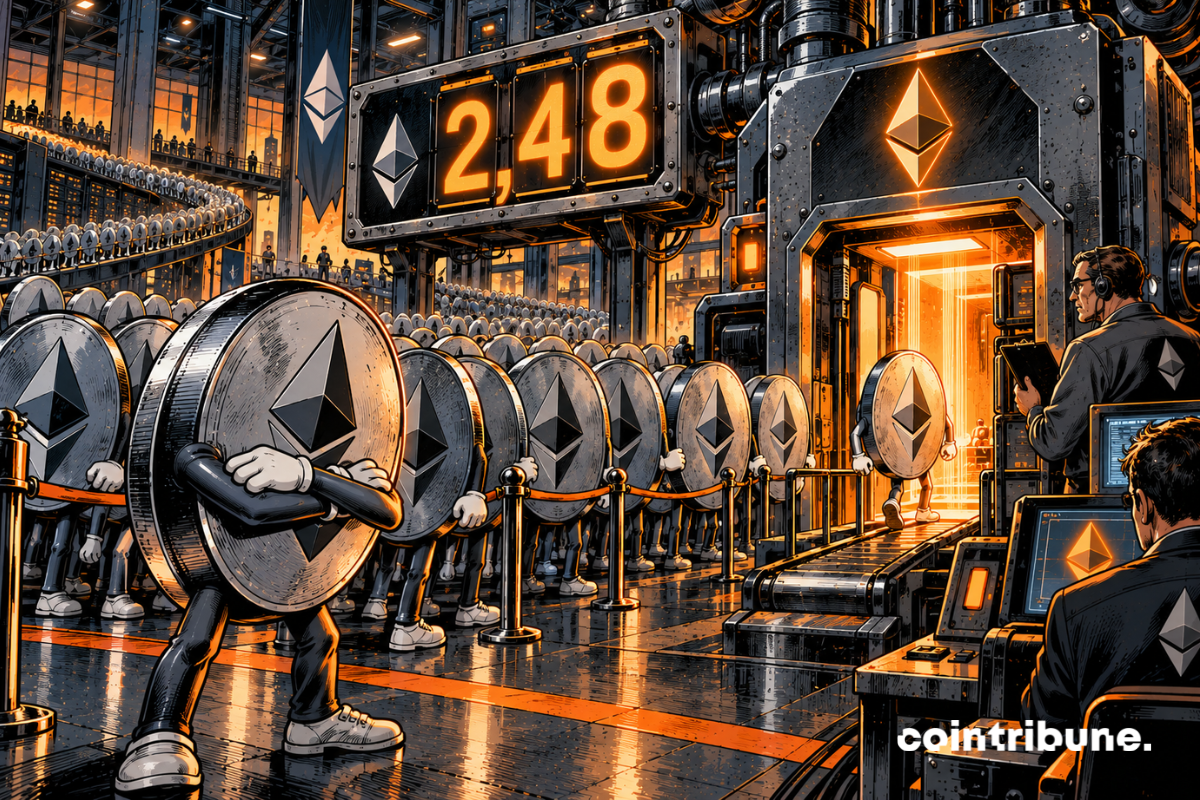
Ethereum staking is regaining real interest, with thirteen times more ETH awaiting entry than exit. This imbalance potentially reduces the available supply, without in itself guaranteeing an increase in the price.
In brief
- Ethereum staking is experiencing a marked resurgence of interest, with many more ETH awaiting entry than exit.
- The activation queue far exceeds the withdrawal queue, creating an imbalance greater than thirteen to one.
- More than 43 million ETH are now staked, more than a third of the total supply.
- This increase in staking may reduce the available liquid supply, without permanently removing ETH from circulation.
- The annual yield remains around 2.58%, despite the increase in the number of validators.
An imbalance greater than thirteen to one
The main signal currently observed is the queue of validators. Nearly 2.48 million ETH are awaiting staking with a time frame of between 43 and 45 days, while Vitalik Buterin wants a one-click process.
However, the various data are progressing rapidly. This September 21, the dashboard of Validator Queue recorded 1.75 million ETH in the entry queue, compared to only 131,040 ETH in the exit queue. Thus, deposit requests remained 13.4 times higher than scheduled withdrawals.
Certain indicators make it possible to measure the importance of this imbalance:
- 1753909 ETH were waiting for activation;
- 131040 ETH were in the exit queue;
- The net spread reached 1,622,869 ETH in favor of entries;
- The activation time exceeded 30 days, compared to around two days to exit;
- 43.2 million ETH were staked, or 35.39% of the supply.
Such a queue is not the result of a malfunction. Ethereum voluntarily limits the number of validators who can enter or leave the network during each period. This mechanism, known as “churn limit”prevents the number of participants in the consensus from fluctuating too quickly.
The observed ceiling was around 256 ETH per epoch. As an epoch can last almost 6.4 minutes, around 57,600 ETH theoretically needs to be processed daily. Such a pace justifies why a request for 1.75 million ETH results in more than a month of waiting.
More than a third of ETH now secures the network
As of September 21, the Ethereum network had 906,000 active validators. To secure the network, validate the blocks, and receive an estimated annual return of 2.58%, they tied up 43.2 million ETH together.
This share constitutes more than a third of the total Ether supply. If more holders position their tokens in staking, these ETH can no longer be automatically sold on the spot market. A lasting evolution of deposits can therefore reduce the liquid supply available on exchanges.
However, this effect must be qualified. Staked ETH will not disappear permanently from circulation. Indeed, validators can request their exit, even if they must respect the deadlines imposed by the protocol. Liquid staking services also provide representative tokens that can be traded or used in decentralized finance.
Some of this demand is attributed to large operators, including BitMine, as well as the accumulation of numerous whales. THE exclusive statistics However, queues do not allow depositors to be identified. It does not distinguish between companies, centralized exchanges, liquid staking protocols and individual holders.
The increase in the number of participants also reduces the return distributed to each person. Thus, the rate of 2.58% remains lower than the levels seen when fewer ETH secured the network. This growth in the entry queue therefore reveals that some investors accept a lower return to maintain long-term exposure to the asset.
A favorable signal that does not guarantee the rise of Ethereum
ETH is currently trading around $2,660. Its price then gained 3.8% over a week, after going from less than $2,400 on September 17 to more than $2,600 two days later.
Such a recovery coincides with the strong demand for staking, but it does not establish a causal link. The price also depends on flows to ETFs, network activity, macroeconomic conditions and the general trend of the crypto market.
Nevertheless, the current imbalance remains constructive. It reveals that far more ETH is intended to secure the network than to quickly return to the market. The difference of 1.62 million ETH between the two queues represents approximately one month of entry capacity at the current rate.
Three indicators will verify the strength of the signal: the maintenance of a long activation queue, the absence of a sudden increase in outflows and the ability of ETH to maintain its recent rebound. A reversal of these trends would weaken the hypothesis of a lasting contraction in liquid supply.
Maximize your Tremplin.io experience with our ‘Read to Earn’ program! For every article you read, earn points and access exclusive rewards. Sign up now and start earning benefits.