

The SEC has just sent a draft reform of crypto custody rules to the White House. The question here is to determine how financial players can legally hold cryptocurrencies on behalf of their clients, without being eaten up by regulations.

In brief
- The SEC transmitted to the White House on August 25 a draft reform of crypto custody rules for investment advisers and funds.
- This reform is part of the pro-crypto shift initiated by Paul Atkins since 2025, marked by the abandonment of several lawsuits.
- The Hyperliquid Policy Center is calling on the SEC and the CFTC to harmonize the rules on perpetual contracts.
The SEC wants to modernize crypto custody
Led by Paul Atkins, the SEC reform project entitled Amendments to the Custody Rules, seeks to update the rules of the Investment Advisers Act and the Investment Company Act of 1940. The document filed with OIRA at the White House specifies that the Commission wishes:
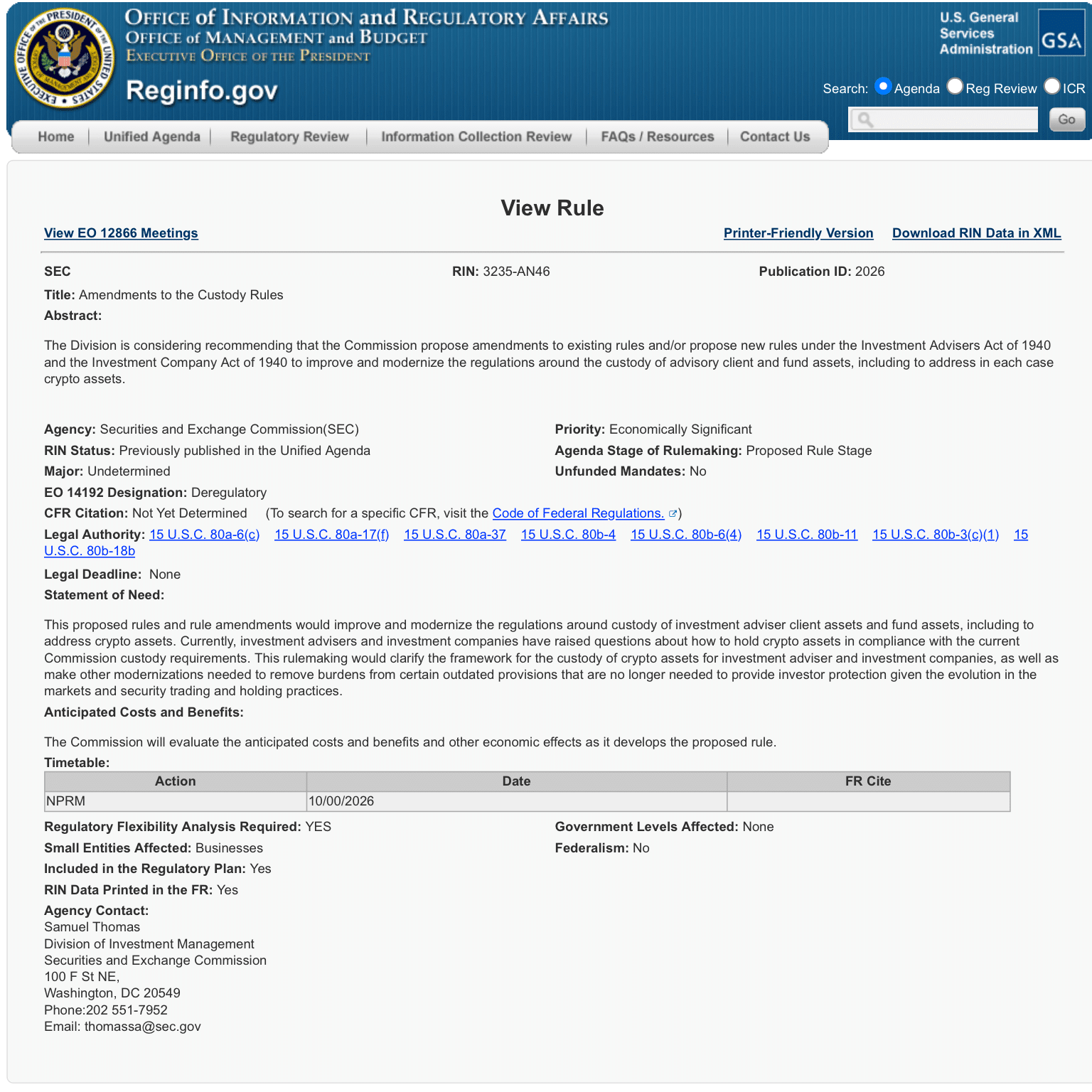
modernize the rules governing the custody of client assets and funds, including in each case crypto assets.
Investment advisors and management companies have until now come up against traditional custody rules designed for traditional financial securities, and which applied poorly to digital assets. As a result, many institutional players preferred to remain on the sidelines rather than expose themselves to compliance risk. The SEC intends to remove this ambiguity and remove certain provisions deemed obsolete. All this, without sacrificing the protection of crypto investors.
Hyperliquid steps up to the plate against the regulator
While the SEC is working on the custody of crypto assetsanother regulatory project is shaking up the industry: that of perpetual contracts. And it was Hyperliquid Policy Center (HPC) which decided to step in. In a letter addressed jointly to the SEC and the CFTC, the HPC asks the two regulators to adopt a harmonized framework for these derivative products without an expiration date. The central argument is that a perpetual contract should be classified according to its economic structure…and not according to the underlying asset it tracks.
The topic is far from theoretical as Hyperliquid’s HIP-3 markets have generated over $480 billion in volume in ten months of existence, for approximately $4 billion in open interest. Without a clear taxonomy, disagreements over the jurisdiction of each regulator inevitably end up in court. A harmonized framework would therefore allow platforms to compete on quality of execution and liquidity. The timing is no coincidence as Donald Trump recently spoke about the work of the CFTC to allow Hyperliquid to operate in the United States in a fully compliant and legal manner.
Two files and a single obsession… Ending the uncertainty that is holding back crypto adoption in the United States. The custody reform sent by the SEC to the White House is the most tangible proof of this. The regulator is no longer content with sanctioning, it is finally building a framework. It remains to be seen whether the text will survive its passage through OIRA without too many alterations.
Maximize your Tremplin.io experience with our ‘Read to Earn’ program! For every article you read, earn points and access exclusive rewards. Sign up now and start earning benefits.


