
Two entities in the crypto ecosystem, DefiLlama and the investment bank Web3 Forgd are launching Universal Token Ratings, have recently developed a ranking whose objective is to evaluate 128 tokens according to the functioning of their market and their transparency. Uniswap is the only project to receive an AAA rating, while 25 other cryptos received an AA. This system is based on the terminology of traditional rating agencies, but does not measure the risk of default. Above all, it interprets liquidity, volumes, token releases without forgetting the quality of the information published by the different projects.
In brief
- Universal Token Ratings covers 128 tokens with ratings ranging from AAA to CCC.
- Uniswap takes first place with 60.8 points out of 100.
- The rating combines a transparency score and a market performance score.
- The ranking does not assess the upside potential or default risk of the token.
Uniswap obtains the only AAA rating in the ranking
While the crypto market is on the rise again, DefiLlama in collaboration with Forgd communicated this August 26 on the start ofUniversal Token Ratings or UTR. The dashboard gives each token a numerical score out of 100, followed by an evaluation between AAA and CCC.
Upon launch, a total of 128 tokens were evaluated. The first place was taken by Uniswap with a rating of AAA and a score of 60.8 points. Furthermore, the project scored 7.87 out of 10 for its public information and 7.72 for its market performance.
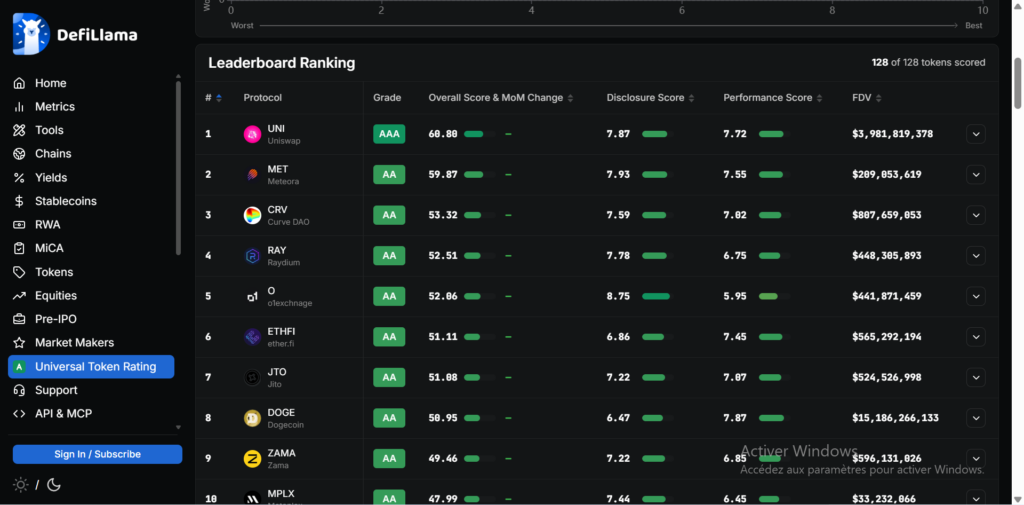
The Meteora protocol came in second place. It totals 59.87 points, just below the AAA category. In the top ten were projects Curve DAO, Raydium, o1exchange, ether.fi, Jito, Dogecoin, Zama and Pyth Network with a rating of AA.
Cryptos with an AA rating also included Solana, Zcash, Aave, Optimism, Avalanche, zk, Optimism, Avalanche, Sync and Arbitrum. In category A were tokens like Worldcoin, Pendle, Ondo, Polygon, NEAR and Hyperliquid. Injective, Filecoin and Celestia received a BB according to the ranking while Sui received a BBB.
Dogecoin, Solana or Zcash are also present in this ranking. This presence reveals that the scope is not limited exclusively to DeFi protocol tokens. The dashboard also covers various areas, including blockchain infrastructure, memecoins, decentralized exchanges, staking, real-world assets as well as artificial intelligence.
Ratings evolve as data changes. The work presented by DefiLlama and Forgd is therefore evolving, because the structures do not wish to produce a definitive evaluation. According to their official presentationa protocol can lose points as soon as its liquidity deteriorates, if its price spreads increase, or if a token release does not match the disclosed schedule.
The rating multiplies transparency and market performance
Two axes evaluated individually out of 10 allow Universal Token Ratings to develop this ranking. The first, called Disclosure Axis, is used to measure the quality, completeness and updating of the information disseminated by the project.
This is a part whose role is to particularly examine the identity of the main actors, the organization of the team, the legal structures, the cash balance sheets as well as the financial flows. It also takes into account token release schedules, token distribution, multisignatures, audits -, relationships with exchanges or market managers.
As for the second axis, known as the Performance Axis, it makes it possible to verify the real functioning of the market. In addition, it also takes care of the analysis of volumes, the depth of liquidity, the various differences between acquisition and sale prices, without forgetting the number of exchange platforms available and the conditions respected on derivative products.
Multiple other data concerns the ratio between valuation and fully diluted capitalization, the unlocking of tokens, token redemptions and compliance with the various commitments made by market managers. Forgd highlights that its infrastructure takes care of monitoring over 500 protocols and 35 liquidity provision companies. The final grade awarded is not equivalent to an average. However, it is obtained thanks to the multiplication of the two axes.
For example, determining the Uniswap rating allows you to verify this formula. So, when we multiply its transparency score, i.e. 7.87, by its performance score 7.72, we obtain 60.76 points. This result is then rounded to almost 60.8 out of 100.
Such a calculation methodology imposes a balance between the two axes. A protocol that scores 9 out of 10 in performance, but only scores 3 in transparency, finishes with 27 points. The absence of information on the team, cash flow or distribution schedule cannot therefore be compensated by significant liquidity.
The opposite is also applicable. Grade 9 can be obtained by a project following the publication of detailed information on the first axis. However, if its market simply receives a 3 given low depth or high spreads, its final score remains limited to 27.
On-chain controllable events are inserted without a protocol having to send a new record. An unplanned token release as well as a new quotation can then change the result. However, many other market parameters are based on averages determined over the previous 30 days. A progressive update therefore does not mean that each price or volume change directly results in a new rating.
An AAA rating that measures neither yield nor default risk
DefiLlama and Forgd are comparing their system against assessments used for decades by rating agencies such as Moody’s, Fitch and S&P. Thus, the choice of letters consolidates this visual proximity. The meaning of the notes, however, remains very different.
At the heart of traditional finance, the AAA rating illustrates an eminently high ability to meet financial commitments. The agencies determine the creditworthiness of an issuer or the risk of non-repayment of a bond, as notified by the definition of S&P Global Ratings.
A token is not necessarily a debt. It does not necessarily guarantee a refund. Uniswap’s AAA rating therefore does not reflect that UNI offers the same risk profile as an AAA-rated bond. It simply means that the crypto obtains the same result according to the criteria specific to the UTR.
Thus, the score does not further evaluate the complete security of the protocol. Conducting an audit is part of the information examined, however it does not guarantee the absence of flaws in a smart contract. Not all regulatory risks, governance, actual concentration of power, or a protocol’s ability to incrementally generate revenue are covered by this ranking either.
The final rating is also neither a price target nor an acquisition recommendation. A well-ranked crypto may see its value reduced when the market undergoes a correction or if initial capitalization is excessive. In contrast, a lower-rated token can experience a speculative rise despite limited transparency.
The interest of the new classification could now depend on its ability to detect deteriorations before they are visible in prices. The modifications of notes, the arguments provided during these revisions and the extension of the number of tokens will be able to determine whether the UTR becomes an excellent indicator of market risk or remains mainly a comparative tool.
Maximize your Tremplin.io experience with our ‘Read to Earn’ program! For every article you read, earn points and access exclusive rewards. Sign up now and start earning benefits.


