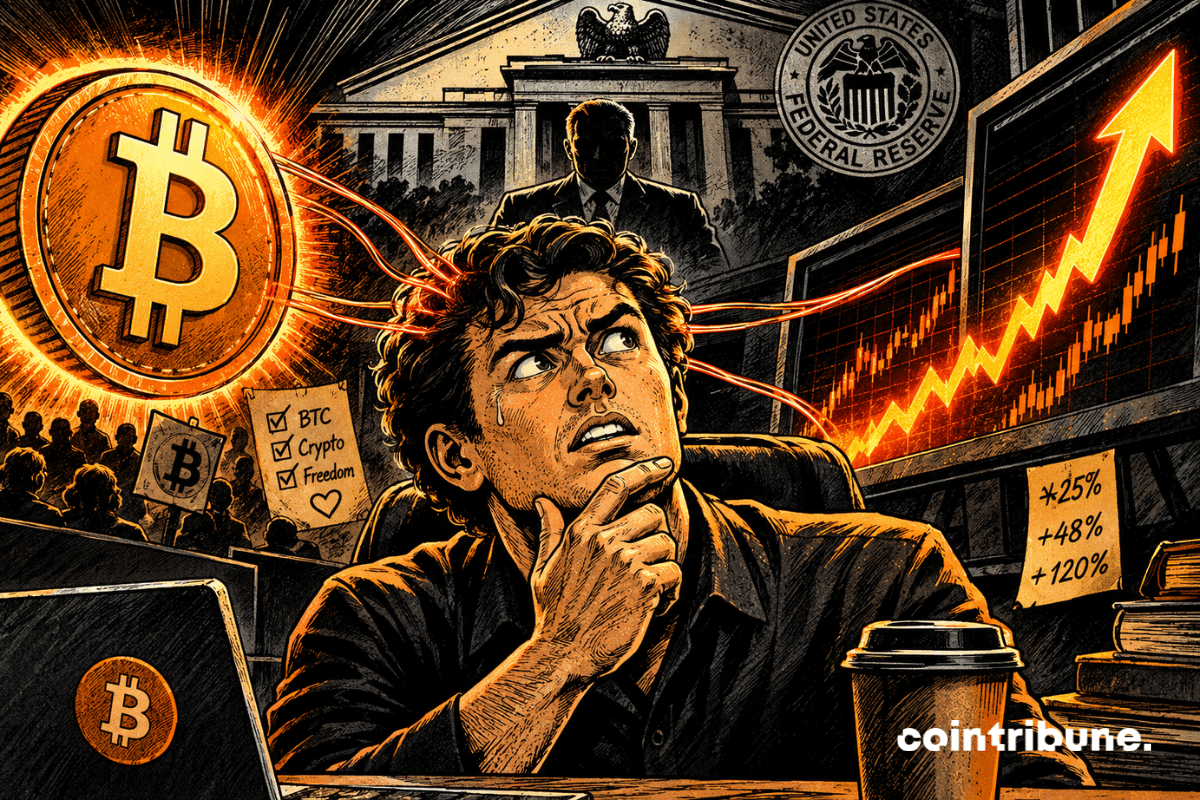
Why do some buy bitcoin while others prefer to stay away? A study from the Cleveland Federal Reserve points less to age or income and more to a harder-to-measure factor: what everyone thinks about crypto’s future performance. And a few figures on past performance can sometimes be enough to sway the undecided.
In brief
- Cleveland Fed releases study finding household return expectations explain crypto holding better than age, income or gender.
- A randomized experiment shows that informing households about past bitcoin performance increases their desired allocation by 47% and their actual purchases by 2.5 points.
- Crypto winnings would be treated like lottery winnings: they boost the purchase of durable goods, but not current spending.
Return expectations weigh more than age or crypto income
The Federal Reserve of Cleveland published a working paper in July devoted to American households and cryptos, based on quarterly surveys conducted since 2018 among 15,000 to 25,000 households.
Its authors, economists Michael Weber, Bernardo Candia, Olivier Coibion and Yuriy Gorodnichenko, compare crypto holders to holders of stocks, bonds or gold. The observation is consistent with the recent debate on investor greed: psychology weighs at least as much as fundamentals.
Titled ” Do You Even CryptoBro? Cryptocurrencies in Household Finance”, the document establishes a first fact: in 2021, 87% of households who did not hold crypto said they did not know what return to expect over twelve months, compared to 54% of holders. Among those who venture a prediction, crypto owners expected an average return of 22% over the year, compared to 7% for others.
The gap is the widest of all assets studied, including stocks and gold. One percentage point more expected return comes with a 0.8 point increase in the probability of holding crypto. Expected returns and perceived risk together explain about twice as much variation in holdings as all observable characteristics combined, age, income or gender.
The demographic profile nevertheless remains marked. Those under 40 hold crypto 13 points more often than those over 60, and men 4 points more than women, with equal characteristics.
Information on past earnings is enough to make people buy
The study includes a randomized controlled experiment, a device that randomly assigns participants to isolate the effect of a given piece of information. Conducted in the second quarter of 2025, it presented to certain households the return of bitcoin over the previous twelve months (14.3%), and to others that of stocks, GameStop or inflation.
Households informed about the bitcoin figure increased their desired crypto allocation by around 2 percentage points, or 47% more than the 4.3% targeted on average by the control group. Their actual purchases also increased by 2.5 points, a statistically significant result. Information about recent returns “induces some households to start purchasing crypto,” the authors write.
The effect is focused on those who did not hold crypto due to lack of information. Households who already considered it a bad investment did not react. For researchers, the mechanism sheds light on the formation of bubbles: “ Positive returns attract new participants, which drives the price further ”, and past performances are extrapolated without expected reversion to the mean.
The question that comes up after each price rise, namely whether it is too late to buy bitcoin, finds the beginning of an answer here: information on past performance attracts new entrants.
Winnings treated like lottery money
The paper also measures what households do with their earnings. A doubling of the price of bitcoin makes a household fully invested in crypto 1.4 points more likely to purchase a durable good, about 7% higher than the average probability of such a purchase. The effect does not extend to current spending, unlike stocks or bonds.
The authors draw a clear comparison: crypto winnings are perceived “more like lottery winnings” than as permanent enrichment, spent in a large purchase rather than spread out over time.
The study has limitations: the expectation data mainly dates from 2021, the sample is a panel of voluntary consumers and the experiment takes place in a single quarter. The researchers nevertheless conclude that the absence of information and common beliefs ” suggests that price volatility will continue to be one of the most defining characteristics of this new asset for the foreseeable future “.
These behavioral readings do not constitute a market forecast. This reading does not constitute financial advice.
The Cleveland Fed’s working paper shifts the question of price to that of information: retail demand would depend as much on what investors hear about past performance as on the price level.
If the loop described by the researchers works, each bullish phase would carry within it the conditions for its continuation, until an external shock, such as tensions on the bond market, breaks the mechanism. The next waves of inflows, measurable in flows to bitcoin ETFs, will tell whether the effect documented in 2025 is replicated at the scale of today’s market.
Maximize your Tremplin.io experience with our ‘Read to Earn’ program! For every article you read, earn points and access exclusive rewards. Sign up now and start earning benefits.