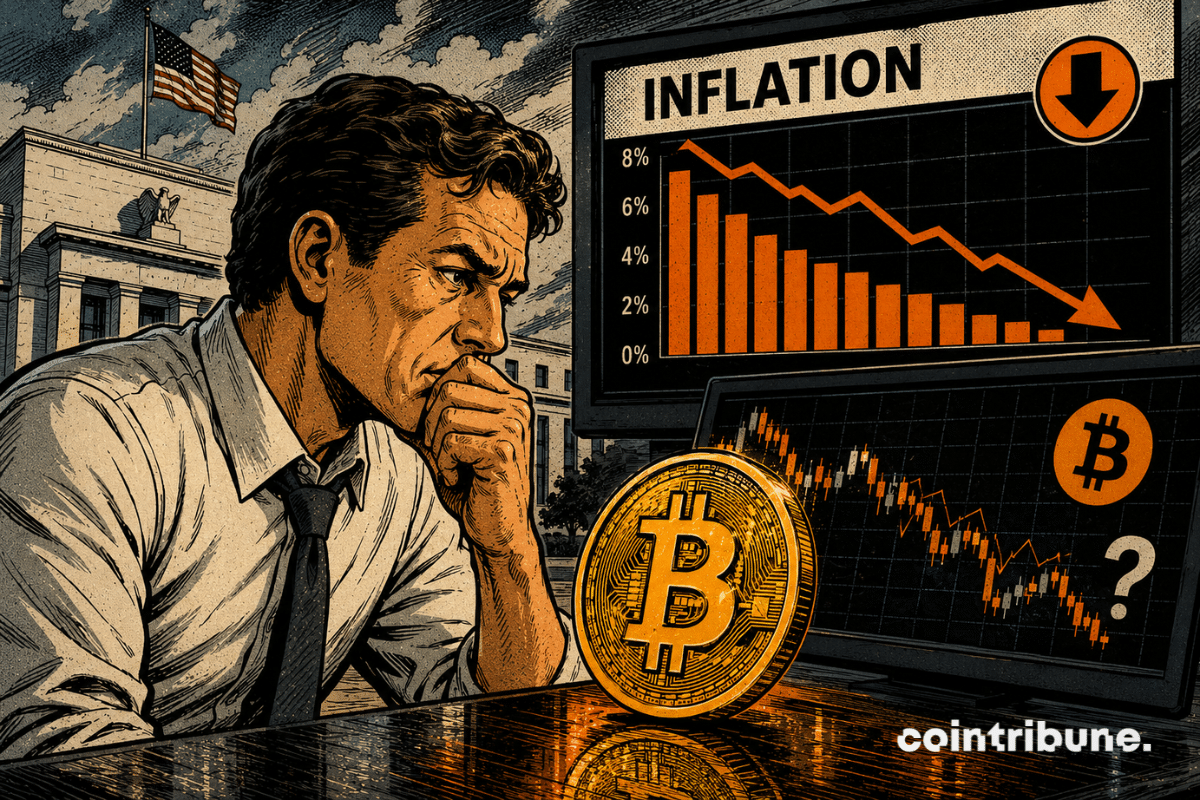
The publication of US inflation data on August 12 did not provide the markets with the positive signal they had hoped for. Indeed, we note a slowdown in price increases without forgetting the Fed’s reserves on the economic trajectory. Bitcoin investors are reluctant to adopt an aggressive accumulation policy. The crypto market thus remains dependent on the next economic data and, above all, on the way in which the Federal Reserve chooses to interpret them.
In brief
- American inflation slowed to 3.4% year-on-year, driven by the CPI Cœur to 2.5% and a temporary drop in energy prices (-1.5%).
- Accommodation costs (+0.1%) alone generate almost two thirds of the monthly increase in the overall index.
- Despite the monthly respite, gasoline remains up 24.6% year-on-year, keeping Brent oil around $91.
- Without a clear catalyst, BTC is stagnating in the tight $63,800-$64,300 zone, ignoring rising stock markets.
US inflation slows
Thanks to official information published on August 12 by the Bureau of Labor Statistics, the consumer price index (CPI) increased by 0.1% during the month of July, taking into account a seasonally adjusted base. This progression scrupulously conforms to the forecasts of American stock market analysts. The rate of annual inflation is then reduced to 3.4% compared to 3.5% during the month of June and a peak in May of 4.2%. Volatile categories such as food and energy should be excluded from the calculations of the underlying indicator. The latter recorded a monthly increase of 0.2% and 2.5 over the year.
Thus, this annual evolution of the underlying element of inflation is part of the moderate measures observed since January 2021. Indeed, the housing component constitutes the catalyst vector of the rebound in prices within this general dynamic. Thus, two thirds of the monthly increase in the overall index was generated by costs linked to accommodation. This change is therefore driven by a 0.3% increase in rents and landlord equivalent rents. We also noted a slight increase of 0.1% in food prices due to an increase of 0.3% in out-of-home catering, while there was a decline of 0.1% in basic food products in supermarkets.
The temporary relief offered by the energy sector in July explains such a statistical respite. According to official data, the overall energy index fell by 1.5% month-on-month. This drop is then driven by the decline in gasoline prices at the pump of 2.9% due to seasonal variations. However, various expenditure items relating to different essential services have sustainably boosted the underlying indicator upwards.
The combination of these different incompatible factors automatically triggered a buying reaction on futures contracts linked to American stock indices before the markets opened. Such a combination illustrates the relief of investors.
The correct distribution of the main variations observed by the economic component makes it possible to measure the exact structure of the July inflation report :
- The overall CPI index: +0.1% over one month (+3.4% over one year, down from 3.5% in June);
- The CPI excluding food and energy: +0.2% over one month (+2.5% over one year);
- Housing: +0.1% over the month, generating nearly two thirds of the overall monthly increase;
- The Energy sector: -1.5% over the month, driven by a 2.9% drop in the price of gasoline;
- Services and Transport: +2.2% for plane tickets, +0.4% for medical care and +0.4% for used vehicles.
Energy Risk and the Federal Reserve
A clear threat continues to loom over the long-term economic trajectory, given the energy crisis earlier in the year, despite the undeniable calm provided to monetary authorities by the monthly figures. The energy sector still remains up a significant 14.7% year-over-year, although gasoline prices show a spectacular annual increase of 24.6%. These statistics bear the after-effects of the oil shock linked to the geopolitical tensions observed in the Middle East as well as the logistical disruptions visible during the first half of the year.
While the barrel of Brent stabilizes around $91 and West Texas Intermediate trades around $83, the Fed finds itself in an uncomfortable position. In terms of maintaining its key rate in the range of 3.50% to 3.75% in July, numerous internal divisions are observed at the level of the American Central Bank. Such situations are corroborated by the dissenting vote of three governors. In fact, the latter advocate monetary tightening. Officials then insisted that a succession of several consecutive months of decline would be necessary before any affirmation of a lasting reduction in inflation to 2%.
The prospects for a decline in short-term rates are immediately limited by an uncertain macroeconomic environment. Thus, investors must take into account the decisions of the Federal Reserve forced to adopt a restrictive position as long as energy and services threaten to bring back inflationary pressures. Also, the crippling reduction in real hourly wages, taking into account the increase in the cost of living in certain indicators, contributes to the deterioration of the real purchasing power of households. In such a context where the cost of capital remains high and where overall demand is showing signs of fatigue, overall liquidity is struggling to move towards more speculative markets.
The stagnation of bitcoin around $64,000
The crypto market shows remarkable resilience in the face of these macroeconomic difficulties. This apathy immediately contrasts with the significant volatility observed after the publication of previous economic data. When the report’s figures were announced, bitcoin remained stable. It thus lost 0.4% before stabilizing in a zone between $63,800 and $64,300, after briefly touching the lower zone of $63,000. We thus notice at the level of the main crypto an accumulation phase in the $60,000 zone.
From this perspective, investors avoid making massive commitments without obtaining clear and solid guarantees on the evolution of monetary policy. Additionally, the lack of a clear catalyst in the market indicates a slowing of flows, while the bitcoin market reels under the repercussions of liquidity conditions. In the absence of a signal of monetary easing from the Federal Reserve or a drop in energy prices, the crypto market in general and bitcoin in particular could continue to evolve in uncertain dynamics.
The next few days will be more than decisive. They will allow us to know whether the current stagnation in the price of bitcoin heralds a correction or a new phase of accumulation before a probable rebound. The real test of truth is now set for September 11, 2026, the date on which the US government will publish inflation figures for the month of August.
Maximize your Tremplin.io experience with our ‘Read to Earn’ program! For every article you read, earn points and access exclusive rewards. Sign up now and start earning benefits.