
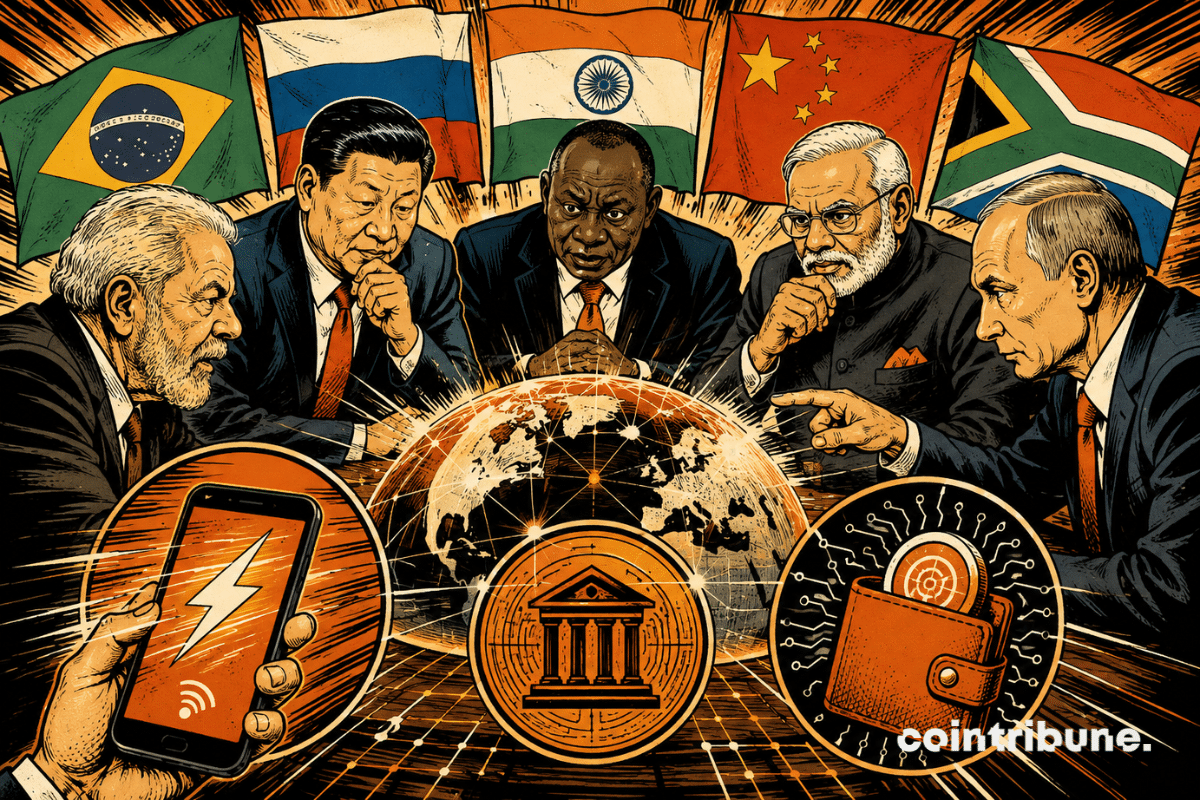
Money transfers between countries remain a central topic for BRICS. In Mumbai, the Governor of the Reserve Bank of India, Sanjay Malhotra, indicated that several avenues were being studied to facilitate these operations. Among them is the connection of CBDCs and fast payment systems. The discussions, however, remain in their early stages. The objective put forward mainly concerns the reduction of costs. This reflection comes as India also seeks to strengthen the international use of its national currency.
In brief
- BRICS is exploring an interconnection between CBDCs and fast payment systems to facilitate cross-border transfers.
- The main objective is to reduce costs and simplify payments between member economies.
- At the same time, India wishes to strengthen the international use of the rupee and local currencies in trade.
- This interconnection also raises questions about confidentiality, transaction control and the programmability of CBDCs.
BRICS explore several solutions for payments
At an event in Mumbai, Sanjay Malhotra, governor of the Reserve Bank of India, explained that cross-border remittances were consistently high on the BRICS agenda. According to him, several options are currently being examined, without a final decision having yet been made. The first avenue concerns Central Bank Digital Currency (CBDC), while another is based on the interconnection of rapid payment systems. These two approaches aim to make transfers clearer between participating economies.
The governor especially insisted on possible savings. Cross-border payments, he said, represent an area where BRICS could seek to reduce costs.
Cross-border payments are an area of interest for all of us, including BRICS, as we believe there is considerable potential for cost reduction.
Sanjay Malhotra, Governor of the Reserve Bank of India. Source: Reuters.
A more direct connection between national infrastructures could limit some current steps. However, those in charge of the group have not yet decided on the model that would allow this interconnection.
India also wants to strengthen the rupee
At the same time, India is continuing its efforts to internationalize the rupee and promote the use of local currencies. Sanjay Malhotra reiterated this orientation during the event organized in Mumbai. The country is hosting this year’s BRICS summit, which brings together Brazil, Russia, India, China and South Africa. The proposal to link CBDCs had already been submitted by the RBI last January to be included on the agenda of the 2026 summit.
This approach therefore meets Indian objectives around cross-border payments and trade. It could also give more space to national currencies in these exchanges. However, discussions remain preliminary and no common architecture has yet been defined. The governor did not announce any timetable, leaving open questions related to technical standards, common rules and future operation together in the longer term.
CBDC: reducing costs while asking questions of control?
CBDCs correspond to digital versions of official currencies issued directly by central banks. Their interconnection would create a channel for transfers between several countries. Payments could follow more direct channels and reduce the use of certain intermediaries. The system would seek to speed up international operations.
Consumers and businesses could use these transfers via the national channels they already know. For the BRICS, the issue also concerns the capacity to facilitate exchanges between local currencies. However, common adoption remains uncertain.
However, this centralized architecture raises questions about payment confidentiality. Relevant institutions could have increased visibility into financial transactions and flows. The protection of privacy is therefore a point to consider in any interconnection.
The programmable nature of CBDCs adds another question to the debate. The authorities could then intervene more in the circulation of funds or condition certain uses. This possibility therefore raises the question of the balance between institutional control, payment efficiency and financial freedoms.
In the short term, members should clarify technical options and modalities of cooperation. The next BRICS summit could continue discussions on cross-border payments, without prejudging their outcome. In the coming months, discussions will have to specify the technical conditions and common rules. The BRICS summit could thus serve to examine this cooperation more concretely, while leaving open the question of its timetable and application.
Maximize your Tremplin.io experience with our ‘Read to Earn’ program! For every article you read, earn points and access exclusive rewards. Sign up now and start earning benefits.


