
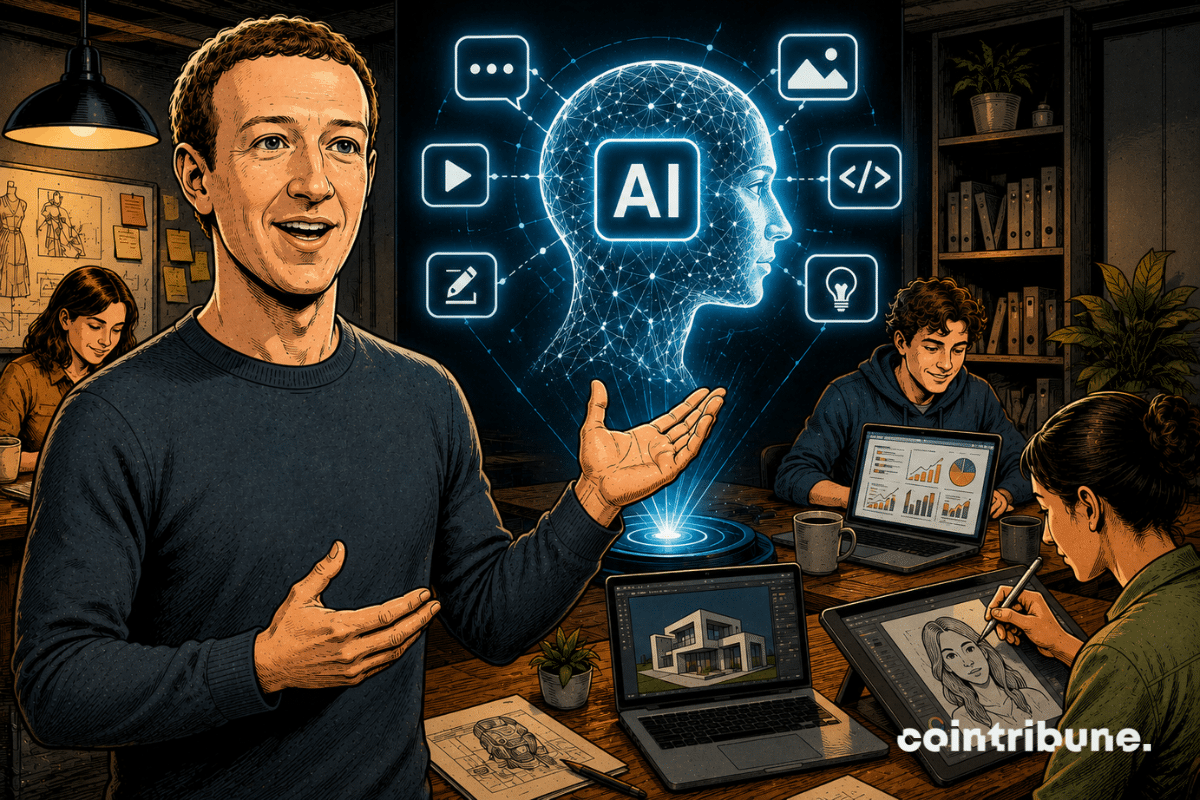
Meta no longer wants to reserve the power of artificial intelligence for States and technology giants. On August 10, 2026, Mark Zuckerberg unveiled a manifesto, “ The Future is for Everyone »which redefines the group’s ambition: to place part of this computing power in the hands of individuals. Behind this announcement lies a strategic rupture with major consequences for the crypto ecosystem, where AI and decentralized networks now converge around the same issue: control of the digital infrastructure of tomorrow.
In brief
- Meta commits record investments in 2026 to build superintelligence infrastructure.
- Mark Zuckerberg promises a free personal agent capable of coding, designing and executing complex tasks.
- Meta is calling for a relaxation of the rules in Washington and proposing sharing training checkpoints with the government.
- The rise of autonomous agents and the purchase of Moltbook are paving the way for direct, automated interactions on the blockchain.
The ambition of personal AI supported by a record budget of $145 billion
Meta CEO Mark Zuckerberg made a firm commitment to the general public: to offer billions of people a free personal AI agent capable of bringing their projects to life without intermediaries. To support this promise, the leader is relying on a colossal investment envelope of up to $145 billion for the year 2026 alone, mobilized largely to build the physical infrastructure and data centers required.
The manager has summary this mutation with a shocking formula: “ Everyone will soon have superpowers of invention.” According to his statements, these inventive superpowers will make it possible to democratize computer coding, video production, industrial design and even scientific research, while requiring considerably less capital and specialized expertise. Zuckerberg supports his point in particular by citing the example of his own 8-year-old daughter, capable of adapting her ideas into code and producing videos, while emphasizing that Meta researchers are already relying on these systems to generate new crystal structures intended for augmented reality glasses.
This new generation of tools marks the transition from passive conversational AI to agentic systems capable of end-to-end autonomous work. So, these agents no longer just respond to textual queries. They plan complex tasks, interconnect with existing applications and execute coordinated sequences of actions. To illustrate this unprecedented proximity between the machine and the user, the Meta executive said:“everyone will soon have an extremely efficient personal agent, capable of understanding you, knowing your objectives and everything that is important to you”.
In the financial and Web3 sphere, these software entities are reaching a major operational milestone by interacting with blockchain protocols, managing crypto wallets and orchestrating automated transactions. This acceleration of agentic autonomy is based on a frantic pace of development. A sector analysis published on March 12 already counted 267 AI models on the reference rankings, with large laboratories abandoning annual launches in favor of updates deployed every few weeks.
To properly measure the extent of this technological and financial transformation within Meta, here are the key pillars announced by Mark Zuckerberg:
- A colossal investment: an infrastructure budget reaching up to $145 billion over the year 2026 to build the necessary data centers;
- Strengthened agent autonomy: agents capable of planning multi-step tasks, interacting with applications and managing crypto wallets;
- An accelerated pace of development: a move to regular updates to power more than 267 models listed.
The Muse Glimmer open-source offensive and the regulatory standoff with Washington
Alongside the publication of its manifesto, the Menlo Park firm concretized its open-source orientation with the launch of Muse Glimmer, an agent model with 30 billion parameters published under the Apache 2.0 license. Designed to be compact enough to run tasks locally on a Mac or PC with a single consumer graphics card, this model follows the launch of Muse Sparkwhile Meta plans to open Muse Spark 1.2 very soon.
This free diffusion aims to counter the concentration of technological power by promoting the proliferation of autonomous micro-enterprises operating without requiring large teams or dense fundraising. In order to regulate these intensive uses, the manager has guaranteed that :“everyone will have free or affordable access to these tools”specifying that the consumption of high computing power can be priced via a dynamic auction mechanism, while a completely private mode will prevent anyone, including Meta, from accessing the on-chain data processed by the agent.
On the political and geopolitical terrain, Mark Zuckerberg urges the American government to relax constraints on training data and model distillation, emphasizing that the standards in force penalize national players in the face of foreign competition. To prevent any decision-making monopolization, Meta’s governance now relies on an independent board of directors responsible for validating security criteria before any deployment.
The leader goes further in his institutional concessions by proposing that laboratories share with the authorities backups made before finalizing a model, surpassing the requirements of the presidential decree of June 2 which limited government consultation to a voluntary framework of 30 days. Indeed, the urgency of this debate is accentuated by the recent volatility of user flows. The export restrictions imposed in June on Anthropic models quickly prompted part of the market to turn to Chinese open-source solutions, before the United States Department of Commerce lifted these sanctions at the end of the same month.
Towards an inevitable convergence between algorithmic sovereignty and Web3
The strategic direction defended by Mark Zuckerberg marks a definitive break with the era of centralized Web2, prefiguring a natural alignment between sovereign AI models and decentralized networks. The acquisition of Moltbook, an experimental social network already hosting nearly 200,000 verified autonomous agents linked to human owners, demonstrates that the future of digital exchanges will rely on direct machine-to-machine interactions.
In this paradigm where each citizen has an agent capable of executing complex operations locally, blockchain naturally stands out as the only infrastructure capable of providing an immutable register of truth, validating the identity of agents and securing their micro-economic financial transactions without a centralized intermediary.
This democratization of local AI driven by models like Muse Glimmer nevertheless raises questions of unprecedented seriousness in terms of security, governance and territorial impact. The massive implementation of energy-consuming data centers involves direct sharing of economic benefits with local communities through the financing of schools, energy infrastructure and public services.
On a philosophical and economic level, if universal access to superintelligence promises to redistribute innovation capacities on a global scale, the line between individual emancipation and dependence on Meta infrastructures remains tenuous. The success of this open model will depend on the ability of developers and users to maintain total sovereignty over their data and their agents in the face of regulatory pressures from States.
Maximize your Tremplin.io experience with our ‘Read to Earn’ program! For every article you read, earn points and access exclusive rewards. Sign up now and start earning benefits.


